

Home
Class 12
PHYSICS
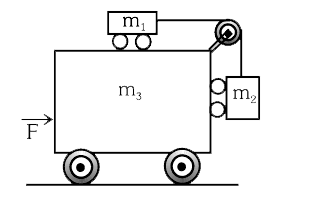
All surfaces assumed to be frictionless ...

All surfaces assumed to be frictionless calculate the horizontal force F that must be applied so that `m_(1)` and `m_(2)` do not move relative to `m_(3)` is :–

Promotional Banner

Similar Questions

Explore conceptually related problems

What force F must be applied so that m_(1) and m_(2) are at rest on m_(3) in

What force F must be applied so that m_(1) and m_(2) are at rest on m_(3) in

A large cubical shaped block of mass M rests on a fixed horizontal surface. Two blocks of mass m_(1) and m_(2) are connected by a light inextensible string passing over a light pulley as shown. Neglect friction everywhere. Then the constant horizontal force of magnitude F that should be applied to M so that m_(1) and m_(2) do not mov relative to M is:

Two blocks m_(1)=1kg , m_(2)=2kg are placed one upon the other. m_(1) is kept on m_(2) . The force of static friction between m_(1) and m_(2) is 0.2 and between m_(2) and the horizontal surface and the floor is 0.28 . Calculate the maximum force that can be applied on m_(2) so that m_(1) and m_(2) does not get separated. (g=10ms^(-2))

In the figure2.217 all the surfaces are frictionless. What force F is required to be applied on the bigger block so that m_(2) and m_(3) will remain at rest on it.

For the system shown in fig, there is no friction anywhere. Masses m_(1) and m_(2) can move up or down in the slots cut in mass M. Two non-zero horizontal force F_(1) and F_(2) are applied as shown. The pulleys are massles and frictionless. Given m_(1) != m_(2) Let F_(1) and F_(2) are applied in such a way that m_(1) and m_(2) do not move w.r.t. M. then what is the magnitude of the acceleration of M? Let m_(1) gt m_(2) .

For the system shown in fig, there is no friction anywhere. Masses m_(1) and m_(2) can move up or down in the slots cut in mass M. Two non-zero horizontal force F_(1) and F_(2) are applied as shown. The pulleys are massles and frictionless. Given m_(1) != m_(2) Let F_(1) and F_(2) are applied in such a way that m_(1) and m_(2) do not move w.r.t. M. then what is the magnitude of the acceleration of M? Let m_(1) gt m_(2) .

A wedge of mass M makes an angle theta with the horizontal. The wedge is placed on horizontal frictionless surface. A small block of mass m is placed on the inclined surface of wedge. What horizontal force F must be applied to the wedge so that the force of friction between the block and wedge is zero ?

In the adjoining figure all surfaces are frictionless, strings are light and inextensible. Consider a force F to be applied. So that block m, neither raises nor falls.

Two masses m_(1) and m_(2) are placed on a smooth horizontal surface and are connected by a string of negligible mass. A horizontal force F is applied on the mass m_(2) as shown in the figure. The tenison in the string is