Home
Class 12
PHYSICS
A small coil of N turns has its plane pe...

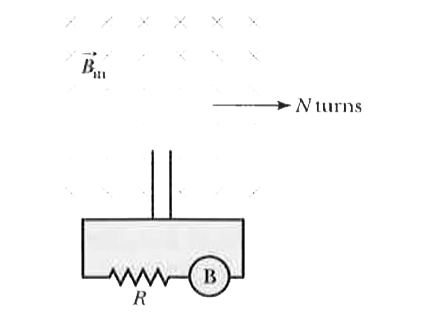
A small coil of N turns has its plane perpendicular to a uniform magnetic field as shown in Fig. 30-5. The coil is connected to a Ballistic galvanometer, a device designed to measure the total charge passing through it. Find the charge passing through the coil if the coil is rotated through 180° about its diameter.

Text Solution

Verified by Experts
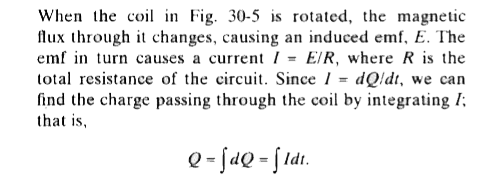

As we stated just now, the total charge flown is the integral of the current:
`Q=intdQ=intIdt`
The current is related to the emf by Ohm.s law as
`I=E/R`
and the emf is only due to the changing magnetic flux, that is
`E=(dphi_(B))/(dt)`
Thus, the induced current is given by
`I=E/R=1/R(dphi_(B))/(dt)`

Substituting it back in Eq. 30-6, we get
`Q=intIdt=(Deltaphi_(B))/R`
The initial flux through the loop is given by
`phi_(i)=NBA`
and after rotating the loop through 180°, the flux would be
`phi_(f)=-NBA`
Hence, the charge flowing through the Ballistic galvanometer is given by
`Q=(2NBA)/R`
Note that the charge Q is independent of the time involved in rotating the coil-all that matters is the change in magnetic flux. A coil used in this way is called a flip coil. It is used to measure magnetic fields. For example, if the Ballistic galvanometer measures a total charge Q passing through the coil when it is flipped, the magnetic field can be found from the equation above.
Promotional Banner

Topper's Solved these Questions

  • ELECTROMAGNETIC INDUCTION

    RESNICK AND HALLIDAY|Exercise CHECKPOINTS|9 Videos
  • ELECTROMAGNETIC INDUCTION

    RESNICK AND HALLIDAY|Exercise PROBLEMS|67 Videos
  • ELECTRIC POTENTIAL

    RESNICK AND HALLIDAY|Exercise (PRACTICE QUESTIONS) Integer Type|1 Videos
  • ELECTROMAGNETIC OSCILLATIONS AND ALTERNATING CURRENT

    RESNICK AND HALLIDAY|Exercise Practice Questions (Integer)|7 Videos

Similar Questions

Explore conceptually related problems

A flip coil consits of N turns of circular coils which lie in a uniform magnetic field. Plane of the coils is perpendicular to the magnetic field as shown in figure. The coil is connected to a current integrator which measures the total charge passing through it. The coil is turned through 180^(@) about the diameter. The charge passing through the coil is

A circular coil of 200 turns and mean radius 30 cm is placed in a uniform magnetic field of induction 0.02 T and is free to rotate about an axis coinciding with its own plane, but perpendicular to the uniform magnetic field. The coil is in closed circuit having a total resistance of 50 Omega . if the plane of the coil is initially perpendicular to the field find the charge flown through the circuit, when the coil is rotated through (i) 60^@ (ii) 180^@ .

A small coil of N turns has area A and a current I flows through it. The magnetic dipole moment of this coil will be

A coil of cross-sectional area 5xx10^(-4)m^(2) and having number of turns 1000 is placed prependicular to a magnetic field of 10^(-2) T. The coil is connected to a galvanometer of resistance 500 Omega . The induced charge generated in the coil on rotating it through an angle of pi radian will be

A coil of 30 turns of wire each of 10 cm^(2) area is placed with its plance perpendicular to a magnetic field of 0.1 T . When the coil is suddenly withdraw from the field, a galvanometer connected in series with the coil indicated that a 10 mu C charge passes around the circuit. The combined resistance of the coil and galvanometer is

A coil of radius 10 cm and resistance 40 Omega has 1000 turns. It is placed with its plane vertical and its axis parallel to the magnetic meridian. The coil is connected to a galvanometer and is rotated about the vertical diameter through an angle of 180^@ . Find the charge which flows through the galvanometer if the horizontal component of the earth's magnetic field is B_H = 3.0X 10^(-5) T .

The coil of a suspended coil galvanometer has a very high resistance when a momentary current is passed through the coil. It

A coil of area 100 cm^(2) having 50turns is perpendicular to a magnetic field of intensity 0.02T. The resistance of the coil is 2Omega . If t is removed from magnetic field in is the charge flown through the coil is:

A current-carrying coil of total resistance R is kept inside magnetic field. How is the change in magnetic flux through the coil related to the amount of charge passing through the coil ?