Home
Class 12
PHYSICS
A uniform magnetic field is restricted w...

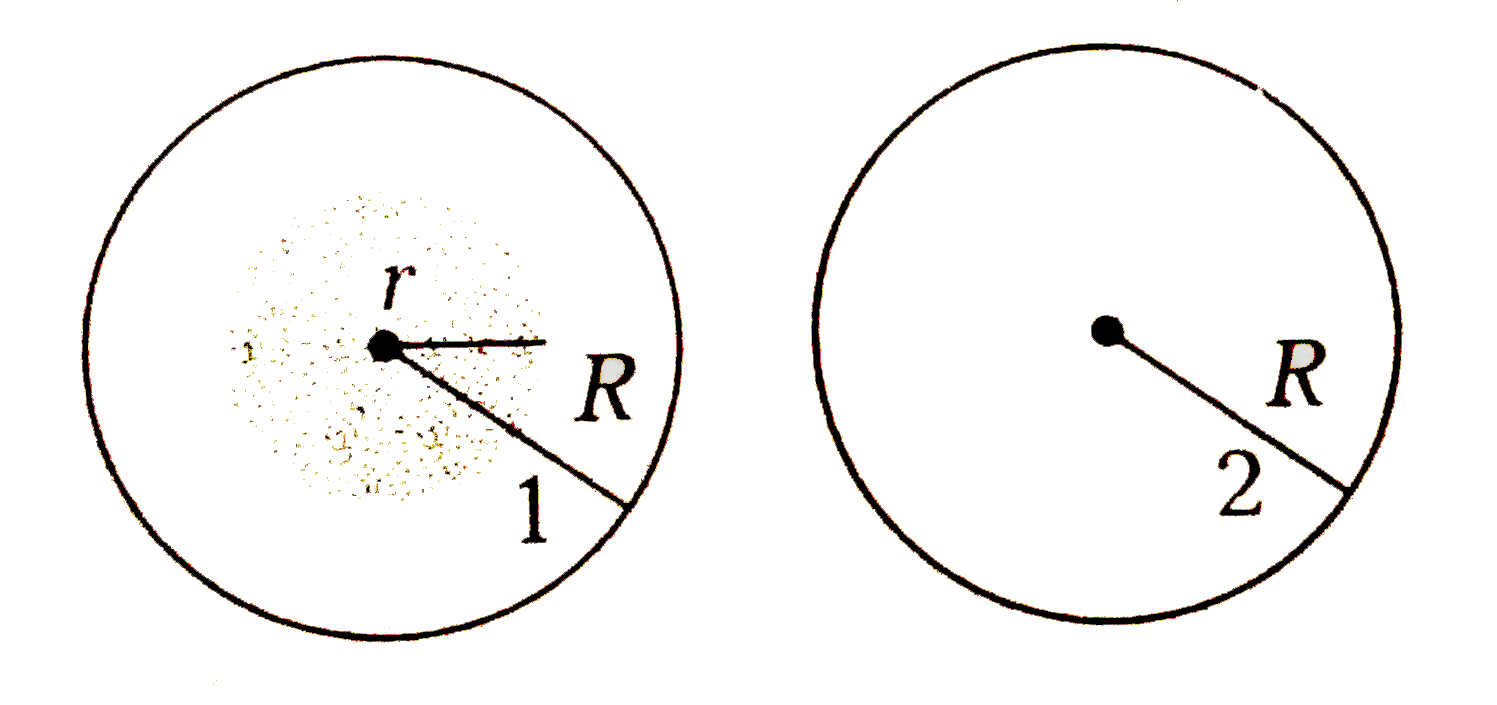
A uniform magnetic field is restricted within a region of radius r. The magnetic field changes with time at a rate `(dB)/(dt)`. Loop 1 of radius R `gt` r encloses the region r and loop 2 of radius R is outside the region of magnetic field as shown in figure. Then, the emf generated is

Text Solution

Verified by Experts
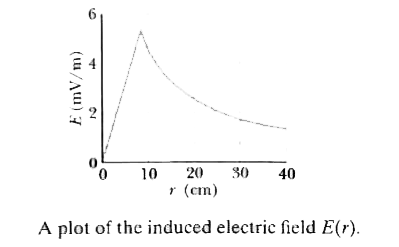
(a) To calculate the field magnitude E, we apply Faraday.s law in the form of Eq. 30-22. We use a circular path of integration with radius `rleR` because we want E for points within the magnetic field. We assume from the symmetry that `vecE` in Fig. 30-22b is tangent to the circular path at all points. The path vector `dvecs` is also always tangent to the circular path, so the dot product `vecE.dvecs` in Eq. 30-22 must have the magnitude E ds at all points on the path. We can also assume from the symmetry that E has the same value at all points along the circular path. Then the left side of Eq. 30-22 becomes
`intovecE.dvecs=intoEds=Eintods=E(2pir)` (30-25)
(The integral `into` ds is the circumference `2pir` of the circular path.)
Next, we need to evaluate the right side of Eq. 30-22. Because `vecB` is uniform over the area A encircled by the path of integration and is directed perpendicular to that area, the magnetic flux is given by Eq. 30-2:
`phi_(B)=BA=B(pir^(2))` (30-26)
Substituting this and Eq. 30-25 into Eq. 30-22 and dropping the minus sign, we find that
`E(2pir)=(pir^(2))(dB)/(dt)`
or `E=r/2(dB)/(dt)`
or `E=r/2(dB)/(dt)` (30-27)
Equation 30-27 gives the magnitude of the electric field at any point for which `rle R` (that is, within the magnetic field). Substituting given values yields, for the magnitude of `vecE` at r = 5.2 cm,
`E=((5.2xx10^(2)m))/2(0.13T//s)`
= 0.0034 V/m= 3.4mV/m.
(b) We can now write
`phi_(B)=BA=B(piR^(2))` (30-28)
Substituting this and Eq. 30-25 into Eq. 30-22 (without the minus sign) and solving for E yield
`E=(R^(2))/(2r)(dB)/(dt)`
Because E is not zero here, we know that an electric field is induced even at points that are outside the changing magnetic field, an important result that (as you will see in Section 31.9) makes transformers possible.
With the given data, Eq. 30-29 yields the magnitude of `vecE` at r = 12.5 cm:
`E=((8.5xx10^(-2)m)^(2))/((2)(12.5xx10^(-2)m))(0.13T//s)`
`=3.8xx10^(-3)V//m=3.8mV//m=3.8mV//m`
Because Eis not zero here, we know that an electric field is induced even at points that are outside the changing magnetic field, an important result that (as you will see in Section 31.9) makes transformers possible. With the given data, Eq. 30-29 yields the magnitude of E at r = 12.5 cm:
Promotional Banner

Topper's Solved these Questions

  • ELECTROMAGNETIC INDUCTION

    RESNICK AND HALLIDAY|Exercise CHECKPOINTS|9 Videos
  • ELECTROMAGNETIC INDUCTION

    RESNICK AND HALLIDAY|Exercise PROBLEMS|67 Videos
  • ELECTRIC POTENTIAL

    RESNICK AND HALLIDAY|Exercise (PRACTICE QUESTIONS) Integer Type|1 Videos
  • ELECTROMAGNETIC OSCILLATIONS AND ALTERNATING CURRENT

    RESNICK AND HALLIDAY|Exercise Practice Questions (Integer)|7 Videos

Similar Questions

Explore conceptually related problems

A uniform magnetic field is restricted within a region of radius 1m. The magnetic field changes with time(t) as vecB=B_0((2t)/3)hatk . A loop of radius 2m is outside the region of magnetic field as shown in figure. The emf induced in loop is

A current carrying loop of radius R and mass 'm' is placed inside a uniform magnetic field an shown

A uniform but time varying magnetic field is present in a circular region of radius R. The magnetic field is perpendicular and into the plane of the loop and the magnitude of field is increasing at a constant rate alpha . There is a straight conducting rod of length 2R placed as shown in figure. The magnitude of induced emf across the rod is

Magnetic field in cylindrical region of radius R in inward direction is as shown in figure.

A uniform magnetic field exists in a circular region of radius r .The magnitude of magnetic field is B and points inward.An electron flies into the region radially as shown in figure.After a certain time, the electron deflected by the magnetic field leaves the region.The time interval during which the electron moves in the region is (Nm tan^(-1(eBr)/(mV)))/(eB) .Then find value of N .( m is mass of electron and e is charge of electron)

