

Home
Class 11
PHYSICS
A ball A of mass 10kg and a ball B of un...

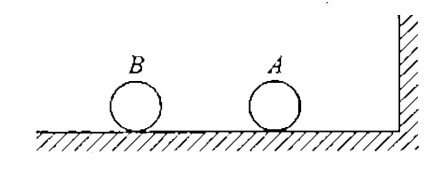
A ball A of mass 10kg and a ball B of unknown mass are placed on a horizontal frictionless table which rest against a rigid wall as shown in figure-4.135. The hail A moves towards the ball B with a velocity v.What should be the mass of B such that both A and B move with the same speed after A has undergone a collision with ball B and the wall ? All collisions are assumed to the elastic.

Promotional Banner

Similar Questions

Explore conceptually related problems

Three balls A, B and C of same mass m are placed on a frictionless horizontal plane in a straight line as shown. Ball A is moved with velocity u towards the middle ball B . If all the collisions are elastic, find the final velocities of all the balls.

Three balls A, B and C of same mass m are placed on a frictionless horizontal plane in a straight line as shown. Ball A is moved with velocity u towards the middle ball B . If all the collisions are elastic, find the final velocities of all the balls.

A ball A of mass 0.2 strikes another ball B of unknown mass at rest . If the ball A makes an elastic head on collision and then rebounds at one half of its original speed , then calculate the mass of ball B .

Ball of mass 5.0 kilograms moving at 20m/s collides with ball B of unknown mass moving at 10m/s in the same direction . After collision ball A moves at 10m/s an ball B at 15m/s , both still in the same direction. What is the mass of ball B?

A billiard ball of mass M , moving with velocity v_1 collides with another ball of the same mass but at rest . If the collision is elastic , the angle of divergence after the collision is

A ball moving with speed u collides with an identical ball at rest. The velocities of two balls after collision are (If the collision is elastic):

A ball of mass M moving with a velocity v collides perfectly inelastically with another ball of same mass but moving with a velocity v in the opposite direction. After collision