A long solenoid having n = 200 turns per metre has a circular cross-section of radius `a_(1) = 1 cm`. A circular conducting loop of radius `a_(2) = 4 cm` and resistance ` R = 5 (Omega)` encircles the solenoid such that the centre of circular loop coincides with the midpoint of the axial line of the solenoid and they have the same axis as shown in Fig.
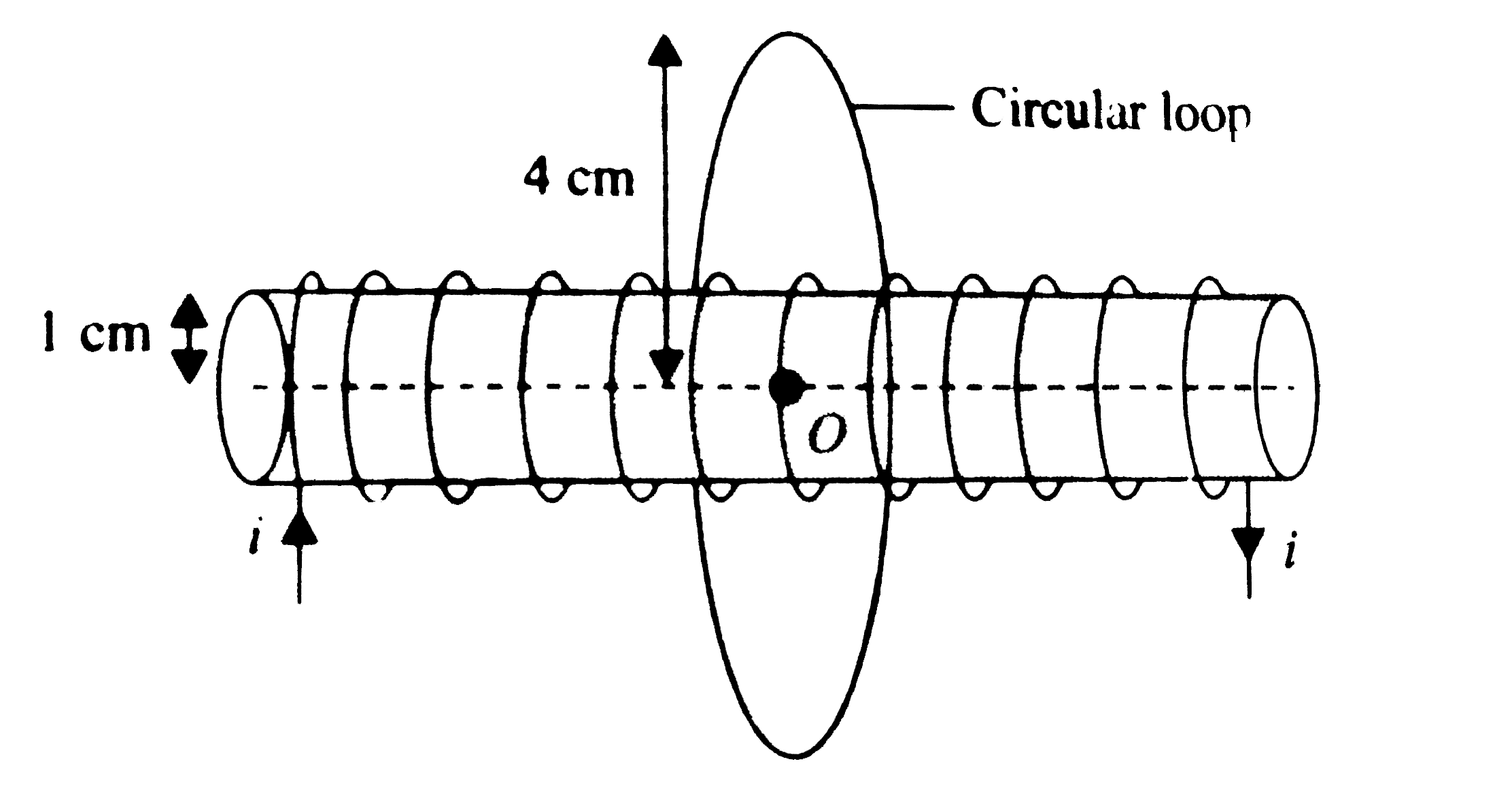
A current 't' in the solenoid results in magnetic field along its axis with magnitude `B = (mu)ni` at points well inside the solenoid on its axis. We can neglect the insignificant field outside the solenoid. This results in a magnetic flux `(phi)_(B)` through the circular loop. If the current in the winding of solenoid is changed, it will also change the magnetic field `B = (mu)_(0)ni` and hence also the magnetic flux through the circular loop. Obvisouly, it will result in an induced emf or induced electric field in the circular loop and an induced current will appear in the loop. Let current in the winding of solenoid be reduced at a rate of `75 A //sec`.
Magentic flux through the loop due to external magnetic field will be
I is the current in the loop
`a_(1)` is the radius of solendoid and `a_(1)=1cm` (given)
`a_(2)` is the radius of circular loop and `a_(2)=4cm` (given)
i is hte current in the solenoid
A long solenoid having n = 200 turns per metre has a circular cross-section of radius `a_(1) = 1 cm`. A circular conducting loop of radius `a_(2) = 4 cm` and resistance ` R = 5 (Omega)` encircles the solenoid such that the centre of circular loop coincides with the midpoint of the axial line of the solenoid and they have the same axis as shown in Fig.
A current 't' in the solenoid results in magnetic field along its axis with magnitude `B = (mu)ni` at points well inside the solenoid on its axis. We can neglect the insignificant field outside the solenoid. This results in a magnetic flux `(phi)_(B)` through the circular loop. If the current in the winding of solenoid is changed, it will also change the magnetic field `B = (mu)_(0)ni` and hence also the magnetic flux through the circular loop. Obvisouly, it will result in an induced emf or induced electric field in the circular loop and an induced current will appear in the loop. Let current in the winding of solenoid be reduced at a rate of `75 A //sec`.
Magentic flux through the loop due to external magnetic field will be
I is the current in the loop
`a_(1)` is the radius of solendoid and `a_(1)=1cm` (given)
`a_(2)` is the radius of circular loop and `a_(2)=4cm` (given)
i is hte current in the solenoid
A current 't' in the solenoid results in magnetic field along its axis with magnitude `B = (mu)ni` at points well inside the solenoid on its axis. We can neglect the insignificant field outside the solenoid. This results in a magnetic flux `(phi)_(B)` through the circular loop. If the current in the winding of solenoid is changed, it will also change the magnetic field `B = (mu)_(0)ni` and hence also the magnetic flux through the circular loop. Obvisouly, it will result in an induced emf or induced electric field in the circular loop and an induced current will appear in the loop. Let current in the winding of solenoid be reduced at a rate of `75 A //sec`.
Magentic flux through the loop due to external magnetic field will be
I is the current in the loop
`a_(1)` is the radius of solendoid and `a_(1)=1cm` (given)
`a_(2)` is the radius of circular loop and `a_(2)=4cm` (given)
i is hte current in the solenoid



Similar Questions
Explore conceptually related problems
A long solenoid having n = 200 turns per metre has a circular cross-section of radius a_(1) = 1 cm . A circular conducting loop of radius a_(2) = 4 cm and resistance R = 5 (Omega) encircles the solenoid such that the centre of circular loop coincides with the midpoint of the axial line of the solenoid and they have the same axis as shown in Fig. A current 't' in the solenoid results in magnetic field along its axis with magnitude B = (mu)ni at points well inside the solenoid on its axis. We can neglect the insignificant field outside the solenoid. This results in a magnetic flux (phi)_(B) through the circular loop. If the current in the winding of solenoid is changed, it will also change the magnetic field B = (mu)_(0)ni and hence also the magnetic flux through the circular loop. Obvisouly, it will result in an induced emf or induced electric field in the circular loop and an induced current will appear in the loop. Let current in the winding of solenoid be reduced at a rate of 75 A //sec . Magnitude of induced current that appears in the circular loop is
A long solenoid having n = 200 turns per metre has a circular cross-section of radius a_(1) = 1 cm . A circular conducting loop of radius a_(2) = 4 cm and resistance R = 5 (Omega) encircles the solenoid such that the centre of circular loop coincides with the midpoint of the axial line of the solenoid and they have the same axis as shown in Fig. A current 't' in the solenoid results in magnetic field along its axis with magnitude B = (mu)ni at points well inside the solenoid on its axis. We can neglect the insignificant field outside the solenoid. This results in a magnetic flux (phi)_(B) through the circular loop. If the current in the winding of solenoid is changed, it will also change the magnetic field B = (mu)_(0)ni and hence also the magnetic flux through the circular loop. Obvisouly, it will result in an induced emf or induced electric field in the circular loop and an induced current will appear in the loop. Let current in the winding of solenoid be reduced at a rate of 75 A //sec . Magnitude of induced current that appears in the circular loop is
A long solenoid having n = 200 turns per metre has a circular cross-section of radius a_(1) = 1 cm . A circular conducting loop of radius a_(2) = 4 cm and resistance R = 5 (Omega) encircles the solenoid such that the centre of circular loop coincides with the midpoint of the axial line of the solenoid and they have the same axis as shown in Fig. A current 't' in the solenoid results in magnetic field along its axis with magnitude B = (mu)ni at points well inside the solenoid on its axis. We can neglect the insignificant field outside the solenoid. This results in a magnetic flux (phi)_(B) through the circular loop. If the current in the winding of solenoid is changed, it will also change the magnetic field B = (mu)_(0)ni and hence also the magnetic flux through the circular loop. Obvisouly, it will result in an induced emf or induced electric field in the circular loop and an induced current will appear in the loop. Let current in the winding of solenoid be reduced at a rate of 75 A //sec . When the current in the solenoid becomes zero so that external magnetic field for the loop stops changing, current in the loop will follow a differenctial equation given by [You may use an approximation that field at all points in the area of loop is the same as at the centre
A long solenoid having n = 200 turns per metre has a circular cross-section of radius a_(1) = 1 cm . A circular conducting loop of radius a_(2) = 4 cm and resistance R = 5 (Omega) encircles the solenoid such that the centre of circular loop coincides with the midpoint of the axial line of the solenoid and they have the same axis as shown in Fig. A current 't' in the solenoid results in magnetic field along its axis with magnitude B = (mu)ni at points well inside the solenoid on its axis. We can neglect the insignificant field outside the solenoid. This results in a magnetic flux (phi)_(B) through the circular loop. If the current in the winding of solenoid is changed, it will also change the magnetic field B = (mu)_(0)ni and hence also the magnetic flux through the circular loop. Obvisouly, it will result in an induced emf or induced electric field in the circular loop and an induced current will appear in the loop. Let current in the winding of solenoid be reduced at a rate of 75 A //sec . When the current in the solenoid becomes zero so that external magnetic field for the loop stops changing, current in the loop will follow a differenctial equation given by [You may use an approximation that field at all points in the area of loop is the same as at the centre
A long solenoid having n = 200 turns per metre has a circular cross-section of radius a_(1) = 1 cm . A circular conducting loop of radius a_(2) = 4 cm and resistance R = 5 (Omega) encircles the solenoid such that the centre of circular loop coincides with the midpoint of the axial line of the solenoid and they have the same axis as shown in Fig. A current 't' in the solenoid results in magnetic field along its axis with magnitude B = (mu)ni at points well inside the solenoid on its axis. We can neglect the insignificant field outside the solenoid. This results in a magnetic flux (phi)_(B) through the circular loop. If the current in the winding of solenoid is changed, it will also change the magnetic field B = (mu)_(0)ni and hence also the magnetic flux through the circular loop. Obvisouly, it will result in an induced emf or induced electric field in the circular loop and an induced current will appear in the loop. Let current in the winding of solenoid be reduced at a rate of 75 A //sec . Magnetic of induced electric field strength in the circular loop is nearly We know that there is magnetic flux through the circular loop because of the magnetic field of current in the solenoid. For the purpose of circular loop, let us call it the external magnetic field. As current in the solenoid is reducing, external magnetic field for the circular loop also reduced resulting in induced current in the loop. Finally, as the solenoid current becomes zero, external field for the loop also becomes zero and stop changing. However, induced current in the loop will not stop at the instant at which the external field stops changing. This is because induced current itself produces a magnetic field that results in a flux through the loop. External field becoming zero without any further change will compel the induced current in the loop to become zero and so magnetic flux through the loop due to change in induced current will also change resulting in a further induced phenomenon that sustains currents in the loop even after the external field becomes zero.
A long solenoid has 200 turns per cm and carries a current of 2.5A. The magnetic field at its centre is
A small, conducting circular loop is placed inside a long solenoid carrying a current. The plane of the loop contains the axis of the solenoid. If the current in the solenoid is varied, the current induced in the loop is
A small, conducting circular loop is placed inside a long solenoid carrying a current. The plane of the loop contains the axis of the solenoid. If the current in the solenoid is varied, the current induced in the loop is
Recommended Questions
- A long solenoid having n = 200 turns per metre has a circular cross-se...
Text Solution
|
- A long solenoid having n = 200 turns per metre has a circular cross-se...
Text Solution
|
- A long solenoid having n = 200 turns per metre has a circular cross-se...
Text Solution
|
- A long solenoid having n = 200 turns per metre has a circular cross-se...
Text Solution
|
- A long solenoid having n = 200 turns per metre has a circular cross-se...
Text Solution
|
- A circular coil of radius a and having N turns is placed at centre of ...
Text Solution
|
- A long solenoid of radius 4 cm, length 400 cmcarries a current of 3 A....
Text Solution
|
- A circular coil with a cross-sectional area of 4cm^(2) has 10 "turns"/...
Text Solution
|
- A 200 turn coil of radius 2 cm is placed coil axially within a long so...
Text Solution
|