

Home
Class 11
PHYSICS
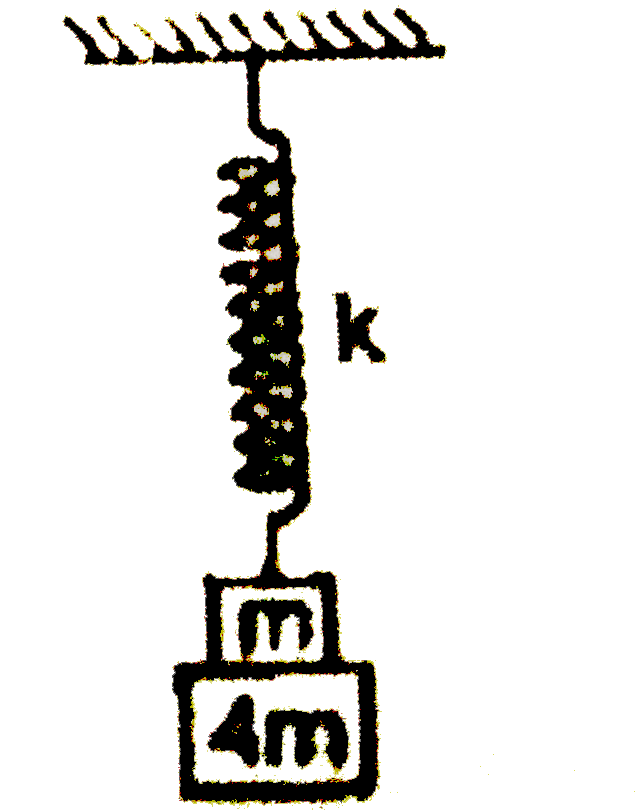
Find how much m will rise if 4m falls aw...

Find how much m will rise if 4m falls away. Block are at rest and in equilibrium.

Promotional Banner

Similar Questions

Explore conceptually related problems

Find how much mass m will rise if 4m falls away. Blocks are at rest and in equilibrium.

Find how much mass m will rise if 4m falls away. Blocks are at rest and in equilibrium.

A block of mass M is tied to a spring of force constant K and the system is suspended vertically. Consider three situations shown in fig. (a), (b) and (c). (a) In fig. (a), an insect of mass M is clinging to the block and the system is in equilibrium. The insect leaves the block and falls. Find the amplitude of resulting oscillations. (b) In fig. (b), an insect of mass M is resting on the top of the block and the system is in equilibrium. The insect suddenly jumps up with a speed u=gsqrt((M)/(K)) and the block starts oscillating. Find amplitude of oscillation assuming that the insect never falls back on the block (c) In fig. (c), an insect of mass M falls on the block this in equilibrium. The insect hits the block with velocity u=gsqrt((M)/(K)) while moving downwards sticks to the block. Find the amplitude of oscillation.

A block of mass m and relative density y( lt 1) si attached to an ideal spring of constant K. The system is initially at rest and at equilibrium. If the container acceleration upwards with a_(0) , find the increase in the elongation of the spring in equilibrium.

Consider the spring block system shown in the figure. Initially block m is in equilibrium. Then block m is displaced b y a small distance h. Find the maximum speed of the block. ltbgt

Two blocks A and B are connected by as string as shown in figure. Friction coefficient of the incline plane and block is 0.5 . The mass of the block A is 5 kg . If minimum & maximum values of masses of the block B for which the block remains in equilibrium are m_(1) & m_(2) then find value of (m_(2) - m_(1)) .

Two blocks A and B are connected by a string as shown as shown in the figure . Friction coefficient of the inclined plane is 0.5 . The mass of the block A is 5 kg. If minimum and maximum values of mass of the block B for which the block A remains in equilibrium are m_(1) and m_(2) then find the value of (m_(2) - m_(1)) [in kg]

A block of mass m is suspended through a spring of spring constant k and is in equilibrium. A sharp blow gives the block an initial downward velocity v. How far below the equilibrium position, the block comes to an instantaneous rest?

A block of mass m is suspended through a spring of spring constant k and is in equilibrium. A sharp blow gives the block an initial downward velocity v. How far below the equilibrium position, the block comes to an instantaneous rest?