

Home
Class 12
PHYSICS
A block of mass m lies on a horizontal f...

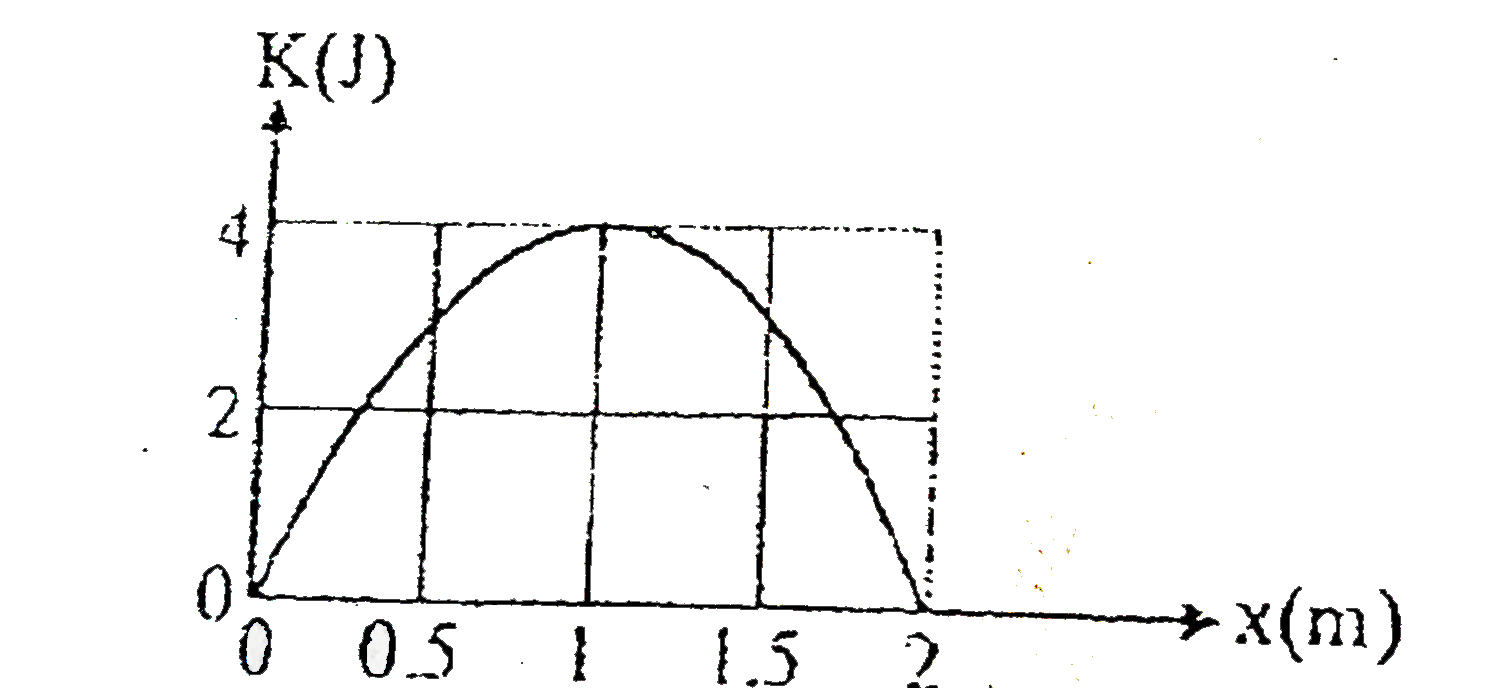
A block of mass `m` lies on a horizontal frictionless surface and is attached to one end of a horizontal spring (with spring constant `k`) whose other end is fixed . The block is intinally at rest at the position where the spring is unstretched `(x=0)`. When a constant horizontal force `vec(F)` in the positive direction of the `x-`axis is applied to it, a plot of the resulting kinetic energy of the block versus its position `x` is shown in figure. What is the magnitude of `vec(F)` ?

Promotional Banner

Similar Questions

Explore conceptually related problems

A block of mass m, lying on a smooth horizontal surface, is attached to a spring (of negligible mass) of spring constant k. The other end of the spring is fixed, as shown in the figure. The block is initally at rest in its equilibrium position. If now the block is pulled withe a constant force F, the maximum speed of the block is :

A block of mass m, lying on a smooth horizontal surface, is attached to a spring (of negligible mass) of spring constant k. The other end of the spring is fixed, as shown in the figure. The block is initally at rest in its equilibrium position. If now the block is pulled withe a constant force F, the maximum speed of the block is :

A block of mass M is kept on a rough horizontal surface and is attached with massless spring of force constant k .The minimum constant force applied on the other end of the spring to lift the block is

A block of mass m is kept on a rough horizontal surface and is attached with a massless spring of force constant k. The minimum constant force applied on the other end of the spring of lift the block is

A block of mass m is initially moving to the right on a horizontal frictionless surface at a speed v. It then compresses a spring of spring constant k. At the instant when the kinetic energy of the block is equal to the potential energy of the spring, the spring is compressed a distance of :

A block of mass m is initially moving to the right on a horizontal frictionless surface at a speed v. It then compresses a spring of spring constant k. At the instant when the kinetic energy of the block is equal to the potential energy of the spring, the spring is compressed a distance of :