

Home
Class 11
PHYSICS
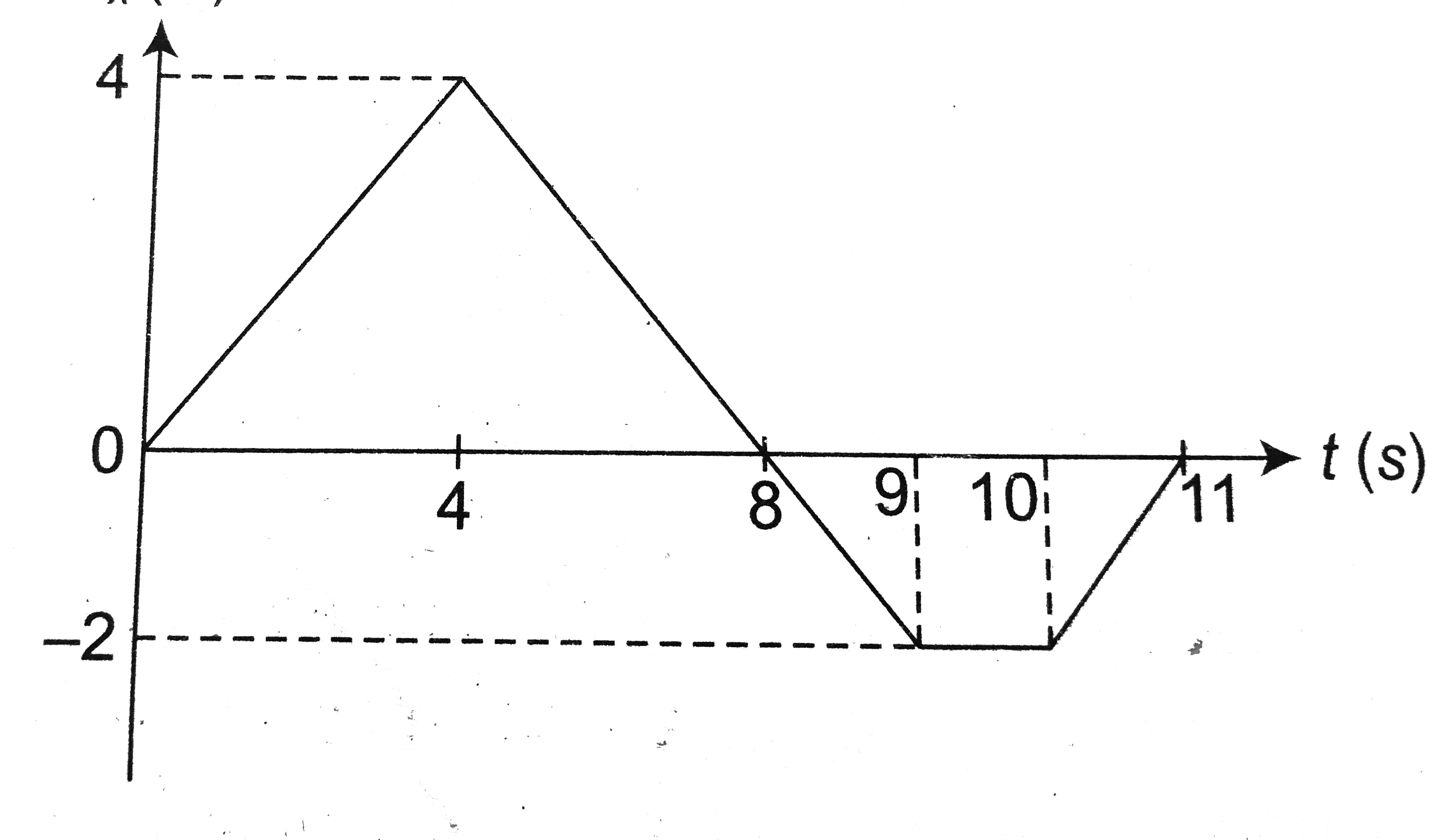
A 2kg toy car can move along an x axis. ...

A 2kg toy car can move along an x axis. Graph shows force `F_(x)` , acting on the car which being at rest at time `t=0` . The velocity of the particle at `t=0s` is:

Promotional Banner

Similar Questions

Explore conceptually related problems

A 2kg toy car can move along an x axis. Graph shows force F_(x) , acting on the car which being at rest at time t=0 . The velocity of the particle at t=10s is:

A time varying force, F=2t is acting on a particle of mass 2kg moving along x-axis. velocity of the particle is 4m//s along negative x-axis at time t=0 . Find the velocity of the particle at the end of 4s.

A time varying force, F=2t is acting on a particle of mass 2kg moving along x-axis. velocity of the particle is 4m//s along negative x-axis at time t=0 . Find the velocity of the particle at the end of 4s.

The acceleration-time graph of a particle moving along x-axis is shown in the figure. If the particle starts with velocity 3 m/s at t = 0, find the velocity of particle at t = 4 s.

The acceleration-time graph of a particle moving along x-axis is shown in the figure. If the particle starts with velocity 3 m/s at t = 0, find the velocity of particle at t = 4 s.

A particle starts from the origin at time t = 0 and moves along the positive x-axis. The graph of velocity with respect to time is shown in figure. What is the position of the particle at time t = 5s ?

A particle starts from the origin at time t = 0 and moves along the positive x-axis. The graph of velocity with respect to time is shown in figure. What is the position of the particle at time t = 5s ?

v_(x) is the velocity of a particle moving along the x-axis as shown in the figure. If x=2.0m at t=1.0s, what is the position of the particle at t=6.0s ?

A particle can move along a straight line. It is at rest when a force (F) starts acting on it directed along the line. Work done by the force on the particle changes with time(t) according to the graph shown in the fig. Can you say that the force acting on the particle remains constant with time?

A particle moves along x-axis in such a way that its r-coordinate varies with time't according to the equation x= (8-4t + 6t^(2) ) metre. The velocity of the particle will vary with time according to the graph