

Home
Class 11
PHYSICS
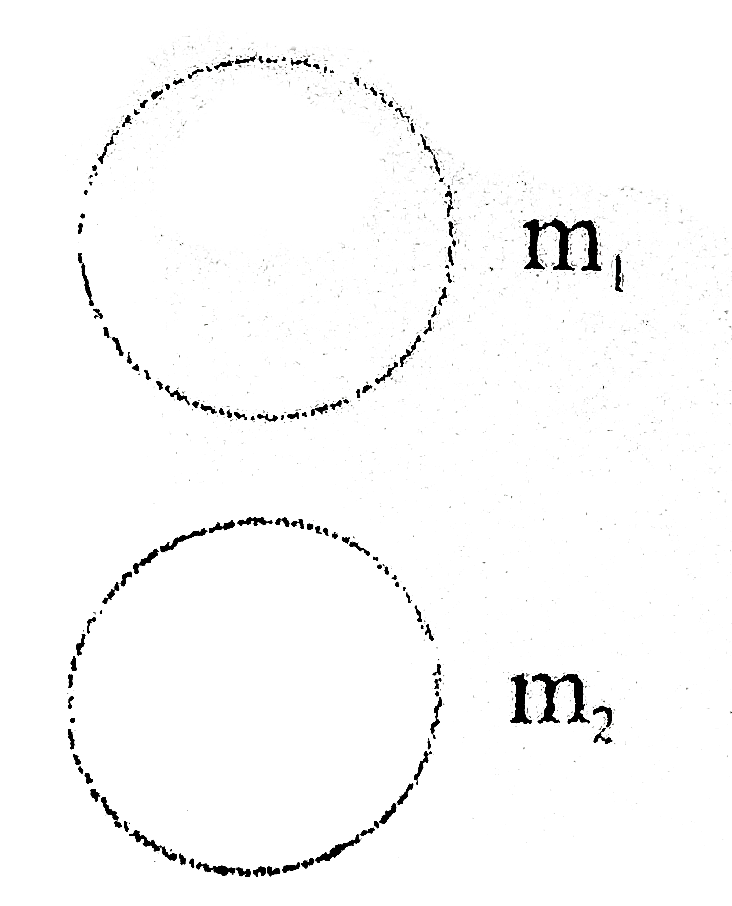
Two balls of masses m(1) and m(2) are pl...

Two balls of masses `m_(1)` and `m_(2)` are placed on top of one over the other (with a small gap between them) and then dropped on to the ground. What is the ration `m_(1)//m_(2)` for which the upper ball ultimately receives the largest possible fraction of the total energy? Take all collisions as elastic. Neglect air resistance

Promotional Banner

Similar Questions

Explore conceptually related problems

Two elastic balls of masses M and m (M gt gt m) are placed on top of each other with a small gap between them. The balls are dropped on to the ground with the bottom of the lower ball at height h above the ground. The lower ball has a radius R and the upper ball has negligible dimension. (a) Up to what height the ball of mass m will bounce above the ground ? (b) Does the result obtained above violates the low of conservation of mechanical energy?

Two balls A & B of mass m_(1) and m_(2) are kept on a horizontal smooth surface. A is given a velocity towards B so that they perform head on collision

A rubber ball is dropped on the ground from a height of 1m. What is the height to which the ball will rebound, if the coefficient of restitution between the ball and the ground is 0.8?

A ball of mass m_(1) and another ball of mass m_(2) are dropped from equal height. If the time taken by the balls are t_(1) and t_(2) , respectively, then

Two balls of masses 2m and 6m are thrown in air : one is vertically upwards and other at an angle theta with the vertical. The balls remain in air for the same time . Find the ratio of maximum heights attained by them .

Two balls of masses m_(1) and m_(2) are separated from each other by a powder charge placed between them. The whole system is at rest on the ground. Suddenly the powder charge explodes and masses are pushed apart. The mass m_(1) travels a distance s_(1) and stops. If the coefficients of friction between the balls and ground are same, the mass m_(2) stops after travelling the distance

Two balls of masses 2 m and 6 m are thrown in air : one vertically upwards and other at an angle theta with the vertical . The balls remain in air for the same time . Find the ratio of maximum heights attained by them.

Two balls of masses m_(1), m_(2) and speeds v_(1) and v_(2) collide at right angle . The maximum amount of kinetic energy loss due ot inelastic collision is ___.

Two balls of masses m_(1), m_(2) and speeds v_(1) and v_(2) collide at right angle . The maximum amount of kinetic energy loss due ot inelastic collision is ___.