

Home
Class 12
PHYSICS
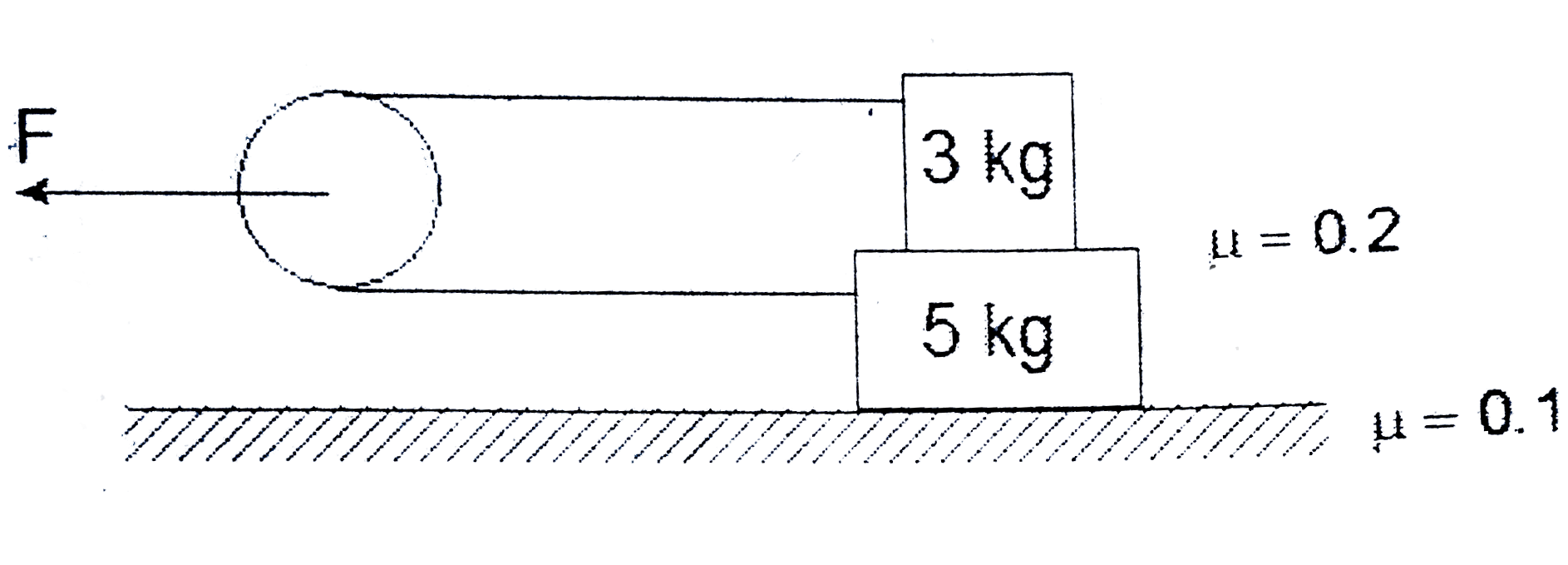
For the arrangement as shown in the figu...

For the arrangement as shown in the figure the maximum force F, for no relative motion between blocks is

Promotional Banner

Similar Questions

Explore conceptually related problems

For the arrangement shown in the figure the coefficient of friction between the two blocks is mu . If both the blocks are identical and moving ,then the acceleration of each block is

For the arrangement shown in the figure the coefficient of friction between the two blocks is mu . If both the blocks are identical and moving ,then the acceleration of each block is

In the given arrangement the maximum value of F for which there is no relative motion between the blocks

In the given arrangement the maximum value of F for which there is no relative motion between the blocks

In the arrangement shown in figure the wall is smooth and friction coefficient between the blocks is mu = 0.1 . A horizontal force F = 1000 N is applied on the 2kg block. The wrong statement is :

Two blocks of masses'm' and 'M' are arranged as shown in the figure. The coefficient of friction between the two blocks is ' mu ', where as between the lower block and the horizontal surface is zero. Find the force 'F' to be applied on the upper block, for the system to be under equilibrium ?

In an arrangement shown in the figure, the acceleration of block A and B are given-

In the arrangement shown in figure, coefficient of friction between the two blocks is mu=1//2 . The force of friction acting between

Block B of mass 2 kg rests on block A of mass 10 kg. All surfaces are rough with the value of coefficient of friction as shown in the figure. Find the minimum force F that should ber appplied on blocks A to cause relative motion between A and B. (g=10(m)/(s^2) )

Block B of mass 2 kg rests on block A of mass 10 kg. All surfaces are rough with the value of coefficient of friction as shown in the figure. Find the minimum force F that should ber appplied on blocks A to cause relative motion between A and B. (g=10(m)/(s^2) )