

Home
Class 11
PHYSICS
A bicycle has pedal rods of length 16 cm...

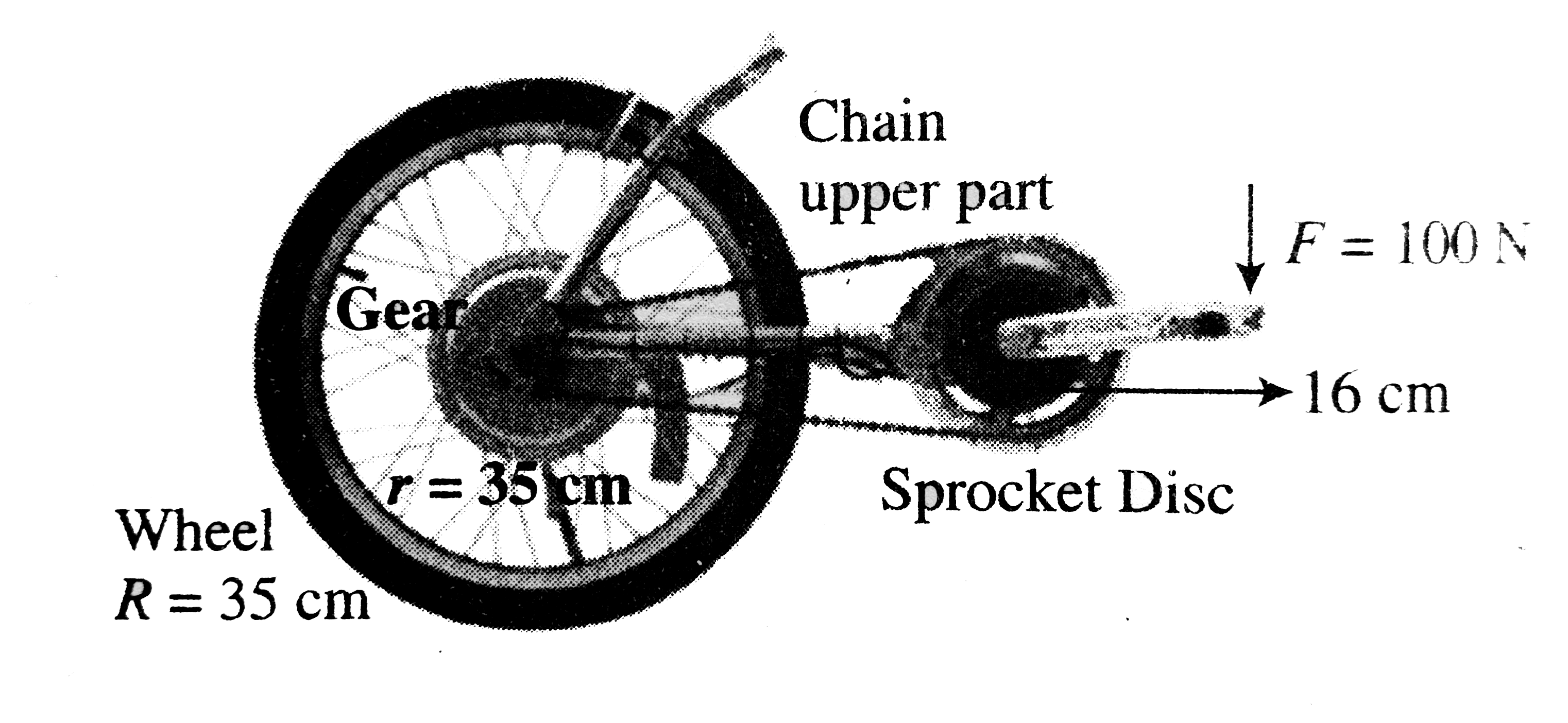
A bicycle has pedal rods of length `16 cm` connected to sprocketed disc of radius `10 cm`. The bicycle wheels are `70 cm` in diameter and the chain runs over a gear of radius `4cm`. The speed of the cycle is constant and the cyclist applies `100 N` for, that is always perpendicular to the pedal rod, as shown in figure. Assume tension in the lower part of chain is negligible. The cyclist is peddling at a constant rate of two revolutions per second. Assume that the force applied by other foot is zero when one foot is exerting `100 N` force. Neglect friction within cycle parts and the rolling friction.

The net force of the friction on the rear wheel due to the road is:

Promotional Banner

Similar Questions

Explore conceptually related problems

A bicycle has pedal rods of length 16 cm connected to sprocketed disc of radius 10 cm . The bicycle wheels are 70 cm in diameter and the chain runs over a gear of radius 4cm . The speed of the cycle is constant and the cyclist applies 100 N for, that is always perpendicular to the pedal rod, as shown in figure. Assume tension in the lower part of chain is negligible. The cyclist is peddling at a constant rate of two revolutions per second. Assume that the force applied by other foot is zero when one foot is exerting 100 N force. Neglect friction within cycle parts and the rolling friction. The speed of the bicycle is

A bicycle has pedal rods of length 16 cm connected to sprocketed disc of radius 10 cm . The bicycle wheels are 70 cm in diameter and the chain runs over a gear of radius 4cm . The speed of the cycle is constant and the cyclist applies 100 N for, that is always perpendicular to the pedal rod, as shown in figure. Assume tension in the lower part of chain is negligible. The cyclist is peddling at a constant rate of two revolutions per second. Assume that the force applied by other foot is zero when one foot is exerting 100 N force. Neglect friction within cycle parts and the rolling friction. The speed of the bicycle is

A bicycle has pedal rods of length 16 cm connected to sprocketed disc of radius 10 cm . The bicycle wheels are 70 cm in diameter and the chain runs over a gear of radius 4cm . The speed of the cycle is constant and the cyclist applies 100 N for, that is always perpendicular to the pedal rod, as shown in figure. Assume tension in the lower part of chain is negligible. The cyclist is peddling at a constant rate of two revolutions per second. Assume that the force applied by other foot is zero when one foot is exerting 100 N force. Neglect friction within cycle parts and the rolling friction. Net torque on the rear wheel of the bicycle is equal to

A bicycle has pedal rods of length 16 cm connected to sprocketed disc of radius 10 cm . The bicycle wheels are 70 cm in diameter and the chain runs over a gear of radius 4cm . The speed of the cycle is constant and the cyclist applies 100 N for, that is always perpendicular to the pedal rod, as shown in figure. Assume tension in the lower part of chain is negligible. The cyclist is peddling at a constant rate of two revolutions per second. Assume that the force applied by other foot is zero when one foot is exerting 100 N force. Neglect friction within cycle parts and the rolling friction. The tension in the upper portion of the chain is equal to

A bicycle has pedal rods of length 16 cm connected to sprocketed disc of radius 10 cm . The bicycle wheels are 70 cm in diameter and the chain runs over a gear of radius 4cm . The speed of the cycle is constant and the cyclist applies 100 N for, that is always perpendicular to the pedal rod, as shown in figure. Assume tension in the lower part of chain is negligible. The cyclist is peddling at a constant rate of two revolutions per second. Assume that the force applied by other foot is zero when one foot is exerting 100 N force. Neglect friction within cycle parts and the rolling friction. The tension in the upper portion of the chain is equal to

A bicycle has pedal rods of length 16 cm connected to sprocketed disc of radius 10 cm . The bicycle wheels are 70 cm in diameter and the chain runs over a gear of radius 4cm . The speed of the cycle is constant and the cyclist applies 100 N for, that is always perpendicular to the pedal rod, as shown in figure. Assume tension in the lower part of chain is negligible. The cyclist is peddling at a constant rate of two revolutions per second. Assume that the force applied by other foot is zero when one foot is exerting 100 N force. Neglect friction within cycle parts and the rolling friction. The power delivered by the cyclist is equal to

A bicycle has pedal rods of length 16 cm connected to sprocketed disc of radius 10 cm . The bicycle wheels are 70 cm in diameter and the chain runs over a gear of radius 4cm . The speed of the cycle is constant and the cyclist applies 100 N for, that is always perpendicular to the pedal rod, as shown in figure. Assume tension in the lower part of chain is negligible. The cyclist is peddling at a constant rate of two revolutions per second. Assume that the force applied by other foot is zero when one foot is exerting 100 N force. Neglect friction within cycle parts and the rolling friction. The power delivered by the cyclist is equal to

A wheel of a bicycle has inner diameter 50 cm and thickness 10 cm. What is the speed of the bicycle if it makes 10 revolutions in 5 seconds?