Home
Class 12
CHEMISTRY
CsCl has cubic structure of ions in whic...

CsCl has cubic structure of ions in which `Cs^(+)` ion is present in the body -centre of the cube. If density is 3.99 g `cm^(-3)` :
(a) Calculate the length of the edge of a unit cell.
(b) What is the distance between `Cs^(+)` and `Cl^(-)` ions ?
(c) What is the radius of `Cs^(+)` ion if the radius of `Cl^(-)` ion is 180 pm ?

Text Solution

Verified by Experts
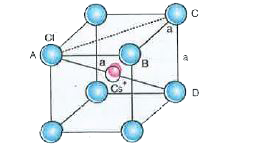
The unit cell of CsCl has cubic arrangement of `Cl^(-)` ions and `Cs^(+)` ion is present in the body centre of the cube. Therefore, the unit cell contains one `Cs^(+)` and one `Cl^(-)` ion or one CsCl unit, i.e, Z = 1.
Molar mass of `CsCl, M = 133 + 35.5 = 168.5 g mol^(-1)`
Density, `rho = (Z xx M)/(a^3 xx N_A)`
`3.99 g cm^(-3) = (1 xx (168.5 g mol^(-1)))/(a^3 xx (6.022 xx 10^(23) mol^(-1)))`
`a^3 = (1 xx (168.5 g mol^(-1)))/((3.99 g cm^(-3)) xx (6.022 xx 10^(23) mol^(-1)))`
`= 7.02 xx 10^(-23) cm^(3)`
(i) Let length of the edge of unit cell = a
`a^3 = 7.02 xx 10^(-23) cm^(3) = 70.2 xx 10^(-24) cm^(3)`
`a = (70.2 xx 10^(-24) cm)^(1//3)`
`= 4.12 xx 10^(-8) cm = 412 ` pm
(ii) As shown in the figure, `Cs^(+)` ion is present in the centre of unit cell and is in contact with `8 Cl^(-)` ions at the corners. It is clear that the length of the body diagonal is equal to twice the distance between centre of `Cs^(+)` and centre of `Cl^(-)` ion. The body diagonal can also be calculated as :
If length of unit cell edge is a, then face diagonal AC, is
`AC = sqrt(AB^2 + BC^2) = sqrt(a^2 + a^2) = sqrt(2) a`
The body diagonal AD is :
`AD = sqrt(AC^2 + CD^2) = sqrt(2a^2 + a^2) = sqrt(3) a`.

Now,
2 (Distance between `Cs^(+) and C,^(-)) = sqrt(3) a`
or Distance between `Cs^(+) and Cl^(-) = (sqrt3)/(2) a`
`= (sqrt3)/2 xx 412 " pm" = 1.732 xx 206` pm
`= 356.8 ` pm.
(iii) Let the radius of `Cl^(-)` be `r(Cl^(-))` so that
`r(Cs^+) + r(Cl^-) = 356.8` pm
`r(Cl^-) = 356.8 - 180 = 176.8` pm.
Promotional Banner

Topper's Solved these Questions

  • SOLID STATE

    MODERN PUBLICATION|Exercise COMPETITION FILE - OBJECTIVE TYPE QUESTIONS (A. MULTIPLE CHOICE QUESTIONS)|30 Videos
  • SOLID STATE

    MODERN PUBLICATION|Exercise COMPETITION FILE - OBJECTIVE TYPE QUESTIONS (B. MULTIPLE CHOICE QUESTIONS)|18 Videos
  • SOLID STATE

    MODERN PUBLICATION|Exercise REVISION EXERCISES (NUMERICAL PROBLEMS)(CBSE Qs)|6 Videos
  • POLYMERS

    MODERN PUBLICATION|Exercise Competition file (OBJECTIVE TYPE QUESTIONS) (C. MULTIPLE CHOICE QUESTIONS)(Integer Type Questions)|6 Videos
  • SOLUTIONS

    MODERN PUBLICATION|Exercise UNIT PRACTICE TEST|14 Videos

Similar Questions

Explore conceptually related problems

The CsCl has cubic structure of Cl^(-) ions in which Cs^(+) in which Cs^(+) ion is present in the body centre of the cube. It density is 3.99g cm^(-3) . Then length of the edge of unit cell is :

The CsCl has cubic structure of Cl^(-) ions in which Cs^(+) in which Cs^(+) ion is present in the body centre of the cube. It density is 3.99g cm^(-3) . The radius of Cs^(+) ion if the radius of Cl^(-) ion is 180 p m is :

The distance between Na^(+) and CI^(-) ion ion NaCI is 281 pm. What is the edge length of the cube

If a is the edge length of unit cell of sodium chloride, the distance between the nearest Na^(+) and Cl^(-) ions is

CsBr has BCC structure. The length of its side is 4.3 Å . The minimum distance between Cs^(+) and Br^(-) ion will be

The distance between Na^+ and Cl^- ions in NaCl with a density 3.165 g cm^(-3) is

The density of NH_(4)Cl is 1.534 g cm^(-3) . It crystallizes in the CsCl lattice. a. Calculate the length of the length of the edge of NH_(4)Cl unit cell. b. Calculate the shortest distance between a NH_(4)^(o+) ion and a Cl^(ɵ) ion. c. Calculate the radius of NH_(4)^(o+) ion if the radius of the Cl^(ɵ) ion is 181 pm

