Home
Class 11
PHYSICS
An elevator accelerates from rest at a c...

An elevator accelerates from rest at a constant rate `alpha` for time interval `t_(1)` and travels a distance `S_(1)` It them retards at a constant rate `beta` for time interval `t_(2)` and finally comes to rest after travelling a distance `S_(2)` during its retardation Show that:
`(S_(1))/(S_(2))=(t_(1))/(t_(2))=(beta)/(alpha)`.

Text Solution

Verified by Experts
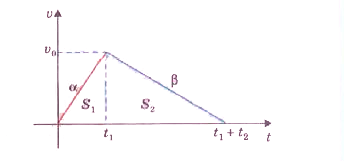
Velocity-time graph for the above situation is as follows:

Maximum velocity attained by the elevator is `v_(0)`. Slope of the v-t graph represents acceleration of the body, hence we can write the following relation:
`alpha=(v_(0))/(t_(1))` and `beta=(v_(0))/(t_(2))`
`rArr (alpha)/(beta)=(t_(2))/(t_(1))`
Area under the v-t graph represents displacement, hence we can write the following,
`S_(1)=(1)/(2)v_(0)t_(1)` and `S_(2)=(1)/(2)v_(0)t_(2)`
Dividing the above two equation e get
`(S_(1))/(S_(2))=(t_(1))/(t_(2))=(beta)/(alpha)`
Promotional Banner

Topper's Solved these Questions

  • MOTION IN A STRAIGHT LINE

    MODERN PUBLICATION|Exercise NCERT (TEXTBOOK EXERCISES )|22 Videos
  • MOTION IN A STRAIGHT LINE

    MODERN PUBLICATION|Exercise NCERT (ADDITIONAL EXERCISE)|6 Videos
  • MOTION IN A STRAIGHT LINE

    MODERN PUBLICATION|Exercise CONCEPTUAL QUESTIONS|14 Videos
  • MOTION IN A PLANE

    MODERN PUBLICATION|Exercise Chapter Practice Test|15 Videos
  • OSCILLATIONS

    MODERN PUBLICATION|Exercise Practice Test (For Board Examination)|12 Videos

Similar Questions

Explore conceptually related problems

A train accelerates from rest at a constant rate a for distance x_(1) and time t_91) . After that is retards at constant rate beta for distance x_(2) and time t_(2) and comes to the rest. Which of the following relation is correct:-

A train moves from rest with acceleration alpha and in time t_(1) covers a distance x. It then decelerates rest at constant retardation beta for distance y in time t_(2) . Then

A train accelerates from at the constant rate b for time t_(2) at a constant rate a and then it retards at the comes to rest. Find the ratio t_(1) // t_(2) .

A car, starting from rest, has a constant acceleration for a time interval t_1 during which it covers a distance In the next time interval the car has a constant retardation and comes to rest after covering a distance in time Which of the following relations is correct?

A car accelerates from rest at a constant rate alpha for sometime , after which it decelerates at a constant rate beta and comes to rest. If T is the total time elapsed, the maximum velocity acquired by the car is

A scooter accelerates from rest for time t_(1) at constant rate a_(1) and then retards at constant rate a_(2) for time t_(2) and comes to rest. The correct value of (t_(1))/(t_(2)) will be :-

A car starting from rest is accelerates at a constant rate alpha until it attains a speed v. It is then retarded at a constant rate beta until it comes to rest.The average speed of the car during its entire journey is

A car starting from rest is accelerates at a constant rate alpha until it attains a speed v .It is then retarded at a constant rate beta until it comes to rest. The average speed of the car during its entire journey is

A car accelerates from rest at a constant rate alpha for some time, after which it decelerates at a constant rate beta and ultimately comes to rest.If the total time-lapse is t, what is the total distance described and maximum velocity reached ?

