Home
Class 11
PHYSICS
The velocity-time graph of a particle in...

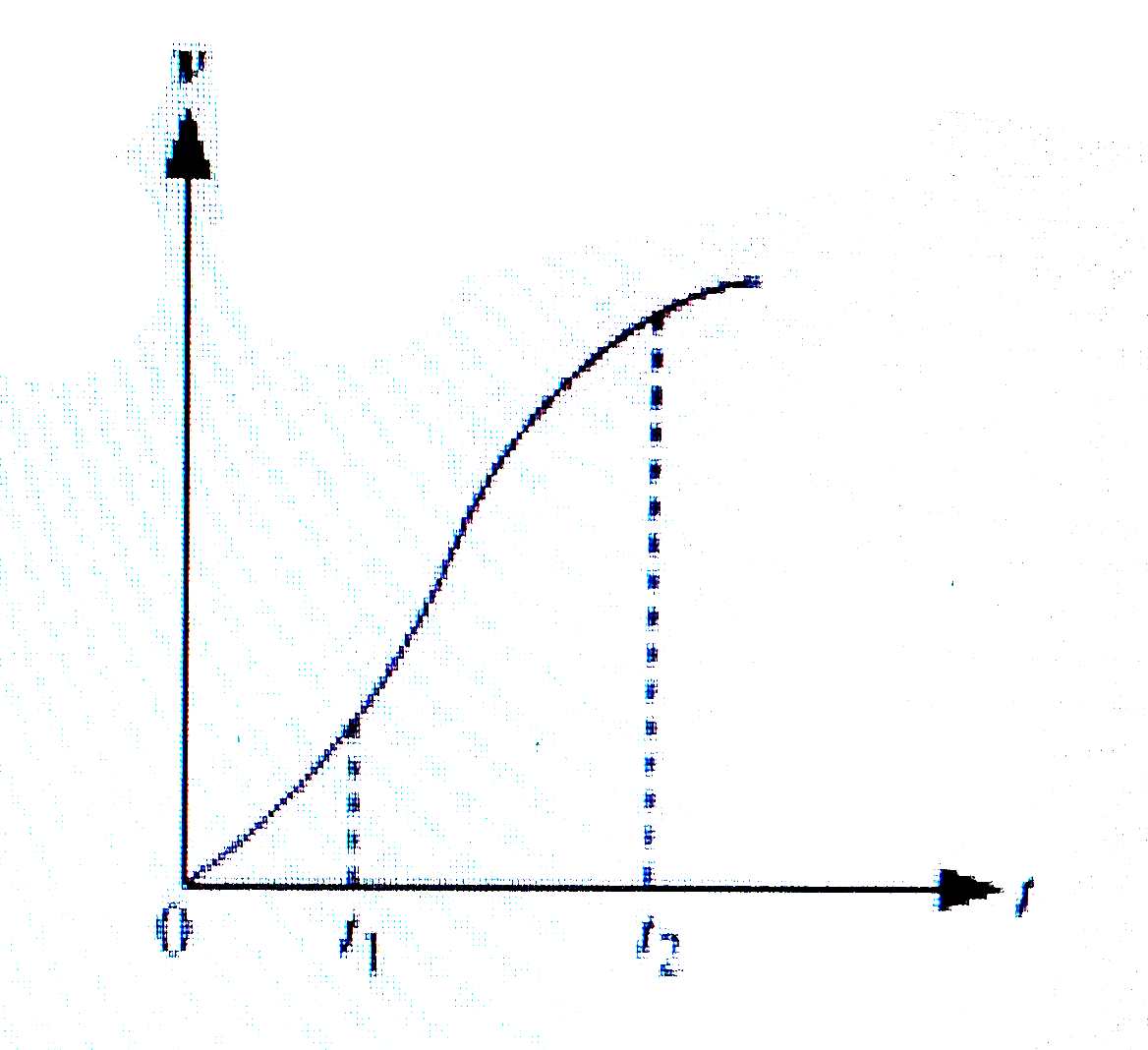
The velocity-time graph of a particle in one-dimensional motion is shown in Fig 3.29:

(a) Which of the following formylae are correct for describing the motion of the particle over the time -interval `t_(1)` to `t_(2)`:
(a) `x(t_(2)) = x(t_(1)) + v (t_(1)) (t_(2) - t_(1)) + (1//2) a (t_(2) - t_(1))^(2)`
(b) `v(t_(2)) = v(t_(1)) + a (t_(2) - t_(1))`
(c) `v_("average") = (x (t_(2)) - x(t_(1)))//(t_(2) - t_(1))`
(d) `a_("average") = (v(t_(2)) - v(t_(1)))//(t_(2) - t_(1))`
(e) `x(t_(2)) = x(t_(1)) + v_("average") (t_(2) - t_(1)) + (1//2) a_("average") (t_(2) - t_(1))^(2)`
(f) `x(t_(2)) - x(t_(1))` = area under the `v - t` curve bounded by the t-axis and the dotted line shown.

Text Solution

Verified by Experts

As the motion of the particle over the interval `t_(1)` and `t_(2)` is non-unifom. Therefore the relation c,d,f are correct but a,b,e represent uniform acceleration.
Promotional Banner

Topper's Solved these Questions

  • MOTION IN A STRAIGHT LINE

    MODERN PUBLICATION|Exercise NCERT (VERY SHORT ANSWER TYPE QUESTION)|5 Videos
  • MOTION IN A STRAIGHT LINE

    MODERN PUBLICATION|Exercise NCERT (SHORT ANSWER TYPE QUESTION)|6 Videos
  • MOTION IN A STRAIGHT LINE

    MODERN PUBLICATION|Exercise NCERT (TEXTBOOK EXERCISES )|22 Videos
  • MOTION IN A PLANE

    MODERN PUBLICATION|Exercise Chapter Practice Test|15 Videos
  • OSCILLATIONS

    MODERN PUBLICATION|Exercise Practice Test (For Board Examination)|12 Videos

Similar Questions

Explore conceptually related problems

The velocity-time graph of a particle in one-dimensional motion is shown in Fig.: (a) Which of the following formulae are correct for describing the motion of the particle over the time-interval t_(1) to t_(2) : (a) x(t_(2)) = x(t_(1)) + v (t_(1)) (t_(2) - t_(1)) + (1//2) a (t_(2) - t_(1))^(2) (b) v(t_(2)) = v(t_(1)) + a (t_(2) - t_(1)) (c) v_("average") = (x (t_(2)) - x(t_(1)))//(t_(2) - t_(1)) (d) a_("average") = (v(t_(2)) - v(t_(1)))//(t_(2) - t_(1)) (e) x(t_(2)) = x(t_(1)) + v_("average") (t_(2) - t_(1)) + (1//2) a_("average") (t_(2) - t_(1))^(2) (f) x(t_(2)) - x(t_(1)) = area under the v - t curve bounded by the t-axis and the dotted line shown.

The velocity-time graph of a particle in one-dimensional motion is shown in the figure. Which of the following formulae is correct for describing the motion of the particle over the time interval t_1 to t_2 ?

For any arbitrary motion in space, which of the following relations are true? (a) v_("average") = (1//2)(v(t_(1)) + v(t_(2))) (b) v_("average") = [r(t_(2))-r(t_(1)]//(t_(2)-t_(1)) (c) v(t) = v(0) + at (d) a_("average") = [v(t_(2))-v(t_(1))]//(t_(2)-t_(1)) The average stands for average of the quantity over time interval t_(1) to t_(2)

Examine the following plots and predict whether in (i) P_(1) lt P_(2) "and" T_(1) gt T_(2) , in (ii) T_(1) = T_(2)ltT_(3) , in (iii) V_(1) gt V_(2), "in" (iv) P_(1) gt P_(2) "or" P_(2) gt P_(1)

The normal drawn at a point (at_(1)^(2),-2at_(1)) of the parabola y^(2)=4ax meets it again in the point (at_(2)^(2),2at_(2)), then t_(2)=t_(1)+(2)/(t_(1))(b)t_(2)=t_(1)-(2)/(t_(1))t_(2)=-t_(1)+(2)/(t_(1))(d)t_(2)=-t_(1)-(2)/(t_(1))

Activity of a radioactive substance is R_(1) at time t_(1) and R_(2) at time t_(2) (t_(2) gt t_(1)) then the ratio (R_(2))/( R_(1)) is :

If the normals at points t_(1) and t_(2) meet on the parabola,then t_(1)t_(2)=1 (b) t_(2)=-t_(1)-(2)/(t_(1))t_(1)t_(2)=2( d) none of these
