Home
Class 11
PHYSICS
A parachutist after bailing out falls 50...

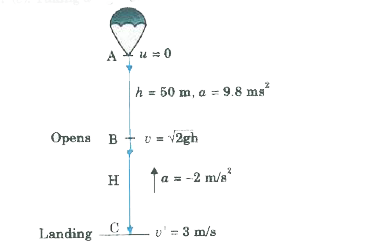
A parachutist after bailing out falls 50m without friction. When parachute opens, it decelerates at `2m//s^2`. He reaches the ground with a speed of `3m//s`. At what height, did the bail out?

A

191m

B

182m

C

293m

D

111m

Text Solution

Verified by Experts

The correct Answer is:
c

Taking ` a= g = 9.8 m//s^(2)`

For motion along A to B
`v^(2)=u^(2)+2gh(u=0)`
`v=sqrt(2gh)=sqrt(2xx9.8xx50)`
`v=sqrt(980)m//s`
Now motion along B to C
`v^(2)=v^(2)+2aH`
`H=((v^(2)-v^(2))/(2a))=((9-980)/(2xx(-2)))`
`=(971)/(4)=242.75m`
Total height `=h+H=50+242.75`
`=292.75=293m`
Promotional Banner

Topper's Solved these Questions

  • MOTION IN A STRAIGHT LINE

    MODERN PUBLICATION|Exercise COMPETITION FILE ( C.(MULTIPLE CHOICE QUESTIONS))|13 Videos
  • MOTION IN A STRAIGHT LINE

    MODERN PUBLICATION|Exercise COMPETITION FILE ( D.(MULTIPLE CHOICE QUESTIONS))|9 Videos
  • MOTION IN A STRAIGHT LINE

    MODERN PUBLICATION|Exercise COMPETITION FILE ( A.(MULTIPLE CHOICE QUESTIONS))|20 Videos
  • MOTION IN A PLANE

    MODERN PUBLICATION|Exercise Chapter Practice Test|15 Videos
  • OSCILLATIONS

    MODERN PUBLICATION|Exercise Practice Test (For Board Examination)|12 Videos

Similar Questions

Explore conceptually related problems

A parachutist after bailing out falls 50 m without friction. When parachute opens, it decelerates at 2 m//s^(2) he reaches the ground with a speed of 3 m//s at what height did he bail out ?

A parachutist after bailing out falls 80 m without friction. When the parachute opens, it decelerates at 2 m//s^(2) . He reaches the ground with a speed of 20 m//s . At what height, did he bail out?

A partachutist after bailing out falls 50 m without friction. When parachute opens, it decelerates at 2 ms^(-2) . At what height did he bail out

A parachutist after bailing out falls 80 m without friction. When the parachute opens, he decelerates downward with 5m//s^(2) and reaches the ground with a speed of 10 m//s . (a) How long is the parachutist in air? (b) At what height did bail out?

A parachutist after bailing out falls 52 m without friction. When the parachute opens, she decelerates at 2.1 ms^(-2) & reaches the ground with a speed of 2.9 ms^(-1) . (i) How long has been the parachutist in the air? (ii) At what height did the fall begin?

A parachutist after bailing out falls for 10 s without friction. When the parachute opens he descends with an acceleration of 2 m//s^(2) against his direction and reached the ground with 4 m//s from what height he has dropped himself? (g=10 m//s^(2))

A parachutist after bailing out falls freely for 50 metres. Then his parachute opens and he falls with deceleration of 2ms^-2 When he reaches the ground his speed is reduced to only 3 metres per seconds. at what height did he bail out ? For how long was he in air ?

A parachutist after bailing out falls freely for 50 metres.Then his parachute opens and he falls with deceleration of 2 ms^(-2) When he reaches the ground his speed is reduced to only 3 metres per second.At what height did he bail out ? For how long was he in air ?

A parrachutist bails out from an aeropane and after dropping through a distance of 40 m opens the parachute and decelerates at 2 ms^(-2) . If he reaches the ground with a speed of 2 ms^(-1) , how lowg he in the air ? At what height did he bail out from the plane ?

MODERN PUBLICATION-MOTION IN A STRAIGHT LINE -COMPETITION FILE ( B.(MULTIPLE CHOICE QUESTIONS))
  1. The x and y coordinates of the particle at any time are x=5t-2t^(2) an...

    Text Solution

    |

  2. A person travelling on a straight line moves with a uniform velocity v...

    Text Solution

    |

  3. A parachutist after bailing out falls 50m without friction. When parac...

    Text Solution

    |

  4. In a car race, car A takes a time t less than car B at the finish and ...

    Text Solution

    |

  5. An automobile travellingat 40 km//h, can be stopped at distance of 4...

    Text Solution

    |

  6. All the graphs below are intended to represent the same motion. One of...

    Text Solution

    |

  7. The velocity of particle is v=v(0)+"gt"+ft^(2). If its position is x=0...

    Text Solution

    |

  8. An object , moving with a speed of 6.25 m//s , is decelerated at a ra...

    Text Solution

    |

  9. A ball is released from the top of a tower of height h metre. It takes...

    Text Solution

    |

  10. A particle of mass m is acted upon by a force F given by the emprical ...

    Text Solution

    |

  11. From a tower of height H, a particle is thrown vertically upwards with...

    Text Solution

    |

  12. A person climbs up a stalled escalator in 60s. If standing on the same...

    Text Solution

    |

  13. The velocity-time graphsof a car and a scooter are shown in the figur...

    Text Solution

    |

  14. Two stones are through up simultaneously from the edge of a cliff 240 ...

    Text Solution

    |

  15. Which of the following option correctly describes the variation of the...

    Text Solution

    |

  16. A car moving with a velocity of 20ms^(-1) is stopped in a distance of ...

    Text Solution

    |

  17. A car is standing 200m behind a bus , which is also at rest . The two....

    Text Solution

    |

  18. Which graph corresponds to an object moving with a constant negative a...

    Text Solution

    |

  19. A body is thrown vertically upwards. Which one of the following graphs...

    Text Solution

    |

  20. Displacement (x) of a particle is related to time (t) as x = at + b ...

    Text Solution

    |

