Home
Class 11
PHYSICS
For a particle moving along the vertical...

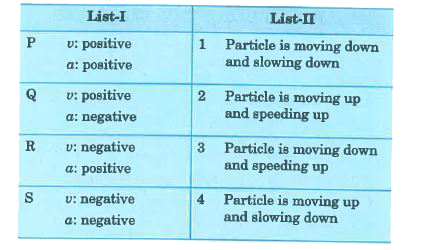
For a particle moving along the vertical direction, assume s,v,a and t represent displacement, velocity, acceleration and time respectively. Assume the vertical upward direction as the positive direction.

A

`{:(P,Q,R,S),(3,2,4,1):}`

B

`{:(P,Q,R,S),(1,3,2,4):}`

C

`{:(P,Q,R,S),(2,1,3,4):}`

D

`{:(P,Q,R,S),(4,1,3,2):}`

Text Solution

Verified by Experts

The correct Answer is:

c
Promotional Banner

Topper's Solved these Questions

  • MOTION IN A STRAIGHT LINE

    MODERN PUBLICATION|Exercise COMPETITION FILE (MATRIX MATCH TYPE QUESTIONS )|1 Videos
  • MOTION IN A STRAIGHT LINE

    MODERN PUBLICATION|Exercise COMPETITION FILE (INTEGER TYPE QUESTIONS )|9 Videos
  • MOTION IN A STRAIGHT LINE

    MODERN PUBLICATION|Exercise COMPETITION FILE (ASSERTION REASON)|9 Videos
  • MOTION IN A PLANE

    MODERN PUBLICATION|Exercise Chapter Practice Test|15 Videos
  • OSCILLATIONS

    MODERN PUBLICATION|Exercise Practice Test (For Board Examination)|12 Videos

Similar Questions

Explore conceptually related problems

For a particle moving in a straight line assume s,v,a and t represents displacement, velocity, acceleration and time respectively.

A ball falls from a height ‘h’ and collides with the ground. Each time it collides, its velocity is halved. Which of the following graphs are correct? Here t, v and y represent time, velocity and height above ground respectively. (vertically upwards direction is taken as positive and ground as y = 0)

A simple pendulum is oscillating in a trolley moving on a horizontal straight road with constant acceleration a. If direction of motion of trolley is taken as positive x direction and vertical upward direction as positive y direction then the mean position of pendulum makes an angle

For a particle undergoing SHM, when will be its (a)velocity and displacement in the same direction (b) velocity and acceleration in the same direction (c ) displacement and acceleration in the same direction

The position time graph for a particle moving along X axis has been shown in the fig. At which of the indicated points the particle has (i) negative velocity but acceleration in positive X direction. (ii) positive velocity but acceleration in negative X direction. (iii) received a sharp blow (a large force for negligible interval of time)?

The velocity of a particle moving in the x direction varies as V = alpha sqrt(x) where alpha is a constant. Assuming that at the moment t = 0 the particle was located at the point x = 0 . Find the acceleration.
