

Home
Class 11
PHYSICS
Two particles A and B each of mass m are...

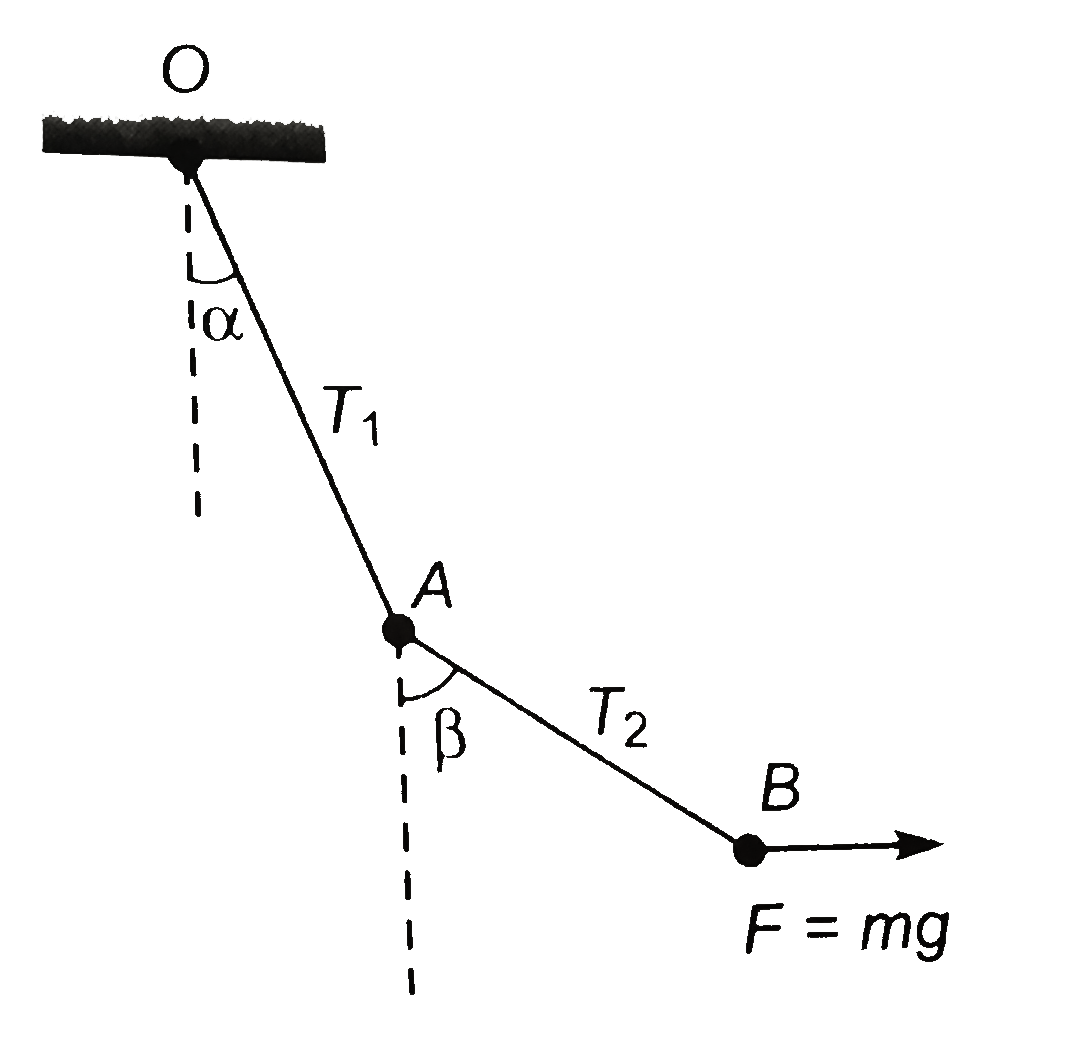
Two particles `A` and `B` each of mass `m` are kept stationary by applying a horizontal force `F = mg` on particle `B` as show in figure .Then

Promotional Banner

Similar Questions

Explore conceptually related problems

Two partical A and B each of mass m are kept stationary by applying a horizontal force F = mg on partical B as show in figure .Then

Two partical A and B each of mass m are kept stationary by applying a horizontal force F = mg on partical B as show in figure .Then

Two particles A and B, each of mass m, are kept stationary by appyling a horizontal force F=mg on particle B as shown in fig.

Two particle A & B each of mass m are in equilibrium in a vertical plane under action of a horizontal force F=mg on particle B, as shown in figure Then :

Three identical cubes each of mass m are place on a smooth horizontal surface.A constant force F is applied on A as shown in the figure.The force on B applied by C is

Two identicle particles A and B, each of mass m, are interconnected by a spring of stiffness k. If particle B experiences a forec F and the elongation of the spring is x, the acceleration of particle B relative to particle A is equal to

Two identicle particles A and B, each of mass m, are interconnected by a spring of stiffness k. If particle B experiences a forec F and the elongation of the spring is x, the acceleration of particle B relative to particle A is equal to

Two blocks 'A' and 'B' each of mass 'm' are placed on a smooth horizontal surface . Two horizontal force F and 2F are applied on the blocks A and B , respectively , as shown in figure . The block A does not slide on block B . The normal reaction acting between the two blocks is

Three particles A, B and C of mass m, m and 2m lie in a straight line as shown. The only force acting on these particles is due to the gravitational attraction towards each other. Let the magnitude of net force on them be F_(A), F_(B) and F_(C ) respectively. Then, F_(A):F_(B):F_(C ) is equal to :

Three particles A, B and C of mass m, m and 2m lie in a straight line as shown. The only force acting on these particles is due to the gravitational attraction towards each other. Let the magnitude of net force on them be F_(A), F_(B) and F_(C ) respectively. Then, F_(A):F_(B):F_(C ) is equal to :