

Home
Class 11
PHYSICS
In the system shown in fig., block A and...

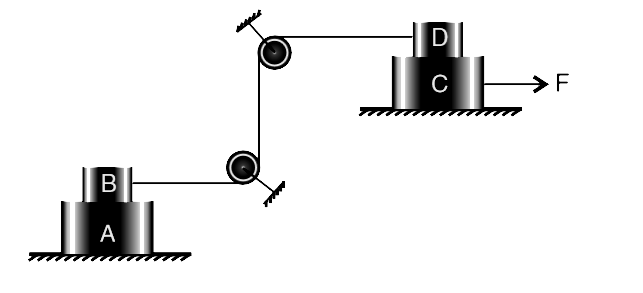
In the system shown in fig., block A and C are placed on smooth floors and both have mass equal to `m_(1)`. Blocks B and D are identical having mass `m_(2)` each. Coefficient of friction

Between A and B and that between C and D are both equal to `mu`. String and pulleys are light. A horizontal force F is applied on block C and is gradually increased.
(a) Find the maximum value of F (call it `F_(0)`) so that all the four blocks move with same acceleration.
(b) Will the value of `F_(0)` increase or decrease if another block (E) of mass `m_(2)` is placed above block D and coefficient of friction between E and D is `mu`?

Promotional Banner

Similar Questions

Explore conceptually related problems

A block of mass m is kept over another block of mass 2m. Coefficient of friction between two blocks is mu and that of between lower blood from the horizontal surface is zero. A horizontal force F=4/3 mu mg is applied on the block of mass 2m . Acceleration of lower block is

A block of mass m is kept over another block of mass 2m. Coefficient of friction between two blocks is mu and that of between lower blood from the horizontal surface is zero. A horizontal force F=4/3 mu mg is applied on the block of mass 2m . Acceleration of lower block is

A block of mass m is placed on another block of mass M which itself is lying on a horizontal surface .The coefficient of friction between two blocks is mu_(1) and that between the block of mass M and horizontal surfece is mu_(2) What maximum horizontal force can be applied to the lower block move without separation?

A block of mass m is placed on another block of mass M which itself is lying on a horizontal surface .The coefficient of friction between two blocks is mu_(1) and that between the block of mass M and horizontal surfece is mu_(2) What maximum horizontal force can be applied to the lower block move without separation?

A block A of mass 2 kg rests on another block B of mass 8 kg which rests on a horizontal floor. The coefficient of friction between A and B is 0.2 while that between B and floor is 0.5 .When a horizontal floor F of 25 N is applied on the block B the force of friction between A and B is

A block A of mass 2 kg rests on another block B of mass 8 kg which rests on a horizontal floor. The coefficient of friction between A and B is 0.2 while that between B and floor is 0.5 .When a horizontal floor F of 25 N is applied on the block B the force of friction between A and B is

A block A of mass 2 kg rests on another block B of mass 8 kg which rests on a horizontal floor. The coefficient of friction between A and B is 0.2 while that between B and floor is 0.5. when a horizontal force of 25 N is applied on the block B. the force of friction between A and B is

A block A of mass 2 kg rests on another block B of mass 8 kg which rests on a horizontal floor. The coefficient of friction between A and B is 0.2 while that between B and floor is 0.5. when a horizontal force of 25 N is applied on the block B. the force of friction between A and B is

The coefficient of static friction between the two blocks shown in figure is mu and the table is smooth. What maximum horizontal forced F can be applied to he block of mass M so that the block move together?

The coefficient of static friction between the two blocks shown in figure is mu and the table is smooth. What maximum horizontal forced F can be applied to he block of mass M so that the block move together?