

Home
Class 11
PHYSICS
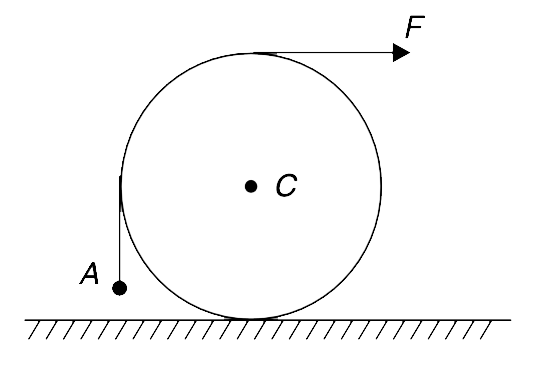
A cylinder C rests on a horizontal surfa...

A cylinder C rests on a horizontal surface. A small particle of mass m is held in equilibrium connected to an overhanging string as shown. The other end of the mass less string is being pulled horizontally by a force F as shown. Find F.

Promotional Banner

Similar Questions

Explore conceptually related problems

Four blocks each of mass M connected by a massless strings are pulled by a force F on a smooth horizontal surface, as shown in figure.

In the following figure, the object of mass m is held at rest by a horizontal force as shown. The force exerted by the string on the block is -

In the following figure, the object of mass m is held at rest by a horizontal force as shown. The force exerted by the string on the block is -

A disc of mass m lies flat on a smooth horizontal table. A light string runs halfway around it as shown in figure. One end of the string is attached to a particle of mass m and the other end is being pulled with a force F. There is no friction between the disc and the string. Find acceleration of the end of the string to which force is being applied.

A disc of mass m and radius R lies flat on a smooth horizontal table. A mass less string runs halfway around it as shown in figure. One end of the string is attached to a small body of mass m and the other end is being pulled with a force F. The circumference of the disc is sufficiently rough so that the string does not slip over it. Find acceleration of the small body.

A mass M is hung with a light inextensible string as shown in Find the tension in the horizontal part of the string .

A mass M is hung with a light inextensible string as shown in Find the tension in the horizontal part of the string .

Two particles of mass m each are tied at the ends of a light string of length 2a. The whole system is kept on a frictionless horizontal surface with the string held tight so that each mass is at a distance a from the centre P (as shown in the figure). Now, the mid-point of the string is pulled vertically upwards with a small but constant force F. As a result, the particles move towards each other on the surface. The magnitude of acceleration, when the separation between them becomes 2x, is

Two particles of mass m each are tied at the ends of a light string of length 2a. The whole system is kept on a frictionless horizontal surface with the string held tight so that each mass is at a distance a from the centre P (as shown in the figure). Now, the mid-point of the string is pulled vertically upwards with a small but constant force F. As a result, the particles move towards each other on the surface. The magnitude of acceleration, when the separation between them becomes 2x, is

Two particles of mass m each are tied at the ends of a light string of length 2a. The whole system is kept on a frictionless horizontal surface with the string held tight so that each mass is at a distance a from the centre P (as shown in the figure). Now, the mid-point of the string is pulled vertically upwards with a small but constant force F. As a result, the particles move towards each other on the surface. The magnitude of acceleration, when the separation between them becomes 2x, is