In physical pendulum, the time period for small oscillation is given by `T=2pisqrt((I)/(Mgd))` where I is the moment of inertial of the body about an axis passing through a pivoted point O and perpendicular to the plane of oscillation and d is the separation point between centre of gravity and the pivoted point. In the physical pendulum a speacial point exists where if we concentrate the entire mass of body, the resulting simple pendulum (w.r.t. pivot point O) will have the same time period as that of physical pendulum This point is termed centre of oscillation.
`T=2pisqrt((I)/(Mgd))=2pisqrt((L)/(g))` Moreover, this point possesses two other important remarkable properties:
Property I: Time period of physical pendulum about the centre of oscillation (if it would be pivoted) is same as in the original case.
Property II: If an impulse is applied at the centre of oscillatioin in the plane of oscillation, the effect of this impulse at pivoted point is zero. Because of this property, this point is also known as the centre of percussion. From the given information answer the following question:
Q. For the above question, locate the centre of oscillation.
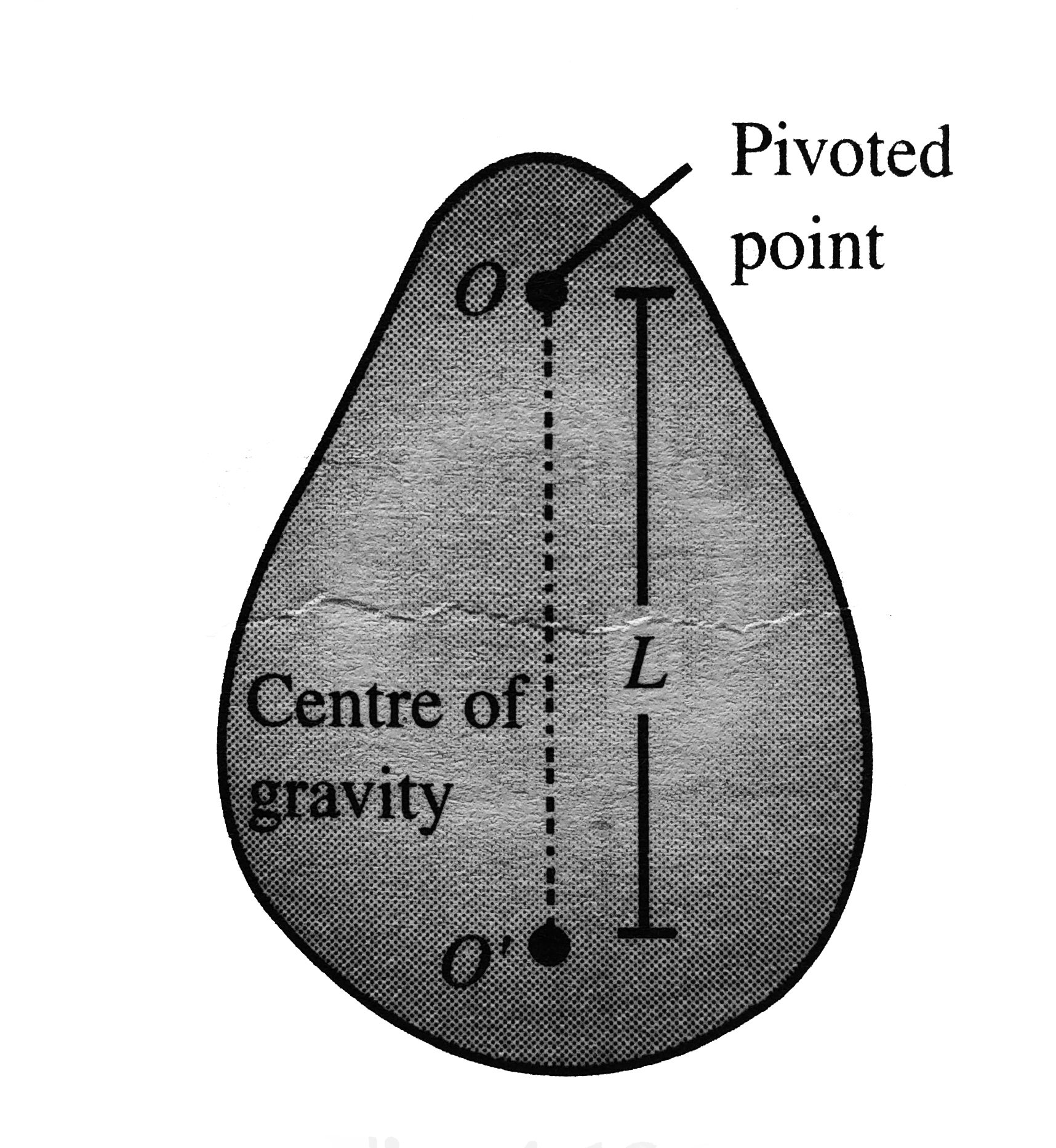
In physical pendulum, the time period for small oscillation is given by `T=2pisqrt((I)/(Mgd))` where I is the moment of inertial of the body about an axis passing through a pivoted point O and perpendicular to the plane of oscillation and d is the separation point between centre of gravity and the pivoted point. In the physical pendulum a speacial point exists where if we concentrate the entire mass of body, the resulting simple pendulum (w.r.t. pivot point O) will have the same time period as that of physical pendulum This point is termed centre of oscillation.
`T=2pisqrt((I)/(Mgd))=2pisqrt((L)/(g))` Moreover, this point possesses two other important remarkable properties:
Property I: Time period of physical pendulum about the centre of oscillation (if it would be pivoted) is same as in the original case.
Property II: If an impulse is applied at the centre of oscillatioin in the plane of oscillation, the effect of this impulse at pivoted point is zero. Because of this property, this point is also known as the centre of percussion. From the given information answer the following question:
Q. For the above question, locate the centre of oscillation.
`T=2pisqrt((I)/(Mgd))=2pisqrt((L)/(g))` Moreover, this point possesses two other important remarkable properties:
Property I: Time period of physical pendulum about the centre of oscillation (if it would be pivoted) is same as in the original case.
Property II: If an impulse is applied at the centre of oscillatioin in the plane of oscillation, the effect of this impulse at pivoted point is zero. Because of this property, this point is also known as the centre of percussion. From the given information answer the following question:
Q. For the above question, locate the centre of oscillation.



Similar Questions
Explore conceptually related problems
In physical pendulum, the time period for small oscillation is given by T=2pisqrt((I)/(Mgd)) where I is the moment of inertial of the body about an axis passing through a pivoted point O and perpendicular to the plane of oscillation and d is the separation point between centre of gravity and the pivoted point. In the physical pendulum a speacial point exists where if we concentrate the entire mass of body, the resulting simple pendulum (w.r.t. pivot point O) will have the same time period as that of physical pendulum This point is termed centre of oscillation. T=2pisqrt((I)/(Mgd))=2pisqrt((L)/(g)) Moreover, this point possesses two other important remarkable properties: Property I: Time period of physical pendulum about the centre of oscillation (if it would be pivoted) is same as in the original case. Property II: If an impulse is applied at the centre of oscillatioin in the plane of oscillation, the effect of this impulse at pivoted point is zero. Because of this property, this point is also known as the centre of percussion. From the given information answer the following question: Q. If an impulse J is applied at the centre of oscillation in the plane of oscillation, then angular velocity of the rod will be .
In physical pendulum, the time period for small oscillation is given by T=2pisqrt((I)/(Mgd)) where I is the moment of inertial of the body about an axis passing through a pivoted point O and perpendicular to the plane of oscillation and d is the separation point between centre of gravity and the pivoted point. In the physical pendulum a speacial point exists where if we concentrate the entire mass of body, the resulting simple pendulum (w.r.t. pivot point O) will have the same time period as that of physical pendulum This point is termed centre of oscillation. T=2pisqrt((I)/(Mgd))=2pisqrt((L)/(g)) Moreover, this point possesses two other important remarkable properties: Property I: Time period of physical pendulum about the centre of oscillation (if it would be pivoted) is same as in the original case. Property II: If an impulse is applied at the centre of oscillatioin in the plane of oscillation, the effect of this impulse at pivoted point is zero. Because of this property, this point is also known as the centre of percussion. From the given information answer the following question: Q. If an impulse J is applied at the centre of oscillation in the plane of oscillation, then angular velocity of the rod will be .
In physical pendulum, the time period for small oscillation is given by T=2pisqrt((I)/(Mgd)) where I is the moment of inertial of the body about an axis passing through a pivoted point O and perpendicular to the plane of oscillation and d is the separation point between centre of gravity and the pivoted point. In the physical pendulum a speacial point exists where if we concentrate the entire mass of body, the resulting simple pendulum (w.r.t. pivot point O) will have the same time period as that of physical pendulum This point is termed centre of oscillation. T=2pisqrt((I)/(Mgd))=2pisqrt((L)/(g)) Moreover, this point possesses two other important remarkable properties: Property I: Time period of physical pendulum about the centre of oscillation (if it would be pivoted) is same as in the original case. Property II: If an impulse is applied at the centre of oscillatioin in the plane of oscillation, the effect of this impulse at pivoted point is zero. Because of this property, this point is also known as the centre of percussion. From the given information answer the following question: Q. A uniform rod of mass M and length L is pivoted about point O as shown in Figgt It is slightly rotated from its mean position so that it performs angular simple harmonic motion. For this physical pendulum, determine the time period oscillation.
In physical pendulum, the time period for small oscillation is given by T=2pisqrt((I)/(Mgd)) where I is the moment of inertial of the body about an axis passing through a pivoted point O and perpendicular to the plane of oscillation and d is the separation point between centre of gravity and the pivoted point. In the physical pendulum a speacial point exists where if we concentrate the entire mass of body, the resulting simple pendulum (w.r.t. pivot point O) will have the same time period as that of physical pendulum This point is termed centre of oscillation. T=2pisqrt((I)/(Mgd))=2pisqrt((L)/(g)) Moreover, this point possesses two other important remarkable properties: Property I: Time period of physical pendulum about the centre of oscillation (if it would be pivoted) is same as in the original case. Property II: If an impulse is applied at the centre of oscillatioin in the plane of oscillation, the effect of this impulse at pivoted point is zero. Because of this property, this point is also known as the centre of percussion. From the given information answer the following question: Q. A uniform rod of mass M and length L is pivoted about point O as shown in Figgt It is slightly rotated from its mean position so that it performs angular simple harmonic motion. For this physical pendulum, determine the time period oscillation.
The time period of an oscillating body is given by T=2pisqrt((m)/(adg)) . What is the force equation for this body?
In the figure shown ABCD is a lamina of mass 12 kg . The moment of inertia of the given body about an axis passing through D, and perpendicular to the plane of the body is
In the figure shown ABCD is a lamina of mass 12 kg . The moment of inertia of the given body about an axis passing through D, and perpendicular to the plane of the body is
The moment of inertia of a disc about an axis passing through its centre and perpendicular to its plane is 20 kg m^2 . Determine its moment of inertia about an axis passing through a point midway between the centre and a point on the circumference, perpendicular to its plane.
A disc is made to oscillate about a horizontal axis passing through mid point of its radius. Determine time period.
Recommended Questions
- In physical pendulum, the time period for small oscillation is given b...
Text Solution
|
- A physical pendulum is positioned so that its centre of gravity is abo...
Text Solution
|
- In physical pendulum, the time period for small oscillation is given b...
Text Solution
|
- In physical pendulum, the time period for small oscillation is given b...
Text Solution
|
- In physical pendulum, the time period for small oscillation is given b...
Text Solution
|
- A ring of diameter 2m oscillates as a compound pendulum about a horizo...
Text Solution
|
- Statement-I: A circular metal hoop is suspended on the edge by a hook....
Text Solution
|
- A uniform disc of radius R is pivoted at point O on its circumstances....
Text Solution
|
- Assertion :- For a physical pendulum if distance of point of suspensio...
Text Solution
|