

Home
Class 12
MATHS
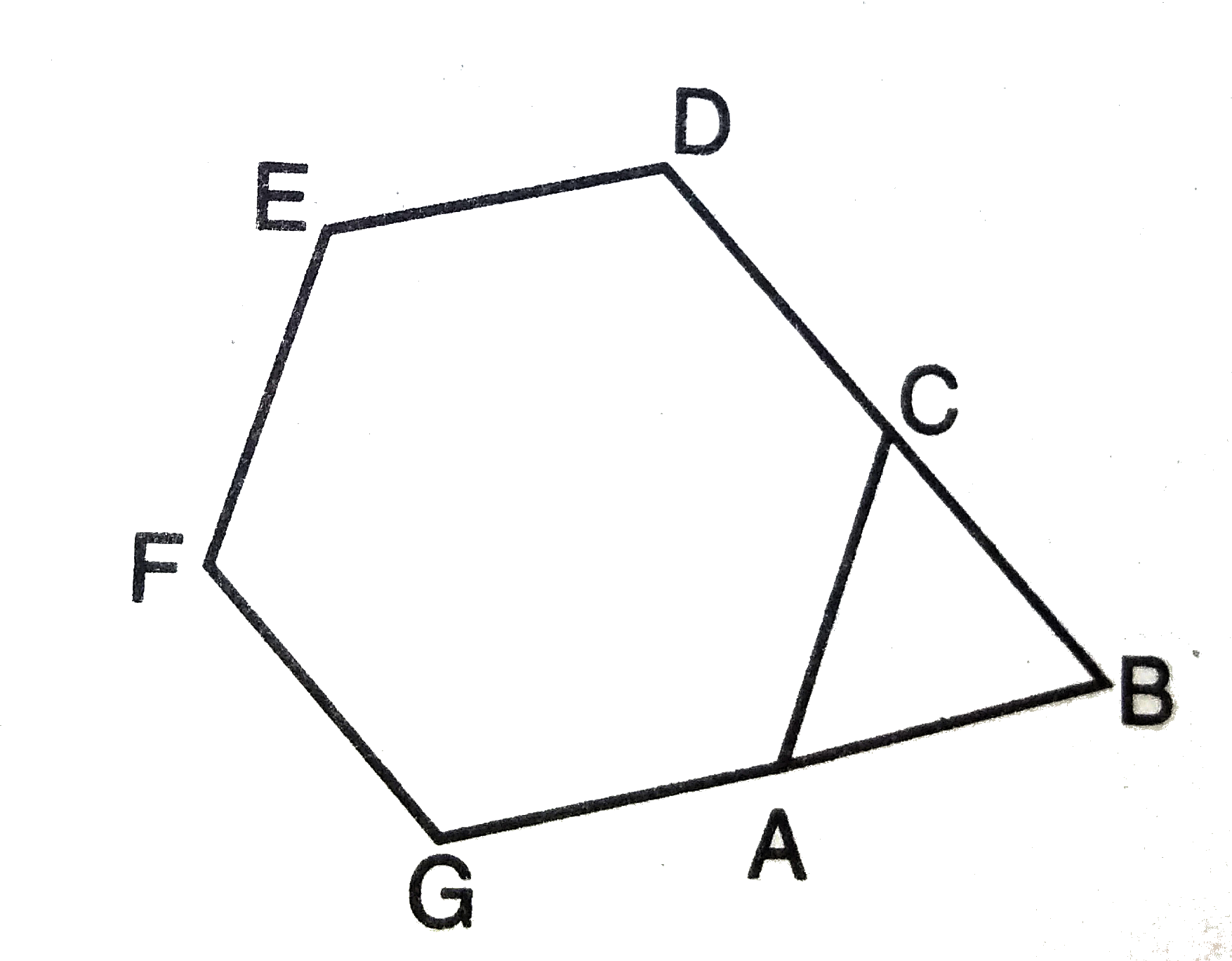
In the figure above, ABCDEFG is a regula...


In the figure above, ABCDEFG is a regular hexagon. Sides DC and GA are extended such that A is the midpoint of `overline(BG) and` C is the midpoint of `overline(BD)`. If the area of `triangleABC` is `9sqrt(3)` square centimeters, what is the number of centimeters in the perimeter of polygon ABCDEFG?

Promotional Banner

Similar Questions

Explore conceptually related problems

In the figure above, quadrilateral ABED, BFGC, and ACHJ are square. If the area of equilateral triangleABC is 16sqrt(3) square inches, what is the number of inches in the perimeter of polygon ADEBFGCHJA?

the figure above shows a quarter of a circle with center at O. if the length of diagonal overline(DM) of rectangle ODCM is 8 and M is the midpoint of overline(OB) , what is the area of the shaded region?

A sterling silver pendant is being designed to have the shape of polygon ABCDEFGD shown above where ABCD and EFGD are squares and triangle CDE is equilateral. If the area of triangleCDE is (27)/(sqrt(3)) square centimeter, what is the total linear distance around the pendant?

The figure above shows a regular hexagon with sides of length a and a square with sides of length a. If the area of the hexagon is 384 sqrt(3) square inches, what is the area, in square inches, of the square?

In the figure above, overline(OA)botoverline(AB and mangleBOC=45^(@) . If the coordinates of point A are (0, 3) and the coordinates of point C are (7, 0) , what is the number of square units in the area of qudrilateral OABC?

In the figure above, P and Q are the midpoints of sides AB and BC, respectively, of square ABCD. Line segment PB is extended by its own length to point E, and line segment PQ is extended to point F so that FEbotPE . If the area of square ABCD is 9, what is the area of quadrilateral QBEF?

In the given figure, a triangle ABC is drawn to circumscribe a circle of radius 3 cm such that the segments BD and DC are of lengths 6 cm and 9 cm respectively. If the area of triangleABC = 54 cm^(2) , then find the lengths of sides AB and AC. ltBRgt

the graph of f(x)=-0.5x^(2)+x+4 in the xy-plane is the parabola shownn in the figure above. The parabola crosses the x-axis at D(-2,0) and at point C(x,0). Point A is the vertex of the parabola. Segment AC and theline of symmetry, overline(AB) , are drawn. what is the number of square units in the area of DeltaABC ?