

Home
Class 12
PHYSICS
A spring-block system is resting on a fr...

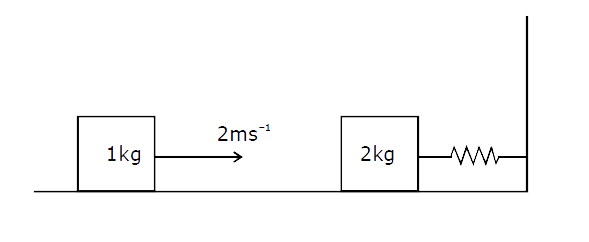
A spring-block system is resting on a frictionless floor as shown in the figure. The spring constant is 2.0 `N m^(–1)` and the mass of the block is 2.0 kg. Ignore the mass of the spring. Initially the spring is in an unstretched condition. Another block of mass 1.0 kg moving with a speed of 2.0 m `s^(–1)` collides elastically with the first block. The collision is such that the 2.0 kg block does not hit the wall. The distance, in metres, between the two blocks when the spring returns to its unstretched position for the first time after the collision is _________.

Promotional Banner

Similar Questions

Explore conceptually related problems

A spring-block system is resting on a frictionless floor as shown in the figure. The spring constant is 2.0Nm^(-1) and the mass of the block is 2.0 kg. Ignore the mass of the spring. Initially the spring is in an unstretched condition. Another block of mass 1.0 kg moving with a speed of 2.0ms^(-1) collides elastically with the first block. The collision is such that the 2.0 kg block does not hit the wall. The distance, in metres, between the two blocks when the spring returns to its unstretched position for the first time after the collision is

A spring-block system is resting on a frictionless floor as shown in the figure. The spring constant is 2.0Nm^(-1) and the mass of the block is 2.0 kg. Ignore the mass of the spring. Initially the spring is in an unstretched condition. Another block of mass 1.0 kg moving with a speed of 2.0ms^(-1) collides elastically with the first block. The collision is such that the 2.0 kg block does not hit the wall. The distance, in metres, between the two blocks when the spring returns to its unstretched position for the first time after the collision is

A constant force F is applied on a spring block system as shown in figure. The mass of the block is m and spring constant is k. The block is placed over a smooth surface. Initially the spring was unstretched. Choose the correct alternative(s)

A constant force F is applied on a spring block system as shown in figure. The mass of the block is m and spring constant is k. The block is placed over a smooth surface. Initially the spring was unstretched. Choose the correct alternative(s)

The block of mass m_1 shown in figure is fastened to the spring and the block of mass m_2 is placed as against it. Find the compression of the spring in the equilibrium position.

The system is released from rest with both the springs in unstretched positions. Mass of each block is 1 kg and force constant of each spring is 10 N//m . Extension of horizontal spring in equilibrium is

The system is released from rest with both the springs in unstretched positions. Mass of each block is 1 kg and force constant of each spring is 10 N//m . Extension of horizontal spring in equilibrium is

Each of the blocks shown in figure has mass 1 kg. The rear block moves with a speed of 2 m/s towards the front block kept at rest. The spring attached to the front block is light and has a spring constant 50 N/m. find the maximum compression of the spring.

A block of mass 1 kg is suspended from a spring of constant 100 N/m. initially the spring is unstretched. The block is then released. What is the acceleration (in m//s^(2) ) of the block when its velocity is 0.6 m/s in the downwards direction ?

A block of mass m is moving with a speed v on a horizontal rought surface and collides with a horizontal monted spring of spring constant k as shown in the figure .The coefficient of friction between the block and the floor is mu The maximum cobnpression of the spring is