

Home
Class 12
CHEMISTRY
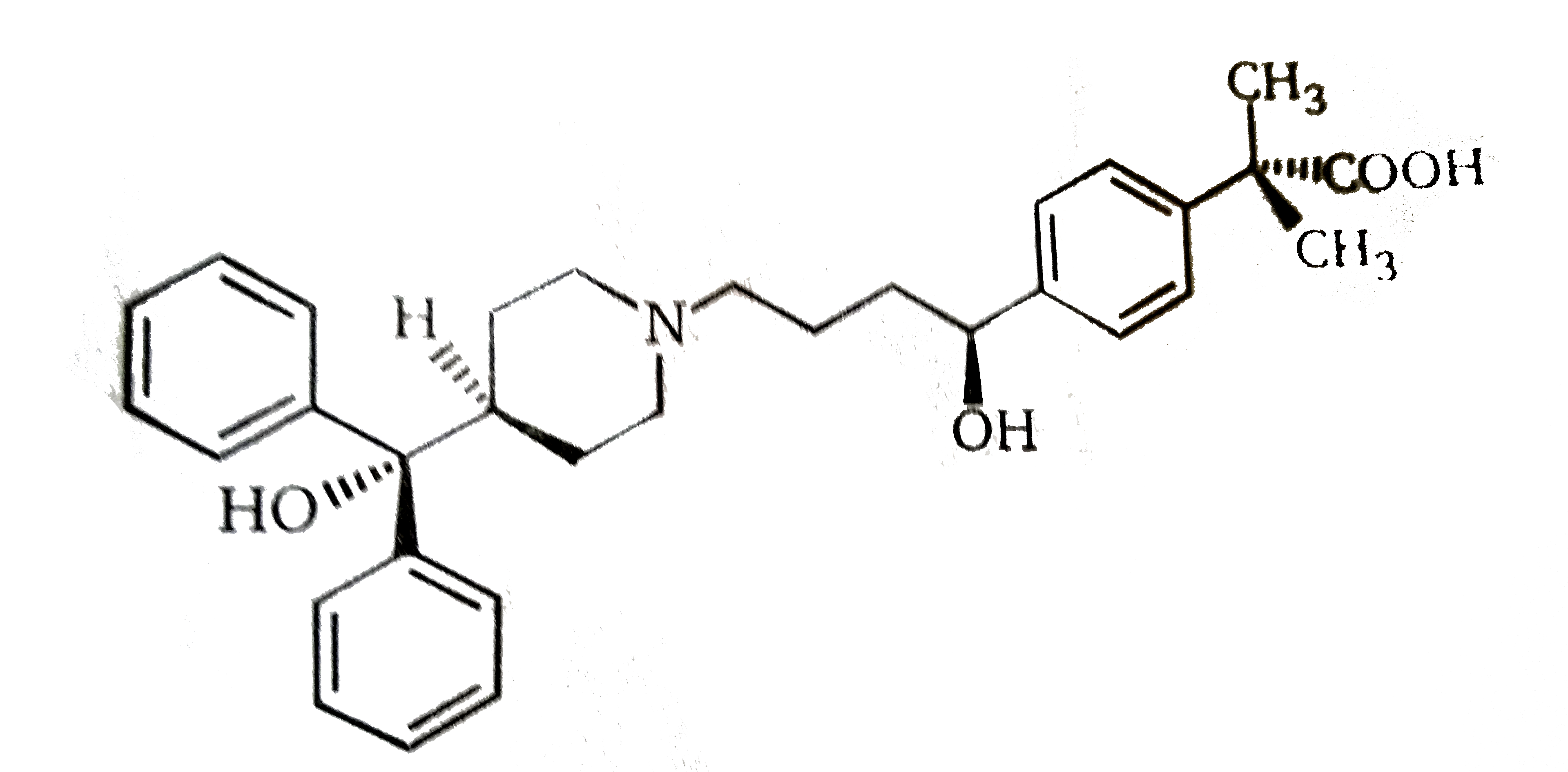
Allegra, a common presciption durg with ...

Allegra, a common presciption durg with the stricture shown below, is given for the treatment of seasonal allergies. Hown many sterogenic carbon does Allerga prossess ?

Promotional Banner

Similar Questions

Explore conceptually related problems

Allegra, a common prescription drug with the structure shown below, is given for the treatment of seasonal allergies. How many stereogenic carbon does Allegra possess ?

Consider the section of the periodic table given below. Note : In this table B does not represent boron C does not represent carbon F does not represent fluorine H does not represent hydrogen K does not represent potassium You must see the position of the element in the periodic table. Some elements are given in their own symbol and position in the periodic table, while others are shown with a letter. With reference to the table: How many valence electrons are present in G?

Consider the section of the periodic table given below. Note : In this table B does not represent boron C does not represent carbon F does not represent fluorine H does not represent hydrogen K does not represent potassium You must see the position of the element in the periodic table. Some elements are given in their own symbol and position in the periodic table, while others are shown with a letter. With reference to the table: Draw the electron dot structure for the compound formed between C and K.

Consider the section of the periodic table given below. Note: In this table, B does not represent boron C does not represent carbon F does not represent fluorine H does not represent hydrogen K does not represent potassium You must see the position of the element in the periodic table. Some elements are given in their own symbol and position in the periodic table, while others are shown with a letter. With reference to the table: Write the formula of the compound between B and H.

Consider the section of the periodic table given below. Note : In this table B does not represent boron C does not represent carbon F does not represent fluorine H does not represent hydrogen K does not represent potassium You must see the position of the element in the periodic table. Some elements are given in their own symbol and position in the periodic table, while others are shown with a letter. With reference to the table: Which is the most electronegative ?

Consider the section of the periodic table given below. Note : In this table B does not represent boron C does not represent carbon F does not represent fluorine H does not represent hydrogen K does not represent potassium You must see the position of the element in the periodic table. Some elements are given in their own symbol and position in the periodic table, while others are shown with a letter. With reference to the table: Write the formula of the compound between B and H.

Consider the section of the periodic table given below. Note : In this table B does not represent boron C does not represent carbon F does not represent fluorine H does not represent hydrogen K does not represent potassium You must see the position of the element in the periodic table. Some elements are given in their own symbol and position in the periodic table, while others are shown with a letter. With reference to the table: In the compound between F and J, what type of bond will be formed ?

Consider the section of the periodic table given below. Note: In this table, B does not represent boron C does not represent carbon F does not represent fluorine H does not represent hydrogen K does not represent potassium You must see the position of the element in the periodic table. Some elements are given in their own symbol and position in the periodic table, while others are shown with a letter. With reference to the table: In the compound between F and J, what type of bond will be formed?

Consider the parallelotrams shown in the figure below representing two-dimensional cells. a. Which of these are primitive and which are multiple unit cells? Are any of these orthogonal? c. What is the relation between the radius of circle and the length of parallelogram for the unit cell shown in the figure below (space filling diagram)? d. How many nearest neighbour circles does a given circle have in the second figure abov? e. What is the radius of the triangular hole shown in the second figure above? f. What is the packing fraction of the unit cell in the second figure above?