

Home
Class 12
PHYSICS
Electrical resistance of certain materia...

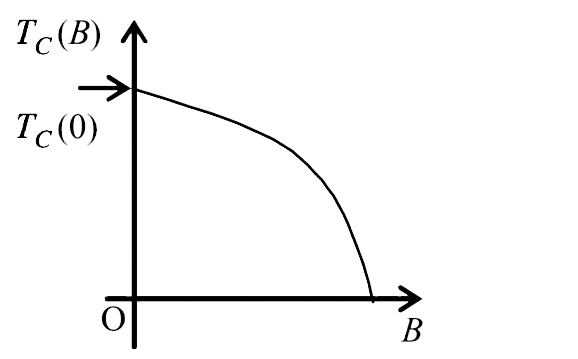
Electrical resistance of certain materials, known as superconductors, changes abruptly from a nonzero value of zero as their temperature is lowered below a critical temperature `T_(C) (0)`. An interesting property of super conductors is that their critical temperature becomes smaller than `T_(C) (0)` if they are placed in a magnetic field, i.e., the critical temperature `T_(C) (B)` is a function of the magnetic field strength B. The dependence of `T_(C) (B)` on B is shown in the figure.
.
A superconductor has `T_(C) (0) = 100 K`. When a magnetic field of 7.5 Tesla is applied , its `T_(C)` decreases to 75 K. For this material one can difinitely say that when

Promotional Banner

Similar Questions

Explore conceptually related problems

Electrical resistance of certain materials, known as superconductors, changes abruptly from a nonzero value of zero as their temperature is lowered below a critical temperature T_(C) (0) . An interesting property of super conductors is that their critical temperature becomes smaller than T_(C) (0) if they are placed in a magnetic field, i.e., the critical temperature T_(C) (B) is a function of the magnetic field strength B. The dependence of T_(C) (B) on B is shown in the figure. . In the graphs below, the resistance R of a superconductor is shown as a function of its temperature T for two different magnetic fields B_1 (solid line) and B_2 (dashed line). If B_2 is larget than B_1 which of the following graphs shows the correct variation of R with T in these fields?

Electrical resistance of certain materials, known as superconductors, changes abruptly from a nonzero value of zero as their temperature is lowered below a critical temperature T_(C) (0) . An interesting property of super conductors is that their critical temperature becomes smaller than T_(C) (0) if they are placed in a magnetic field, i.e., the critical temperature T_(C) (B) is a function of the magnetic field strength B. The dependence of T_(C) (B) on B is shown in the figure. . In the graphs below, the resistance R of a superconductor is shown as a function of its temperature T for two different magnetic fields B_1 (solid line) and B_2 (dashed line). If B_2 is larget than B_1 which of the following graphs shows the correct variation of R with T in these fields?

Define critical temperature ( T_c )

Define the following terms. Critical Temperature (T_c)

The temperature 30.98^(@)C is called critical temperature (T_(C)) of carbon dioxide. The critical temperature is the