Home
Class 12
PHYSICS
Figure given in the question is a cross-...

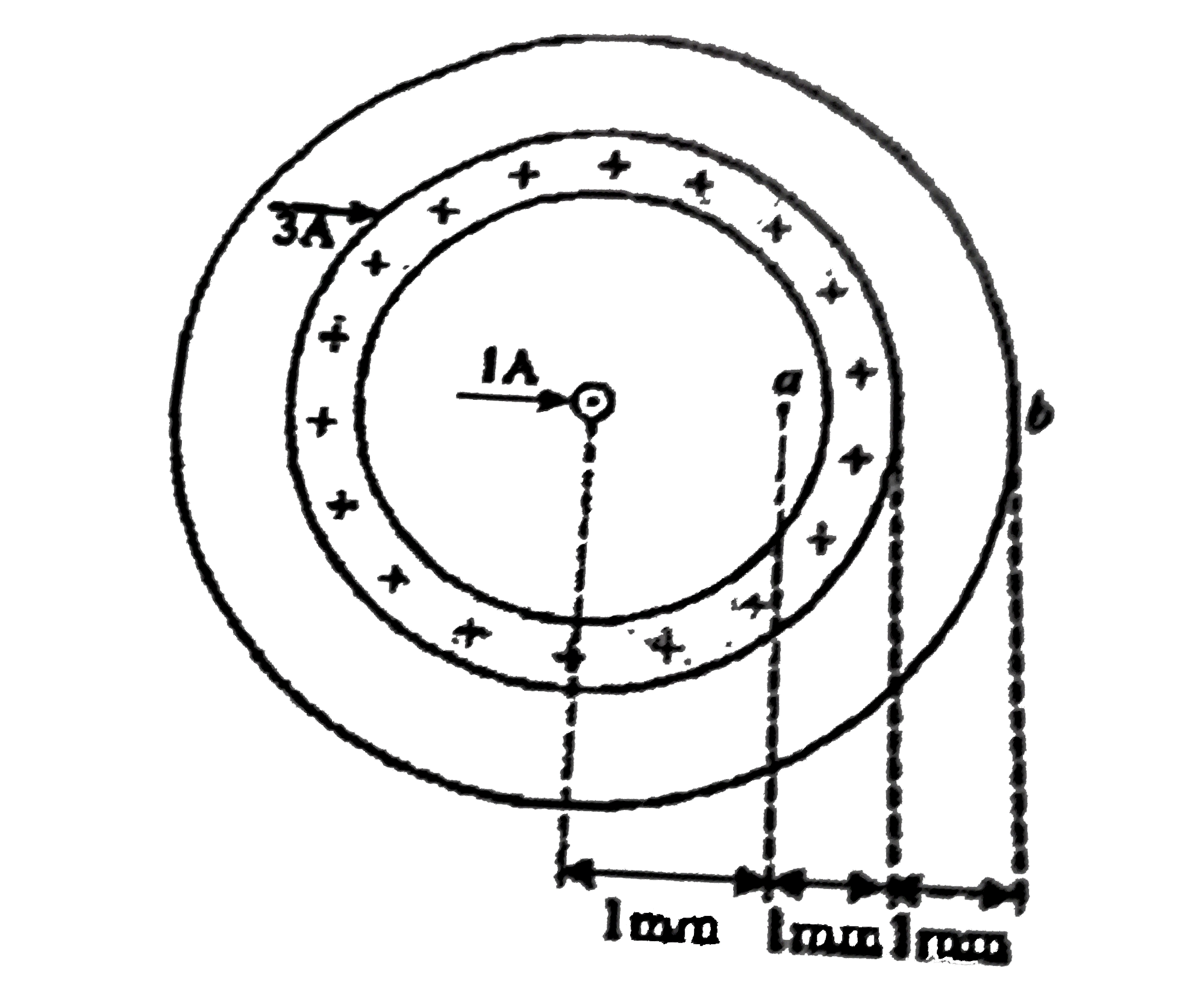
Figure given in the question is a cross-sectional view of a coaxial cable. The centre conductor is surrounded by a rubber layer, which is surrounded by an outer conductor, which is surrounded by another rubber layer. The current in the inner conductor is `1.0 A` out of the page, and the current in the outer conductor is 3.0A into the page. Determine the magnitude and direction of the magnetic field at points a and b.

Text Solution

Verified by Experts

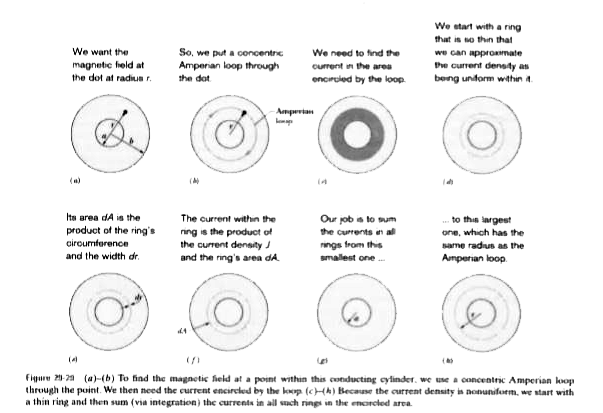
The point at which we want to evaluate `vecB` is inside the material of the conducting cylinder, between its inner and outer radii. We note that the current distribution has cylindrical symmetry (it is the same all around the cross section for any given radius). Thus, the symmetry allows us to use Ampere.s law of find `vecB` at the point. We first draw the Amperian loop shown in Fig. 29-29b. The loop is concentric with the cylinder and has radius `r=3.0cm` because we want to evaluate `vecB` at that distance from the cylinder.s central axis.
Next, we must compute the current `i_(enc)` that is encircled by the Amperian loop. However, we cannot set up a proportionality as in Eq. 29-38, because here the current is not uniformly distributed . Instead, we must integrate the current density magnitude from the cylinder.s inner radius a to the loop radius r, using the steps shown in Figs. 29-29c through h.
Calculations : We write the integral as
`i_(enc)=intJdA=int_(a)^(r )cr^(2)(2pirdr)`
`=2picint_(a)^(r )r^(3)dr=2pic[(r^(4))/(4)]_(a)^(r)`
`=(pic(r^(4)-a^(4))/(2))`.
Note that in these steps we took the differential area dA to be the area of the thin ring in Figs. 29-29d-f and then replaced it with its equivalent, the product of the ring .s circumference `2pir` and its thickness dr.
For the Amperian loop, the direction of integration indicated in Fig. 29-29b is (arbitarily) clockwise. Applying the right-hand rule for Ampere.s law to that loop, we find that we should take `i_(enc)` as negative because the current is directed out of the page but our thumb is directed into the page.
We next evaluate the left side of Ampere.s law as we did in Fig. 29-28, and we again obtain Eq. 29-37. Then Ampere.s law
`ointvecB*dcecs=mu_(0)i_(enc)`
gives us
`B(2pir)=-(mu_(0)pic)/(2)(r^(4)-a^(4))`
Solving for B and substituting known data yield
`B=-(mu_(0)c)/(4r)(r^(4)-a^(4))`
`=-((4pixx10^(-7)T*m//A)(3.0xx10^(6)A//m^(4)))/(4(0.030m))xx](0.030m)^(4)-(0.020m)^(4)]`
`=-2.0xx10^(-5)T`
Thus, the magnetic field `vecB` at a point `3.0cm` from the central axis has magnitude
`B=2.0xx10^(5)T`
and forms magnetic field lines that are directed opposite our direction of integration , hence counterclockwise in Fig. 29-29b
Promotional Banner

Topper's Solved these Questions

  • MAGNETIC FIELDS DUE TO CURRENTS

    RESNICK AND HALLIDAY|Exercise Check point|4 Videos
  • MAGNETIC FIELDS DUE TO CURRENTS

    RESNICK AND HALLIDAY|Exercise Problems|45 Videos
  • INTERFERENCE AND DIFFRACTION

    RESNICK AND HALLIDAY|Exercise PRACTICE QUESTIONS (Integer Type)|6 Videos
  • MAGNETIC FORCE

    RESNICK AND HALLIDAY|Exercise Practice Questions (Integer type )|7 Videos

Similar Questions

Explore conceptually related problems

Five current carrying conductor meet at a point P. What is the magnitude and direction of the current in the fifth conductor ?

A current flows in a conductor from east to west. The direction of the magnetic field at a points above the conductor is

If a straight conductor is held normal to this page and current is flowing into the page, what is the direction of the electromagnetic field produced ?

Four long, parallel conductors carry equal currents of 5.0 . The direction of the currents is into the pge at points. A and B and out of the page at C and D . Calculate the magnitude and directionof the mgnetic field at point P , located at the centre of the square.

The magnetic field near a current carrying conductor is given by

If a long horizontal conductor is bent as shown in figure and a current I is passed in it, find the magnitude and direction of magnetic field induction at the centre of circular part.

In a coaxial, straight cable, the central conductor and the outer conductor carry equal currents in opposite directions. The magnetic field is zero.

In a coaxial, straght cable, the central conductor and the outer conductor carry equal currents in opposite directions.The magnetic field is non-zero.

Four long, parallel conductors carry equal currents of 5.0A. The direction of the currents is into the page at point A and B and out of the page at C and D. Calculate the magnetic and direction of the magnetic field at point P, located at the centre of the square.