Notice that the boy is viewing the fish normally. The rays emanating from fish do not directly reach the boy, they undergo refraction at the water air interface. It seems that the rays should not deviate at all when we are viewing normally. However, it is not one single ray that we are going to use for the formation of image. There is a narrow pencil of rays which refract to form an image. So, we can use the formula for the apparent depth (Eq. 34-3) that we derived just before.
Calculation : Given that the rays are incident from water to air. So `n_(i)` is 4/3 and `n_(r )` is 1. The depth is measured from the water surface, so the depth is taken to be `h//2`. Now,
`(d_(1))/(mu_(r ))=(d_(0))/(mu_(i))`
`(d_(app))/(1)=((h)/(2))/((4)/(3))`.
As discussed before, this answer is the distance from the water surface .
Distance from the observer is
`(3h)/(8)+h=(11h)/(8)`.
(b) Find the apparent distance at which the boy sees the image of the fish (reflected in the mirror at the bottom).
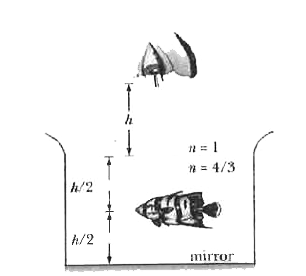
(1) Here, we can see that first rays from fish are reflected from the mirror. These reflected rays will again strike the water surface and after refraction from there, final image will be formed. Here two events occur one after another.
(2) Reflection from the mirror : For this, the object is at a distance h/2 from the mirror. So, the image will be formed at a distance h/2 behind the mirror. Note that although this image will be formed behind the mirror, no refraction will occur to form this image. Therefore, we need not consider the apparent depth while considering this reflection. This image will act as an object for refraction from water surface. For this refraction, the distance is measured from the water surface.
Calculation : The distance of this object from the water surface will be `h+(h//2)=3h//2`. Therefore,
`(d_(app))/(1)=((3h)/(2))/((4)/(3))=(9h)/(8)`.
So, distance from observer is
`(9h)/(8)+h=(17h)/(8)`
Although the object here is in air (image behind the mirror), we need not consider the refractive index of air because in the formula for the apparent depth, we consider the refractive index for the incident rays and that for the refracted rays.
Note : If you are still having a doubt as to what refers to `n_(i)` and what refers to `n_(r )`, draw a ray diagram to see the formation of image.


