Home
Class 12
PHYSICS
A ray of light travelling in air is inci...

A ray of light travelling in air is incident at grazing angle (incident angle=`90^(@))` on a long rectangular slab of a transparent medium of thickness `t=1.0` (see figure). The point of incidence is the origin `A(O,O)` .The medium has a variable index of refraction n(y) given by :`n(y)=[ky^(3//2)+1]^(1//2)` ,where k=`1.0m^(-3//2)`.the refractive index of air is 1.0`

(i) Obtain a relation between the slope of the trajectory of the ray at a point `B(x,y)`in the medium and the incident angle at that point
(ii) obtain an equation for the trajectory `y(x)`of the ray in the medium.
(ii) Determine the coordinates (`x_(1),y_(1))` of the point `P`.where the ray the ray intersects upper surface of the slab -air boundary.
Indicate the path of the ray subsequently.

Text Solution

Verified by Experts
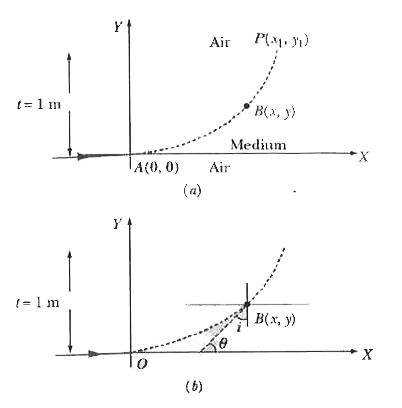
(1) In situation where refractive index changes only in one direction, medium can be considered as a collection of large number of the thin layers. Let refractive index be a function of y, that is n=f(y) then medium can be considered as to made up of a large number of thin slabs placed parallel to x axis and normal at any surface is parallel to x axis and normal at any surface is parallel to y axis.
(2) Although the refractive index is not constant, we cannot apply Snell.s laws here, but still we can divide the whole medium into thin layers as shown in Fig. 34-22. Within a layer, refractive index is constant. So here we have a case of many parallel slabs. We can apply Snell.s law here.
`n_(1) sin theta_(1)=n_(2)sintheta_(2)=n_(3)sintheta_(3)=.....`
`nsintheta`=constant
Calculations
(a) From Fig. 34-22b,
`i+theta=90^(@)`
Slope of the tangent `=tantheta`
`=tan(90-i)=coti`
(b) We know that at any point in the medium with variable refractive index n sin i constant, where n= refractive index at any point y and i=angle of incidence at any point y. Therefore,
`nsini=1sin90^(@)`
`sini=(1)/(coseci)=(1)/(sqrt(1+cot^(2)i))`
Substituting the values `(ky^(3//2)+1)^(1//2)`, we get
`(1)/(sqrt(1+m^(2))=1`
`ky^(3//2)+1=1+m^(2)`
Slope `m=(dy)/(dx)=sqrt(k)y^(3//4)`
`y^(-3//4)dy=sqrt(k)dx`.
On integrating both sides, we get
`int_(0)^(y)y^(-3//4)dy=int_(0)^(x)sqrt(k)dx`
`4y^(1//4)=x` (since `k=1`)
`y=(x^(4))/(256)`
(c ) For `y=1m`, `x=4m`
(d) Let `alpha_(e )` be the angle of emergence in the air, then by Snell.s law ,
`n_(e )sinalpha_(e )=n_(1)sinalpha_(1)=1` (refractive index of air `n_(e)=1`)
This gives
`sinalpha_(e )=1impliesalpha_(e )=90^(@)`
Thus, it emerges parallel to the incident ray , this could have been interpreted by Snell.s law too.
Promotional Banner

Topper's Solved these Questions

  • GEOMETRICAL OPTICS : REFRACTION

    RESNICK AND HALLIDAY|Exercise Check point|6 Videos
  • GEOMETRICAL OPTICS : REFRACTION

    RESNICK AND HALLIDAY|Exercise Problems|44 Videos
  • GEOMETRICAL OPTICS : REFLECTION

    RESNICK AND HALLIDAY|Exercise PRACTICE QUESTIONS (Integer Type)|3 Videos
  • GRAVITATION

    RESNICK AND HALLIDAY|Exercise PRACTICE QUESTIONS (INTEGER TYPE)|4 Videos

Similar Questions

Explore conceptually related problems

A ray of light travelling in air is incident at 45^(@) on a medium of refractive index sqrt(2) . The angle of refractive in the medium is

A ray of light is incident at an angle of incidence 45^@ on an equilateral prism and emerge at an angle 45^@ then the refractive index of the medium of the prism is:

A ray of light is incident at an angle of 60^(@) on one face of a rectangular glass slab of thickness 0.1 m , and refractive index 1.5 .Calculate the lateral shift produced.

A ray of light is incident on a glass slab at grazing incidence. The refractive index of the material of the slab is given by mu =sqrt(1+sqrty) . If the thickness of the slab is d, determine the equation ofthe trajectory of the ray inside the slab and the coordinates of the point where the ray exits from the slab. Take the origin to be at the point of entry of the ray.

A ray of light travelling in air is incident at grazing incidence on a slab with variable refractive index, n (y) = [ky^(3//2) + 1 ]^(1//2) where k=1 m^(-3//2) and follows path as shown in the figure. What is the total deviation produced by slab when the ray comes out.

