Home
Class 12
PHYSICS
Four similar prisms of same material hav...

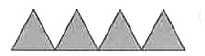
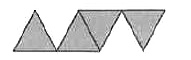
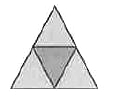
Four similar prisms of same material having same angle of prism are arranged. Which among the four of the arrangements shown in the following figures gives no not angular deviation ?

A

B

C

D

Text Solution

AI Generated Solution

The correct Answer is:

To solve the question regarding the arrangement of four similar prisms of the same material and the same angle of prism, we will analyze each arrangement to determine which one results in no angular deviation of the light ray passing through them. ### Step-by-Step Solution: 1. **Understanding the Concept of Angular Deviation**: - When light passes through a prism, it bends towards the base of the prism. The amount of bending is quantified as angular deviation. If multiple prisms are arranged in such a way that their effects on the light ray cancel each other out, then the net angular deviation can be zero. 2. **Analyzing Arrangement A**: - In the first arrangement, a light ray enters the first prism, bends towards the base, exits, and then enters the second prism. Each prism causes a deviation in the light ray. As the light continues through the prisms, it will have a net angular deviation. - **Conclusion**: Arrangement A has a net angular deviation. 3. **Analyzing Arrangement B**: - In the second arrangement, the prisms are arranged in such a way that the light ray enters the first prism, bends towards the base, and then enters the second prism. The second prism will counteract the deviation caused by the first prism, and this pattern continues with the subsequent prisms. - Since each prism's deviation is countered by the next, the light ray will exit parallel to its original path, resulting in no net angular deviation. - **Conclusion**: Arrangement B has no angular deviation. 4. **Analyzing Arrangement C**: - In this arrangement, all prisms are stacked together. The light ray will pass through all prisms as if it were passing through a single prism. Since a single prism always causes some angular deviation, this arrangement will also have a net angular deviation. - **Conclusion**: Arrangement C has a net angular deviation. 5. **Analyzing Arrangement D**: - In the fourth arrangement, the prisms are arranged in a way that resembles a single prism with a 90-degree angle. The light ray will bend towards the base and then exit, resulting in a net angular deviation. - **Conclusion**: Arrangement D has a net angular deviation. ### Final Answer: The arrangement that gives no angular deviation is **Arrangement B**.
Promotional Banner

Topper's Solved these Questions

  • GEOMETRICAL OPTICS : REFRACTION

    RESNICK AND HALLIDAY|Exercise Practice questions(More than one correct choice type)|14 Videos
  • GEOMETRICAL OPTICS : REFRACTION

    RESNICK AND HALLIDAY|Exercise Practice questions(Linked Comprehension)|2 Videos
  • GEOMETRICAL OPTICS : REFRACTION

    RESNICK AND HALLIDAY|Exercise Problems|44 Videos
  • GEOMETRICAL OPTICS : REFLECTION

    RESNICK AND HALLIDAY|Exercise PRACTICE QUESTIONS (Integer Type)|3 Videos
  • GRAVITATION

    RESNICK AND HALLIDAY|Exercise PRACTICE QUESTIONS (INTEGER TYPE)|4 Videos

Similar Questions

Explore conceptually related problems

Four square plates, each with edge length a, are arranged as shown in the following figure. The equivalent capacitance between A and C is

Four wires of the same material are stretched by the same load. Which one of them will elongate most if their dimensions are as follows

Four wires made of same material have different lengths and radii, the wire having more resistance in the following case is

A ray PQ incident on face AB of a prism ABC , as shown in Fig., emerges from the face AC such that AQ = AR . Draw the ray diagram showing the pasage of the ray through the prism. If the angle of prism is 60^@ and refractive index of the material of the prism is sqrt(3) , determine the values of angle of incidence and angle of deviation. .

Four identical resistances each having value R are arranged as shown in Figure. Find the equivalent resistance between A and B.

The following four wires are made of same material. Which of these will have the largest extension when the same tension is applied?

The plot of deviation versus angle of incidence for two prisms made of same material has been shown in the Figure. Which of the two graph corresponds to the prism of higher refracting angle (A)?

There is a thin prism of angle 5^(@) made of material having refractive index 1.6. There is another thin prism made of material of refractive index 1.8. These two prisms are combined in such a manner that they may produce dispersion without mean deviation. What should be the angle of second prism ?

RESNICK AND HALLIDAY-GEOMETRICAL OPTICS : REFRACTION-Practice questions(single correct choice type)
  1. A concave mirror has a local length of 2m in vacuum. What would be its...

    Text Solution

    |

  2. Four similar prisms of same material having same angle of prism are ar...

    Text Solution

    |

  3. A layered lens is made of materials indicated by shades in the figure....

    Text Solution

    |

  4. In a swimming pool, a person is viewing outside objects by keeping an ...

    Text Solution

    |

  5. If f(V) and f(R) are the focal lengths of a concex lens for violet and...

    Text Solution

    |

  6. The angle of prism is 60^(@) and its refractive index is 1.5. There wi...

    Text Solution

    |

  7. A thin prism of glass is placed in air and water respectively. If n(g)...

    Text Solution

    |

  8. The dispersion for a medium of wavelength lambda is D, then the disper...

    Text Solution

    |

  9. A concave lens of focal length f produces an image (1/x) of the size o...

    Text Solution

    |

  10. A lens is placed between the source of light and a wall. It forms imag...

    Text Solution

    |

  11. A thin biconvex lens of focal length f=25cm forms a real image of a re...

    Text Solution

    |

  12. A laser beam and a sound wave from directional sources both enter a li...

    Text Solution

    |

  13. An air bubble inside a glass slab (µ=1.5) appears 6 cm when viewed fro...

    Text Solution

    |

  14. A bird is flying 3m above the surface of water. To a fish underwater, ...

    Text Solution

    |

  15. In the previous question, if the bird is diving vertically down with s...

    Text Solution

    |

  16. A bucket of total height is half filled with a liquid of index and hal...

    Text Solution

    |

  17. A flat glass slab of thickness 6cm and index 1.5 is placed in front of...

    Text Solution

    |

  18. Critical angle of glass is theta(1) and that of water is theta(2). The...

    Text Solution

    |

  19. A ray of light travels from a medium of refractive index n into air. I...

    Text Solution

    |

  20. A real object is kept in air and refraction occurs at the convex bound...

    Text Solution

    |
