

Home
Class 11
PHYSICS
Force acting on a particle moving in the...

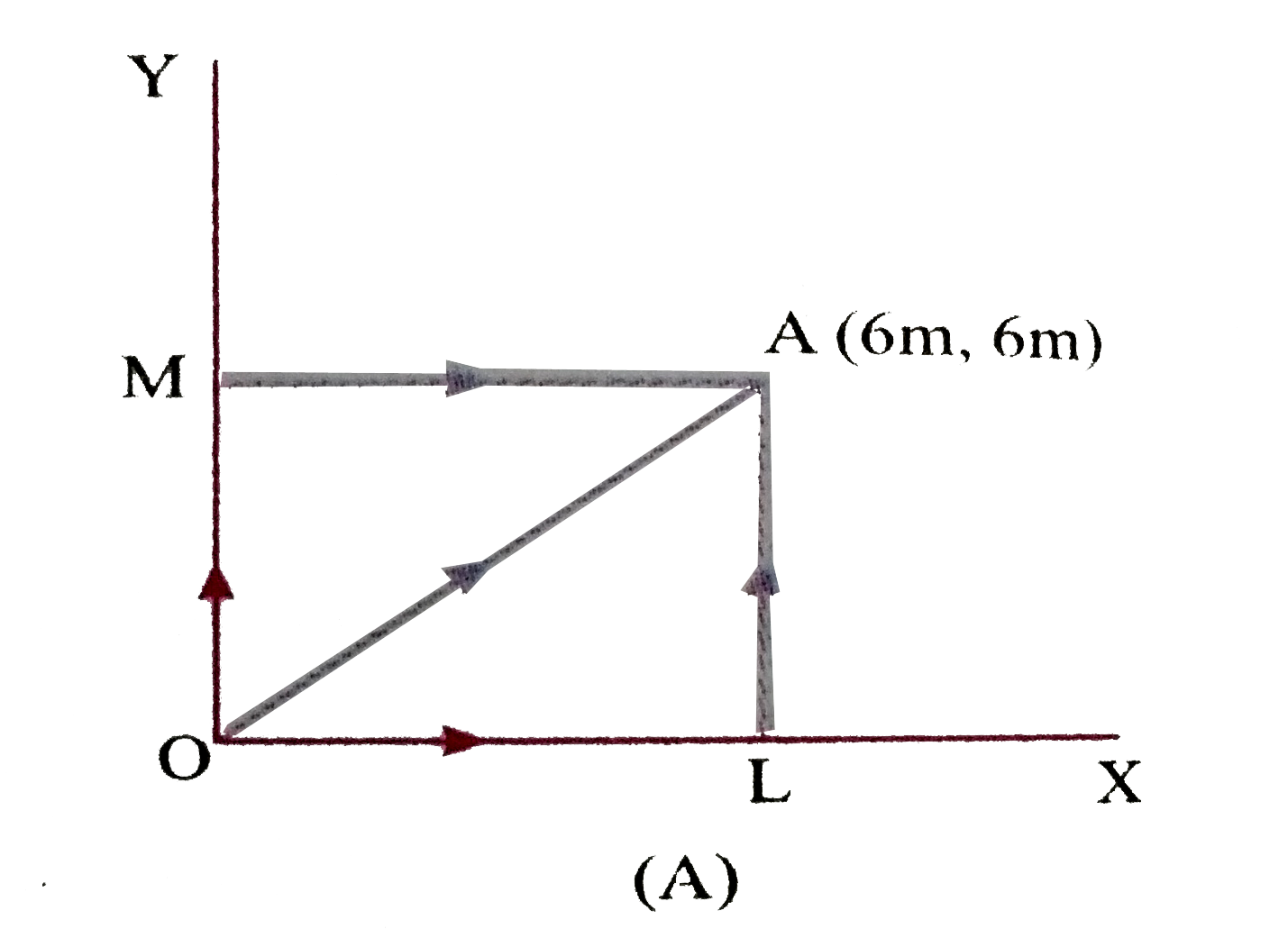
Force acting on a particle moving in the `x-y` plane is `vec F=(y^(2) hat i + x hat j) N, x` and `y` are in metre. As shown in fig. the particle moves from the origin `O` to point `A(6m,6m)`. The figure shows three paths, `OLA,OMA` and `OA` for the motion of the particle from `O` to `A`.

Along which of the three paths is the work done maximum.

Promotional Banner

Similar Questions

Explore conceptually related problems

Force acting on a particle moving in the x-y plane is vec F=(y^(2) hat i + x hat j) N, x and y are in metre. As shown in fig. the particle moves from the origin O to point A(6m,6m) . The figure shows three paths, OLA,OMA and OA for the motion of the particle from O to A . Work done for motion along path OA is nearly

Force acting on a particle moving in the x-y plane is vecF=(y^2hati+xhatj)N , x and y are in metre. As shown in figure, the particle moves from the origin O to point A (6m, 6m) . The figure shows three paths, OLA, OMA, and OA for the motion of the particle from O to A. Which of the following is correct?

Force acting on a particle moving in the x-y plane is vecF=(y^2hati+xhatj)N , x and y are in metre. As shown in figure, the particle moves from the origin O to point A (6m, 6m) . The figure shows three paths, OLA, OMA, and OA for the motion of the particle from O to A. Which of the following is correct?

Force acting on a particle moving in the x-y plane is vecF=(y^2hati+xhatj)N , x and y are in metre. As shown in figure, the particle moves from the origin O to point A (6m, 6m) . The figure shows three paths, OLA, OMA, and OA for the motion of the particle from O to A. Which of the following is correct?

Force acting on a particle moving in the x-y plane is vecF=(y^2hati+xhatj)N , x and y are in metre. As shown in figure, the particle moves from the origin O to point A (6m, 6m) . The figure shows three paths, OLA, OMA, and OA for the motion of the particle from O to A. Work done for motion along path OA is nearly

Force acting on a particle moving in the x-y plane is vecF=(y^2hati+xhatj)N , x and y are in metre. As shown in figure, the particle moves from the origin O to point A (6m, 6m) . The figure shows three paths, OLA, OMA, and OA for the motion of the particle from O to A. Work done for motion along path OA is nearly

Force acting on a particle moving in the x-y plane is vecF=(y^2hati+xhatj)N , x and y are in metre. As shown in figure, the particle moves from the origin O to point A (6m, 6m) . The figure shows three paths, OLA, OMA, and OA for the motion of the particle from O to A. Now consider another situation. A force vecF=(4hati+3hatj)N acts on a particle of mass 2kg . The particle under the action of this force moves from the origin to a point A (4m, -8m) . Initial speed of the particle, i.e., its speed at the origin is 2sqrt6ms^-1 . Figure shows three paths for the motion of the particle from O to A. If the potential energy at O is 16J , the potential energy at A will be

Force acting on a particle moving in the x-y plane is vecF=(y^2hati+xhatj)N , x and y are in metre. As shown in figure, the particle moves from the origin O to point A (6m, 6m) . The figure shows three paths, OLA, OMA, and OA for the motion of the particle from O to A. Now consider another situation. A force vecF=(4hati+3hatj)N acts on a particle of mass 2kg . The particle under the action of this force moves from the origin to a point A (4m, -8m) . Initial speed of the particle, i.e., its speed at the origin is 2sqrt6ms^-1 . Figure shows three paths for the motion of the particle from O to A. If the potential energy at O is 16J , the potential energy at A will be

Force acting on a particle moving in the x-y plane is vecF=(y^2hati+xhatj)N , x and y are in metre. As shown in figure, the particle moves from the origin O to point A (6m, 6m) . The figure shows three paths, OLA, OMA, and OA for the motion of the particle from O to A. Now consider another situation. A force vecF=(4hati+3hatj)N acts on a particle of mass 2kg . The particle under the action of this force moves from the origin to a point A (4m, -8m) . Initial speed of the particle, i.e., its speed at the origin is 2sqrt6ms^-1 . Figure shows three paths for the motion of the particle from O to A. Speed of the particle at A will be nearly

Force acting on a particle moving in the x-y plane is vecF=(y^2hati+xhatj)N , x and y are in metre. As shown in figure, the particle moves from the origin O to point A (6m, 6m) . The figure shows three paths, OLA, OMA, and OA for the motion of the particle from O to A. Now consider another situation. A force vecF=(4hati+3hatj)N acts on a particle of mass 2kg . The particle under the action of this force moves from the origin to a point A (4m, -8m) . Initial speed of the particle, i.e., its speed at the origin is 2sqrt6ms^-1 . Figure shows three paths for the motion of the particle from O to A. Speed of the particle at A will be nearly