Home
Class 12
MATHS
Let f(x) lim( n to infty) [(n^(n)(x+n)...

Let ` f(x) lim_( n to infty) [(n^(n)(x+n)(x+n/2)...(x+n/n))/(n! (x^(2+n^(2)))(x^(2)+n^(2)/4)...(x^(2)+n^(2)/n^(2)))]^(x/n) ` ,for all x = 0 . Then

A

`f(1/2) ge f(1)`

B

` f(1/3) le f(2/3)`

C

` f'(2) le 0`

D

` (f'(3))/(f(3)) ge (f'(2))/(f(2)) `

Text Solution

Verified by Experts

The correct Answer is:
B, C

Here,
` f(x) = underset( n to infty) lim [( n^(n) (x+n)(x+n/2)...(x+n/n))/(n!(x^(2)+n^(2))(x^(2)+n^(2)/4)...(x^(2)+n^(2)/n^(2)))]^(x/n) , x gt 0 `
Taking log on both sides, we get
`log_(e) {f(x)} = underset( n to infty) lim log [(n^(n)(x+n)(x+n/2)...(x+n/n))/(n! (x^(2)+n^(2))(x^(2)+n^(2)/4)...(x^(2)+n^(2)/n^(2)))]^(x/n)`
`= underset( n to infty)lim x/n * log[(underset(r=1)overset(n) "II"(x+1/(r//n)))/(underset( r = 1) overset(n) "II" (x^(2) + 1/((r//n)^(2)))underset(r=1)overset(n) "II" (r//n))]`
` = x underset( n to infty ) lim 1/n underset( r = 1)overset(n) sum log[(x+n/r)/((x^(2)+n^(2)/r^(2))r/n)]`
` = x underset( n to infty) lim 1/n underset( r = 1) overset( n) sum log ((r/n*x + 1)/(r^(2)/n^(2)*x^(2) + 1))`
Converting summation into definite integraton, we get
` log _(e) {f(x)} = x int_(0)^(1) log ((xt+1)/(x^(2)t^(2)+1))dt`
Put, t x = z
` rArr" " xdt = dz `
`:." " log_(e) {f(x)}= x int_(0)^(x) log ((1+z)/(1+z^(2)))(dz)/x `
` rArr " " log_(e) {f(x)}= int_(0)^(x) log ((1+z)/(1+z^(2))) dz`
Using Newton-Leibnitz formula, we get
` 1/(f(x)) * f'(x) = log ((1+x)/(1+x^(2)))` .....(i)
Here, at x = 1,
` (f'(1))/(f'(1)) = log (1) = 0`
` :." " f'(1) = 0`
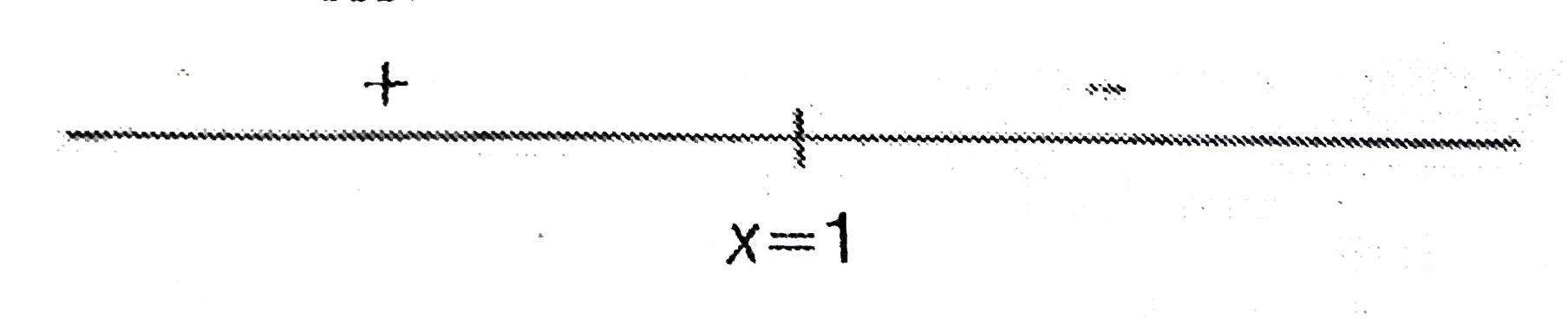
Now, sign scheme of f'(x) is shown below
`:. ` At x = 1 , function attains maximum.
Since, f(x) increases on (0, 1).
`:." " f(1) gt f(1//2)`
`:. ` Option (a) is incorrect.
` " " f(1//3) lt f(2//3)`
`:.` Option (b) is correct.
Also, ` f'(x) lt 0 " when " x gt 1`
` rArr" " f'(2) lt 0`
`:.` Option (c ) is correct.
Also, `(f'(x))/(f(x)) = log ((1+x)/(1+x^(2)))`
` :. (f'(3))/(f(3)) -(f'(2))/(f(3)) = log (4/10) - log (3/5)`
` = log (2//3) lt 0 `
` rArr" " (f'(3))/(f(3)) lt (f'(2))/(f(2)) `
`:.` Option (d) is incorrect.
Promotional Banner

Similar Questions

Explore conceptually related problems

f(x)=lim_(n rarr oo)((n^(n)(x+n)(x+(n)/(2))...(x+(n)/(n)))/(n!(x^(2)+n^(2))(x^(2)+(n^(2))/(4))......(x^(2)+(n^(2))/(n^(2))))) foe all x>0. Then

let f(x)=lim_(n rarr oo)(x^(2n)-1)/(x^(2n)+1)

(2) lim_(n rarr0) (n!sin x)/(n)

lim_(n rarr infty) sum_(k=1)^(n) (n)/(n^(2)+k^(2)x^(2)),x gt 0 is equal to

Let f(x)=lim_(n to oo) ((2 sin x)^(2n))/(3^(n)-(2 cos x)^(2n)), n in Z . Then

lim_(x rarr0)(e^(x)-1-x-(x^(2))/(2!)-.........-(x^(n))/(n!))/(x^(n+1))

The value of lim_(x rarr1)(x^(n)+x^(n-1)+x^(n-2)+...x^(2)+x-n)/(x-1)

Divide x^(2n)+a^(2^(n-1))x^(2^(n-1))+a^(2^(n))byx^(2^(n-1))-a^(2^(n-2))x^(2^(n-2))+a^(2^(n-1))

