

Home
Class 11
PHYSICS
A point P moves in counter-clockwise dir...

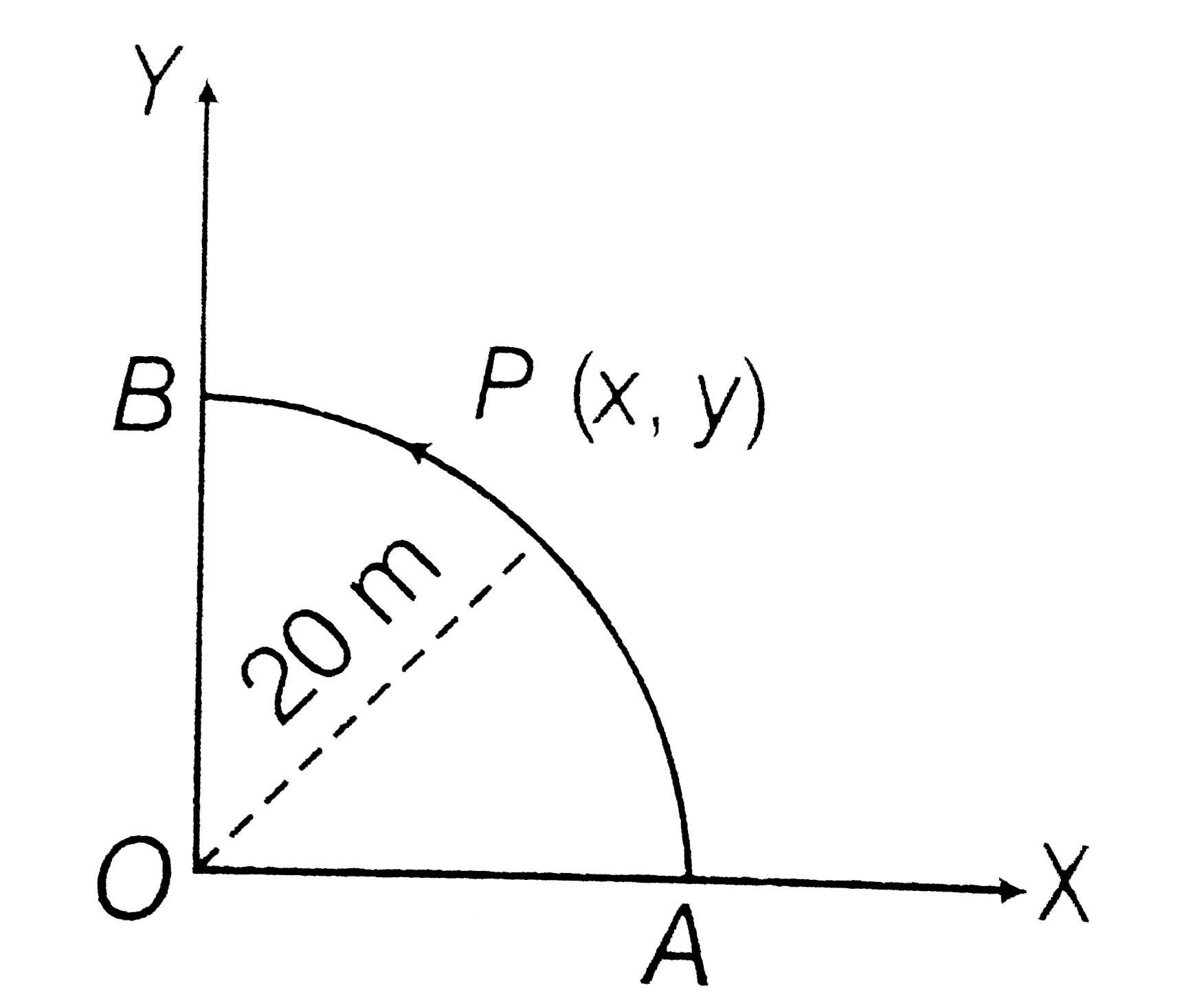
A point P moves in counter-clockwise direction on figure. The movement of P is such that it sweeps out a length `s=t^(3)+5`, where s is in metre and t is in second. The radius of the pathh is 20 m. the acceleration of P when t=2s is nearly

Promotional Banner

Similar Questions

Explore conceptually related problems

A point P moves in counter-clockwise direction on a circular path as shown in the figure. The movement of P is such that it sweeps out a length s=t^3+5 , where s is in metres and t is in seconds. The radius of the path is 20 m. The acceleration of P when t = 2 s is nearly

A point P moves in counter-clockwise direction on a circular path as shown in the figure. The movement of P is such that it sweeps out a length s=t^(3)+5 , where s is in meters and t is in seconds. The radius of the path is 20 m. The acceleration of P when t = 2 s is nearly

A point p moves in counter - clockwise direction on a circular path as shown in the figure . The movement of 'p' is such that it sweeps out in the figure . The movement of 'p' is such that it sweeps out a length s = t^(3) + 5 , where s is in metres and t is in seconds . The radius of the path is 20 m . The acceleration of 'P' when t = 2 s is nearly .

A point p moves in counter - clockwise direction on a circular path as shown in the figure . The movement of 'p' is such that it sweeps out in the figure . The movement of 'p' is such that it sweeps out a length s = t^(3) + 5 , where s is in metres and t is in seconds . The radius of the path is 20 m . The acceleration of 'P' when t = 2 s is nearly .

A point p moves in counter - clockwise direction on a circular path as shown in the figure . The movement of 'p' is such that it sweeps out in the figure . The movement of 'p' is such that it sweeps out a length s = t^(3) + 5 , where s is in metres and t is in seconds . The radius of the path is 20 m . The acceleration of 'P' when t = 2 s is nearly .

A point P moves in counter clockwise direction on a circular path as shown in the figure. The movement of 'P' is such that it sweeps out a length s=t^(2)+5 , wheres is in metres and t is in seconds. The radius of the path is 20m. The acceleration of 'P' when t=5sqrt((3)/(10)) seconds is nearly:

A point P moves in counter clockwise direction on a circular path as shown in the figure. The movement of 'P' is such that it sweeps out a length s=t^(2)+5 , wheres is in metres and t is in seconds. The radius of the path is 20m. The acceleration of 'P' when t=5sqrt((3)/(10)) seconds is nearly:

A point P moves in counter-clockwise direction on a circular path as shown in the figure. The movement of 'P ' is such that it sweeps out a length s = t ^ 3 + 5 where s is in meters and t is in seconds. The radius of the path is 20 m. The acceleration of ' P ' when t = 2 s is nearly: