

Home
Class 11
PHYSICS
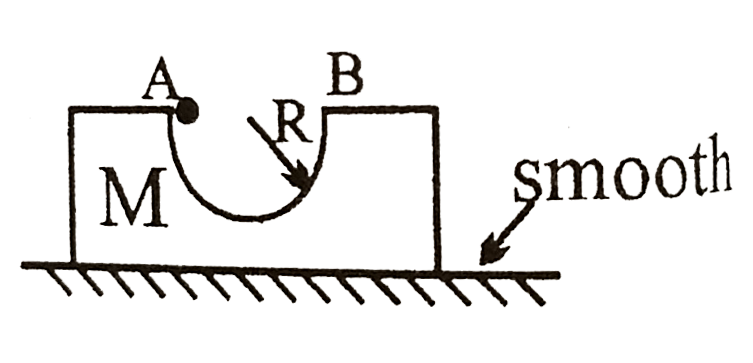
In the figure shown the wedge of mass M ...

In the figure shown the wedge of mass `M` has a semicircular groove. `A` particle of mass `m=(M)/(2)` is released frem `A`. It slides on the smooth circular track and starts climbing on the right face. Find the maximum velocity of wedge during process of motion.

Promotional Banner

Similar Questions

Explore conceptually related problems

in the fig 4E.25 (a) shown the wedge of mass M has a semiciular groove. A particle of mass m=m/2 is realeased from A ,it sliders on the smooth cirular track and starts climbing cirular track and starts climbing on the right face. (i) find the maximum value of 0 which it can subtend with vertical and also find the distance displaced by wedge at this position. (ii) find the maximum velcoity of wedge during process of motion.

A block of mass m slides down a smooth vertical circular track. During the motion, the block is in

A block of mass m slides down a smooth vertical circular track. During the motion, the block is in

A block of mass m slides down a smooth vertical circular track. During the motion, the block is in

A block of mass m slides down a smooth vertical circular track. During the motion, the block is in:

A wedge of mass M is kept at rest on smooth surface a particle of mass m hits the wedge normally. Find the velocity of wedge and particle just after collision. Take coefficient of restitution as e .

A wedge of mass M is kept at rest on smooth surface a particle of mass m hits the wedge normally. Find the velocity of wedge and particle just after collision. Take coefficient of restitution as e .

A smooth wedge of mass M is kept at rest on a smooth horizontal surface . Inclined face of the wedge make an angle theta with the horizontal . A particle of mass m collides normal to inclined face of wedge . If speed of the particle just before collision is u and coefficient of restitution is e then find velocity of wedge after collision .

A wedge of mass M=4m lies on a frictionless plane. A particle of mass m approaches the wedge with speed v. there is no friction between the particle and the plane or between the particle and the wedge. The maximum height climbed by the particle on the wedge is given by