

Home
Class 11
PHYSICS
A car begains from rest at time t = 0, a...

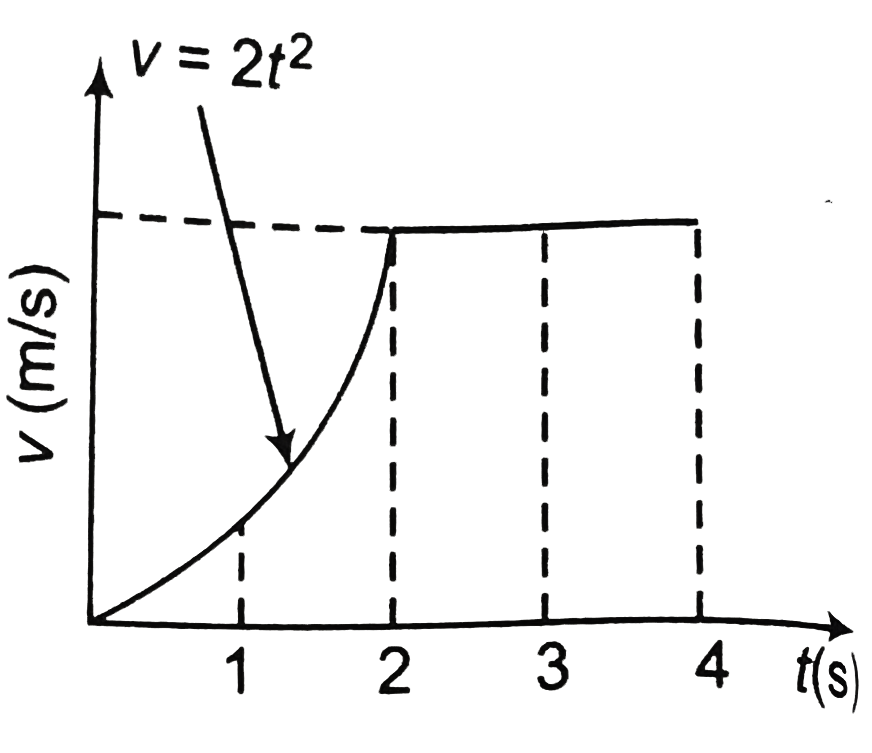
A car begains from rest at time `t = 0`, and then acceleration along a straight track during the interval `0 lt t le 2 s` and thereafter with constant velocity as shown in figure in the graph. A coin is initially at rest on the floor of the car. At `t = 1 s`, the coin begains to slip and its stops slipping at `t = 3 s` . The coefficient of static friction between the floor and the coin is `(g = 10 m//s^(2))`

Promotional Banner

Similar Questions

Explore conceptually related problems

A car starts from rest at time t = 0 and it a-t graph is shown in figure. A coin is initially at rest on the floor of the car. At t = 1 s the coin begins to slip and it stops slipping at t = 3 s. The coefficient of static friction between the floor and the coin is (g = 10 m/ s^2 )

A car starts from rest at time t = 0 and it a-t graph is shown in figure. A coin is initially at rest on the floor of the car. At t = 1 s the coin begins to slip and it stops slipping at t = 3 s. The coefficient of static friction between the floor and the coin is (g = 10 m/ s^2 )

A long plank begins to move at t=0 and accelerates along a straight track wit a speed given by v=2t^(2) for 0le t le 2 (where v is in m/s and t is in second). After 2 sec the plane continues to move at the constant speed acquired. A small initially at rest on the plank begins to slip at t=1 sec and stops sliding at t=3 sec. If the coefficient of static friction and kinetic friction between the plank and the block is 0.s and 0.k (where s and k are digits) respectively, find s+k (take g=10m//s^(2) )

A long plank begins to move at t=0 and accelerates along a straight track wit a speed given by v=2t^(2) for 0le t le 2 (where v is in m/s and t is in second). After 2 sec the plane continues to move at the constant speed acquired. A small initially at rest on the plank begins to slip at t=1 sec and stops sliding at t=3 sec. If the coefficient of static friction and kinetic friction between the plank and the block is 0.s and 0.k (where s and k are digits) respectively, find s+k (take g=10m//s^(2) )

A car starts from rest and moves with uniform acceleration a on a straight road from time t=0 to t=T . After that, a constant deceleration brings it to rest. In this process the average speed of the car is

A car starts from rest and moves with uniform acceleration a on a straight road from time t=0 to t=T . After that, a constant deceleration brings it to rest. In this process the average speed of the car is

A car starts from rest and moves with uniform acceleration a on a straight road from time t=0 to t=T . After that, a constant deceleration brings it to rest. In this process the average speed of the car is

A body starts from rest at time t = 0 , the acceleration time graph is shown in the figure . The maximum velocity attained by the body will be

A car accelerates from rest with 2ms^-2 for 2s and then decelerates constantly with 4ms^-2 for t_0 second to come to rest. The graph for the motion is shown in figure. a. Find the maximum speed attained by the car. b. Find the value of t_0 .