

Home
Class 12
PHYSICS
One end of a rod of length L is fixed to...

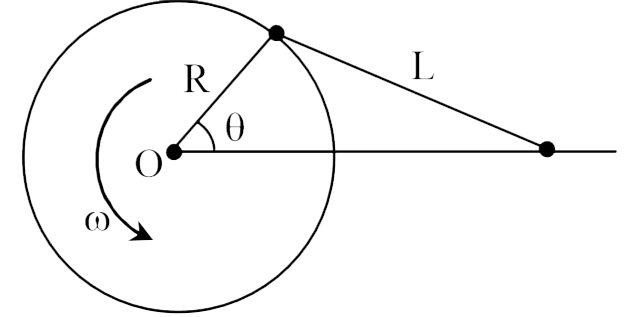
One end of a rod of length L is fixed to a point on the circumference of a wheel of radius R. The other end is sliding freely along a straight channel passing through the centre O of the wheel as shown in the figure below. The wheel is rotating with a constant angular velocity `omega` about O. Taking `T = (2pi)/(omega)` the motion of the rod is

Promotional Banner

Similar Questions

Explore conceptually related problems

One end of a rod of length L=1 m is fixed to a point on the circumference of a wheel of radius R=1//sqrt3 m. The other end is sliding freely along a straight channel passing through the center O of the wheel as shown in the figure below. The wheel is rotating with a constant angular velocity omega about O. The speed of the sliding end P when theta= 60^(@) is

A conducting wheel in which there are four rods of lengthe l as shown in figure is rotating with angular velocity omega in a uniform magnetic field B. The induced potential difference between its centre and rim will be

A disc of radius R has a light pole fixed perpendicular to the disc at its periphery which in turn has a pendulum of length R attached to its other end as shown in figure. The disc is rotated with a constant angular velocity omega The string is making an angle 45^(@) with the rod. Then the angular velocity omega of disc is

A disc of radius R has a light pole fixed perpendicular to the disc at its periphery whish in turn has a pendulum of legth R attached to its other end as shown in figure. The disc is rotated with a constant angular velocity omega The string is making an angle 45^(@) with the rod. Then the angular velocity omega of disc is

The kinetic energy of a uniform rod of mass m rotating with constant angular velocit omega about one of its end which is fixed as shown in figure is (momega^(2)l^(2))/(N) find N

The kinetic energy of a uniform rod of mass m rotating with constant angular velocit omega about one of its end which is fixed as shown in figure is (momega^(2)l^(2))/(N) find N

For the L shaped conductor in a uniform magnetic field B shown in figure the emf across its ends when it rotates with angular velocity omega about an axis through one its ends O and normal to its plane will be