

Home
Class 12
PHYSICS
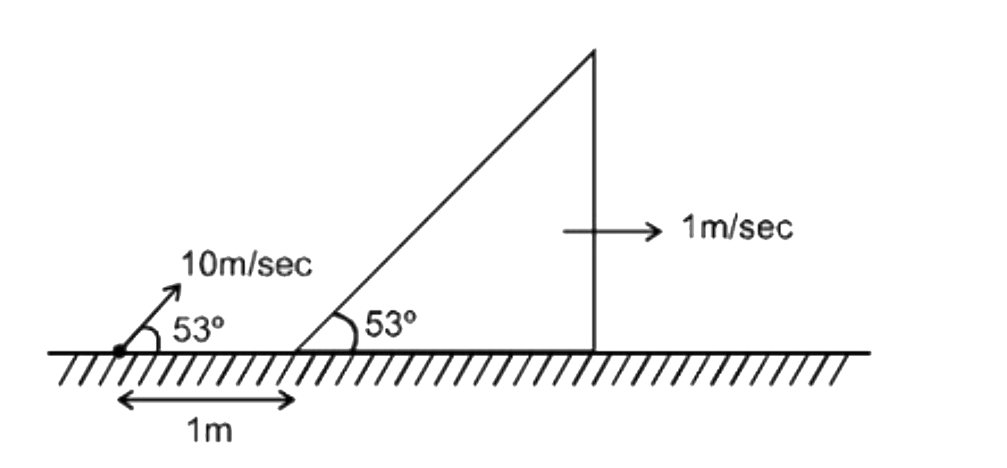
A particle is projected from the ground ...

A particle is projected from the ground and simultaneously a wedge starts moving towards the right, as shown in the figure. The maximum height of the wedge for which the particle will not hit the wedge is `[g=10ms^(-2)]`

Promotional Banner

Similar Questions

Explore conceptually related problems

Particle projected from tower fo heigh 10m as shown in figure. Find the time (in sec) after which particle will hit the ground.

A particle is projected at an angle 60^@ with speed 10(sqrt3)m//s , from the point A, as shown in the figure. At the same time the wedge is made to move with speed 10 (sqrt3) m//s towards right as shown in the figure. Then the time after which particle will strike with wedge is

Choose the correct option: A particle is projected at an angle 60^@ with speed 10(sqrt3)m//s , from the point A, as shown in the figure. At the same time the wedge is made to move with speed 10 (sqrt3) m//s towards right as shown in the figure. Then the time after which particle will strike with wedge is

A particle is projected at an angle 60^(@) with speed 10sqrt3 m/s from the point A as shown in the figure. At the same time the wedge is made to move with speed 10sqrt3 m/s toward right as shown in figure. Find the time after which particle will strike the wedge.

A particle is projected from point A at an angle of 53^(@) with horizontal.At the same time wedge starts from rest and moves with constant acceleration a as shown.The value of a for which the particle strikes the plane perpendicular to it at P is (tan53^(@)=4/3 g=10m/s^(2)) qquad P 45^(@) g' B'

A particle is projected from point A at an angle of 53^(@) with horizontal.At the same time wedge starts from rest and moves with constant acceleration a as shown. The value of a for which the particle strikes the plane perpendicular to it at P is (tan53^(@)=4/3 g=10m/s^(2))

A wedge of mass M = 4m lies on a frictionless plane. A particle of mass m approaches the wedge with speed v. There is no friction between the particle and the plane or between the particle and the wedge. The maximum height climbed by the particle on the wedge is given by:

A wedge of mass M=4m lies on a frictionless plane. A particle of mass m approaches the wedge with speed v. there is no friction between the particle and the plane or between the particle and the wedge. The maximum height climbed by the particle on the wedge is given by