

Home
Class 11
PHYSICS
Two blocks A and B of mass 10 kg and 20 ...

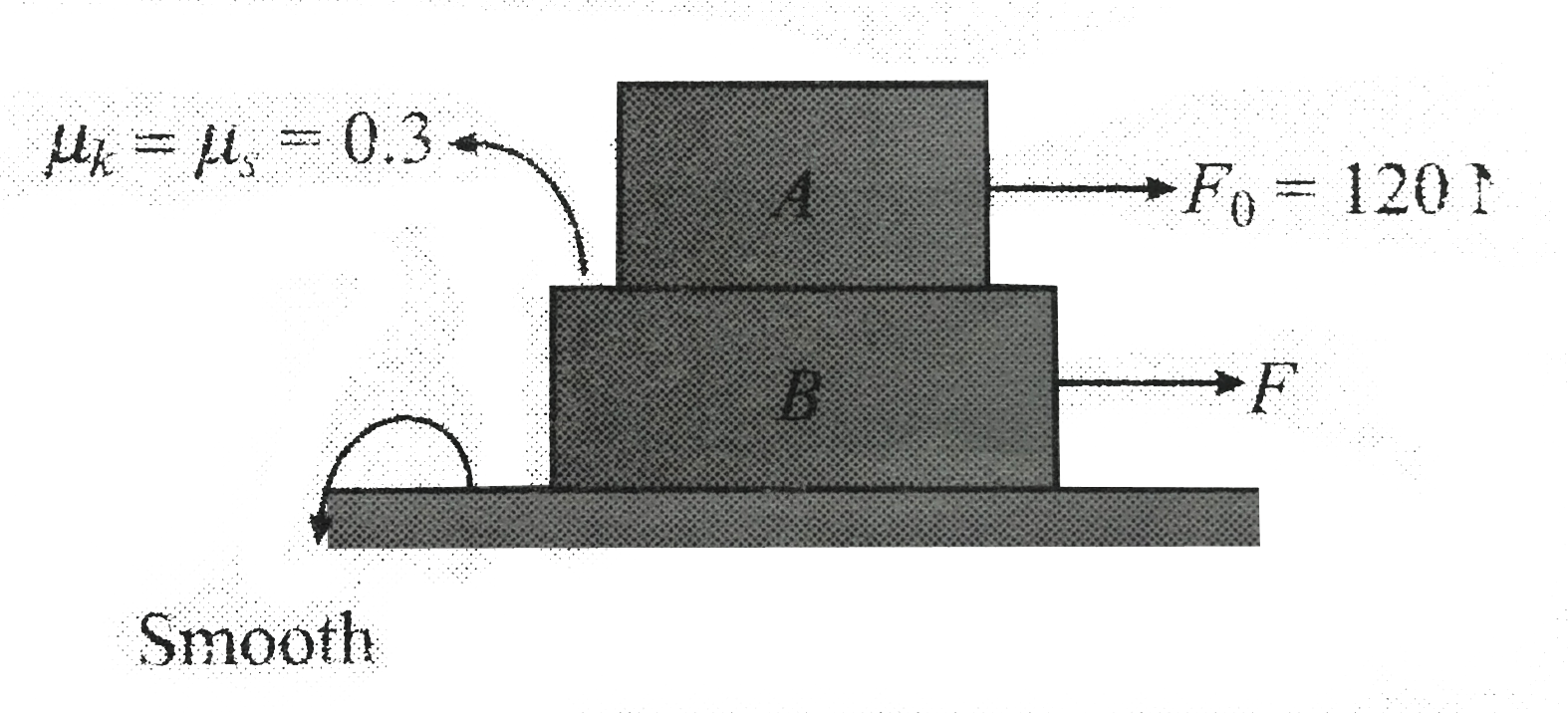
Two blocks `A` and `B` of mass `10 kg` and `20 kg` respectivelly, are arranged as shown in figure In the figure given a constant force `F_(0) = 120 N `act on block `A` and a force zero discoss the direction and nature of friction force and the acceleations of the block for different value of `F`

Promotional Banner

Similar Questions

Explore conceptually related problems

Two blocks A and B of mass 10 kg and 20 kg respectivelly, are arranged as shown in figure In the figure given a constant force F_(0) = 120 N act on block A and a force F applied horizontally on block B is gradually increased from zero. Discuss the direction and nature of friction force and the acceleations of the block for different value of F

As shown in the figure , the friction force acting on the block is

If in pervious problem, an additional force F' = 100N is applied in vertical direction as shown in figure The friction force acting on the block is

If in pervious problem, an additional force F' = 100N is applied in vertical direction as shown in figure The friction force acting on the block is

Two bodies A and B of masses 10 kg and 5 kg placed very slightly seperated as shown in figure The coefficient of friction between the floor and the block are as mu_(s) = 0.4 block A is pushed by an external force F The value of F can be changed when the weight between block A and ground breaks block A will start prssing block B will start pressing the vertical wall If F = 50N the friction force acting between block B and ground will be

Two bodies A and B of masses 10 kg and 5 kg placed very slightly seperated as shown in figure The coefficient of friction between the floor and the block are as mu_(s) = 0.4 block A is pushed by an external force F The value of F can be changed when the weight between block A and ground breaks block A will start prssing block B will start pressing the vertical wall If F = 50N the friction force acting between block B and ground will be

Two bodies A and B of masses 10 kg and 5 kg placed very slightly seperated as shown in figure The coefficient of friction between the floor and the block are as mu_(s) = 0.4 block A is pushed by an external force F The value of F can be changed when the weight between block A and ground breaks block A will start pressing block B will start pressing the vertical wall The force of friction acting on B verius with the applied force F acceleration to curve

Two bodies A and B of masses 10 kg and 5 kg placed very slightly seperated as shown in figure The coefficient of friction between the floor and the block are as mu_(s) = 0.4 block A is pushed by an external force F The value of F can be changed when the weight between block A and ground breaks block A will start prssing block B will start pressing the vertical wall The force of friction acting on B verius with the applied force F acceleration to curve

Two bodies A and B of masses 10 kg and 5 kg placed very slightly seperated as shown in figure The coefficient of friction between the floor and the block are as mu_(s) = 0.4 block A is pushed by an external force F The value of F can be changed when the weight between block A and ground breaks block A will start prssing block B will start pressing the vertical wall If F = 20N ,with how much force block A press block B?

Two bodies A and B of masses 10 kg and 5 kg placed very slightly seperated as shown in figure The coefficient of friction between the floor and the block are as mu_(s) = 0.4 block A is pushed by an external force F The value of F can be changed when the weight between block A and ground breaks block A will start prssing block B will start pressing the vertical wall If F = 20N ,with how much force block A press block B?