The following diagram represents people who speak different languages.
`{:("(i) Kannada","(ii) English"),("(iii) Hindi","(iv) Marathi"):}`
What does the shaded area respresents ?
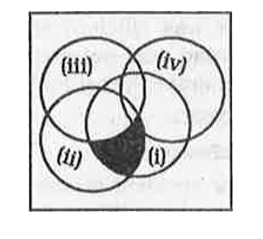
The following diagram represents people who speak different languages.
`{:("(i) Kannada","(ii) English"),("(iii) Hindi","(iv) Marathi"):}`
What does the shaded area respresents ?
`{:("(i) Kannada","(ii) English"),("(iii) Hindi","(iv) Marathi"):}`
What does the shaded area respresents ?
A
People who speak English and Hindi.
B
People who speak Kannada, English and Hindi
C
People whe speak Kannada, English and Marathi.
D
People who speak Kannada and English.
Text Solution
Verified by Experts
The correct Answer is:
C
The shaded area is common to circle (i), (ii) and (iv). Therefore, the shaded area represents such people who speak Kannada, English and Marathi.



Similar Questions
Explore conceptually related problems
The given Venn diagram represents four sets of students who have opted for Mathematics (M) physics (P) , Chemistry (C) and Electronics (E) What does the shaded region represent ?
The given Venn diagram represents the students who can speak different languages. According to it, the total number of students who can speak exactly two languages is ______.
In the the following diagram, reactangle represents people who read English newspaper , circle represents urban , and triangle represents people who read kannada newspaper . Which region represents non - urban people who read English newspaper ?
In each of the following questions, identify the diagram that best represents the relationship among classes given below: Languages, English, and Kannada
Study the information given below and answer the questions based on it. A, B, C, D, E, F, G, H and I are nine people standing in 3 parallel rows facing north, in such a way that there is an equal distance between adjacent persons. Each row contains three positions. They speak different language Hindi, Marathi, Gujarati, English, Tamil, and Telugu. 1) I, D and G are standing in 3 different rows and they all speak a different language. 2) One who speaks Gujarati is immediate left of the one who speaks Marathi in Row-1. 3) There are 3 students who can speak English and all are standing in different rows. 4) H is standing in row-1 and speaks English. Also, he is at the right end. 5) G speaks neither Hindi nor English and speaks only that language which is not spoken by any other student. 6) One who speaks Tamil is in Row-2 and is diagonally opposite to the one who speaks Hindi and Telugu in Row-3. 7) One who Speaks Telugu in row-2 is in parallel to the students who speak Gujarati in row-1 and Hindi in row-3. 8) B is the only one who speaks Gujarati and is diagonally opposite to A. I is in the second row and D cannot speak English. 9) In Row-3 F is on the extreme right end. And He finds no difficulty to talk to E. Who does not speak English?
Study the information given below and answer the questions based on it. A, B, C, D, E, F, G, H and I are nine people standing in 3 parallel rows facing north, in such a way that there is an equal distance between adjacent persons. Each row contains three positions. They speak different language Hindi, Marathi, Gujarati, English, Tamil, and Telugu. 1) I, D and G are standing in 3 different rows and they all speak a different language. 2) One who speaks Gujarati is immediate left of the one who speaks Marathi in Row-1. 3) There are 3 students who can speak English and all are standing in different rows. 4) H is standing in row-1 and speaks English. Also, he is at the right end. 5) G speaks neither Hindi nor English and speaks only that language which is not spoken by any other student. 6) One who speaks Tamil is in Row-2 and is diagonally opposite to the one who speaks Hindi and Telugu in Row-3. 7) One who Speaks Telugu in row-2 is in parallel to the students who speak Gujarati in row-1 and Hindi in row-3. 8) B is the only one who speaks Gujarati and is diagonally opposite to A. I is in the second row and D cannot speak English. 9) In Row-3 F is on the extreme right end. And He finds no difficulty to talk to E. Who is immediate neighbour of the one who speaks English in Row-2?
Study the information given below and answer the questions based on it. A, B, C, D, E, F, G, H and I are nine people standing in 3 parallel rows facing north, in such a way that there is an equal distance between adjacent persons. Each row contains three positions. They speak different language Hindi, Marathi, Gujarati, English, Tamil, and Telugu. 1) I, D and G are standing in 3 different rows and they all speak a different language. 2) One who speaks Gujarati is immediate left of the one who speaks Marathi in Row-1. 3) There are 3 students who can speak English and all are standing in different rows. 4) H is standing in row-1 and speaks English. Also, he is at the right end. 5) G speaks neither Hindi nor English and speaks only that language which is not spoken by any other student. 6) One who speaks Tamil is in Row-2 and is diagonally opposite to the one who speaks Hindi and Telugu in Row-3. 7) One who Speaks Telugu in row-2 is in parallel to the students who speak Gujarati in row-1 and Hindi in row-3. 8) B is the only one who speaks Gujarati and is diagonally opposite to A. I is in the second row and D cannot speak English. 9) In Row-3 F is on the extreme right end. And He finds no difficulty to talk to E. Who is standing in the middle of row-3 ?
Study the information given below and answer the questions based on it. A, B, C, D, E, F, G, H and I are nine people standing in 3 parallel rows facing north, in such a way that there is an equal distance between adjacent persons. Each row contains three positions. They speak different language Hindi, Marathi, Gujarati, English, Tamil, and Telugu. 1) I, D and G are standing in 3 different rows and they all speak a different language. 2) One who speaks Gujarati is immediate left of the one who speaks Marathi in Row-1. 3) There are 3 students who can speak English and all are standing in different rows. 4) H is standing in row-1 and speaks English. Also, he is at the right end. 5) G speaks neither Hindi nor English and speaks only that language which is not spoken by any other student. 6) One who speaks Tamil is in Row-2 and is diagonally opposite to the one who speaks Hindi and Telugu in Row-3. 7) One who Speaks Telugu in row-2 is in parallel to the students who speak Gujarati in row-1 and Hindi in row-3. 8) B is the only one who speaks Gujarati and is diagonally opposite to A. I is in the second row and D cannot speak English. 9) In Row-3 F is on the extreme right end. And He finds no difficulty to talk to E. Who is not standing in row-2?
Direction: The following line graph shows the number of Peoples who are working in certain institute and speaks four different language. Study the following data and answer the following questions: The total number of people who speaks Tamil language on both days is what approximate percent of the total number of people who speak four different languages on both days?
Recommended Questions
- The following diagram represents people who speak different languages....
Text Solution
|
- रासायनिक समीकरण देते हुए स्पष्ट कीजिये कि क्लोरोबेन्जीन से निम्नलिख...
Text Solution
|
- निम्नलिखित पर संक्षिप्त टिप्पणी लिखिए- (i ) आयोडोफॉर्म परीक्षण । ...
Text Solution
|
- निम्नलिखित पर संक्षिप्त टिप्पणी लिखिए- (i ) डार्जेन अभिक्रिया , ...
Text Solution
|
- निम्नलिखित पर संक्षिप्त टिप्पणी लिखिए- (i ) आयोडोफॉर्म परीक्षण । ...
Text Solution
|
- संक्रमण तत्वों के निम्नलिखित गुणों की व्याख्या कीजिए । (i) धानात्वि...
Text Solution
|
- संक्रमण तत्व क्या हैं? इनकी निम्न गुणों को कारण सहित स्पष्ट कीजिए । ...
Text Solution
|
- फारफोरस के निम्नलिखित ऑक्सी अम्ल, के संरचना सूत्र लिखिए - (i) हाइपोफ़ॉस...
Text Solution
|
- अपररूपता क्या है ? कार्बन के विभिन्न अपररूपों कस वर्णन कीजिए ।
Text Solution
|