

Home
Class 12
PHYSICS
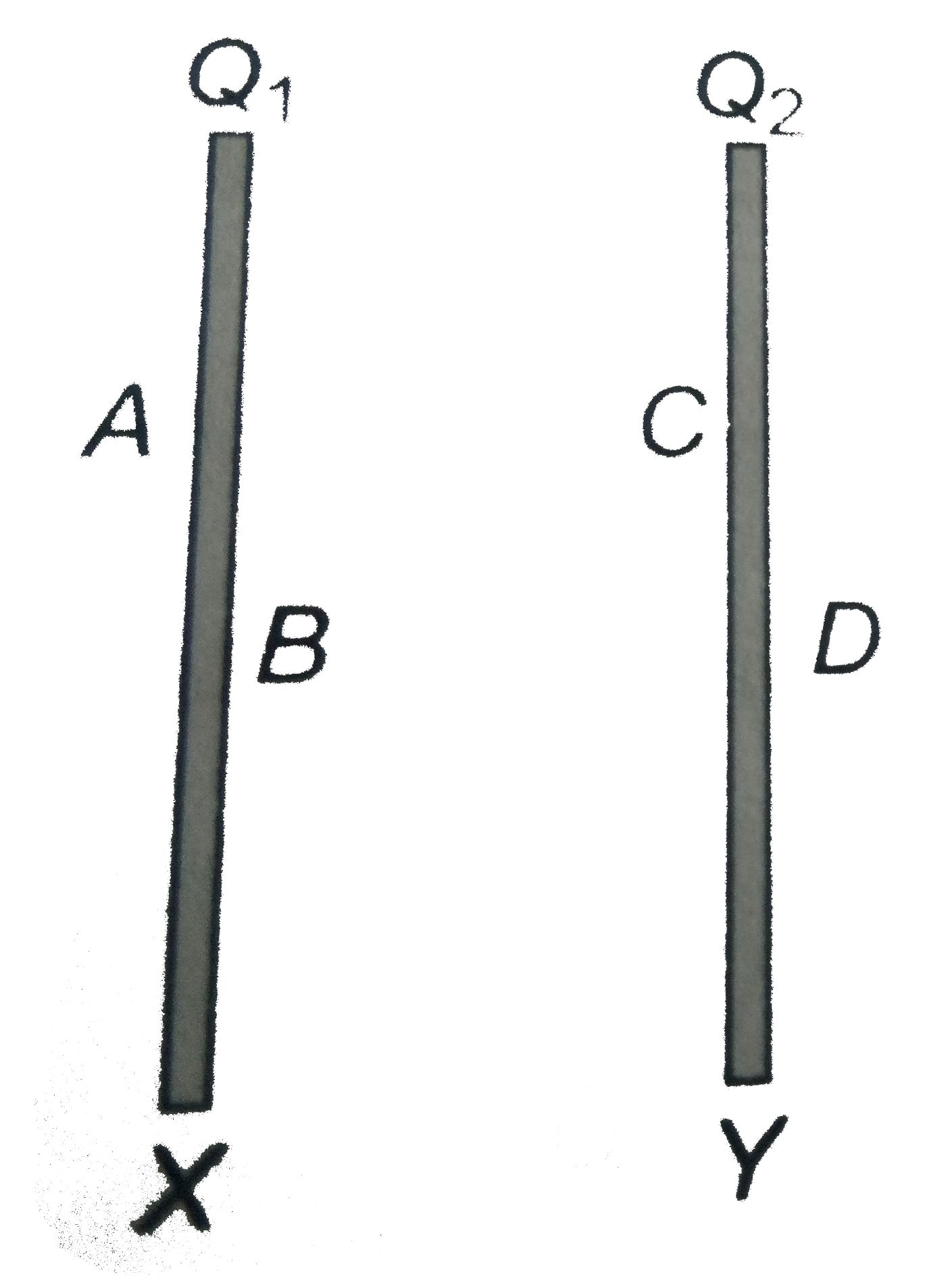
Two large , parallel conducting plates X...

Two large , parallel conducting plates `X` and `Y` , kept close to each other , are given `Q_(1)` and `Q_(2) (Q_(1) gt Q_(2))`. The four surfaces of the plates are `A,B,C` and `D` , as shown

(i) The charge on `A` is `(1)/(2) (Q_(1) + Q_(2))`
(ii) The charge on `B` is `(1)/(2) (Q_(1) - Q_(2))`
(iii) The charge on `C` is `(1)/(2) (Q_(2) - Q_(1))`
(iv) The charge on `D` is `(1)/(2) (Q_(1) + Q_(2))`

Promotional Banner

Similar Questions

Explore conceptually related problems

Two conducting plates A and B are placed parallel to each other. A is given a charge. Q_1 and B a charge Q_2 . Find the distribution of charges on the four surface.

Two conducting plates A and B are placed parallel to each other. A is given a charge. Q_1 and B a charge Q_2 . Find the distribution of charges on the four surface.

Two conducting plates A and B are placed parallel to each other. A is given a charge. Q_1 and B a charge Q_2 . Find the distribution of charges on the four surface.

Two conducting plates A and B are placed parallel to each other. A is given a charge Q_1 and B a charge Q_2 . Prove that the charges on the inner surfaces are of equal magnitude and opposite sign.

Two conducting plates A and B are placed parallel to each other. A is given a charge Q_1 and B a charge Q_2 . Prove that the charges on the inner surfaces are of equal magnitude and opposite sign.

Two conducting plates A and B are placed parallel to each other. A is given a charge Q_1 and B a charge Q_2 . Prove that the charges on the inner surfaces are of equal magnitude and opposite sign.

Charges Q_(1) and Q_(2) lie inside and outside respectively of an uncharged conducting shell. Their separation is r . (i) The force on Q_(1) is zero (ii) The force on Q_(1) is k((Q_(1) Q_(2))/(r^(2))) (iii) The force on Q_(2) is k((Q_(1) Q_(2))/(r^(2))) (iv) The force on Q_(2) is zero

In an isolated parallel plate capacitor of capacitance C , the plates have charge Q_(1) and Q_(2) . The potential difference between the plates is

Consider a parallel plate capaciter having plates of unequal area. When a battery supplies +Q_(1) and -Q_(2) charges to two plates.