

Home
Class 11
PHYSICS
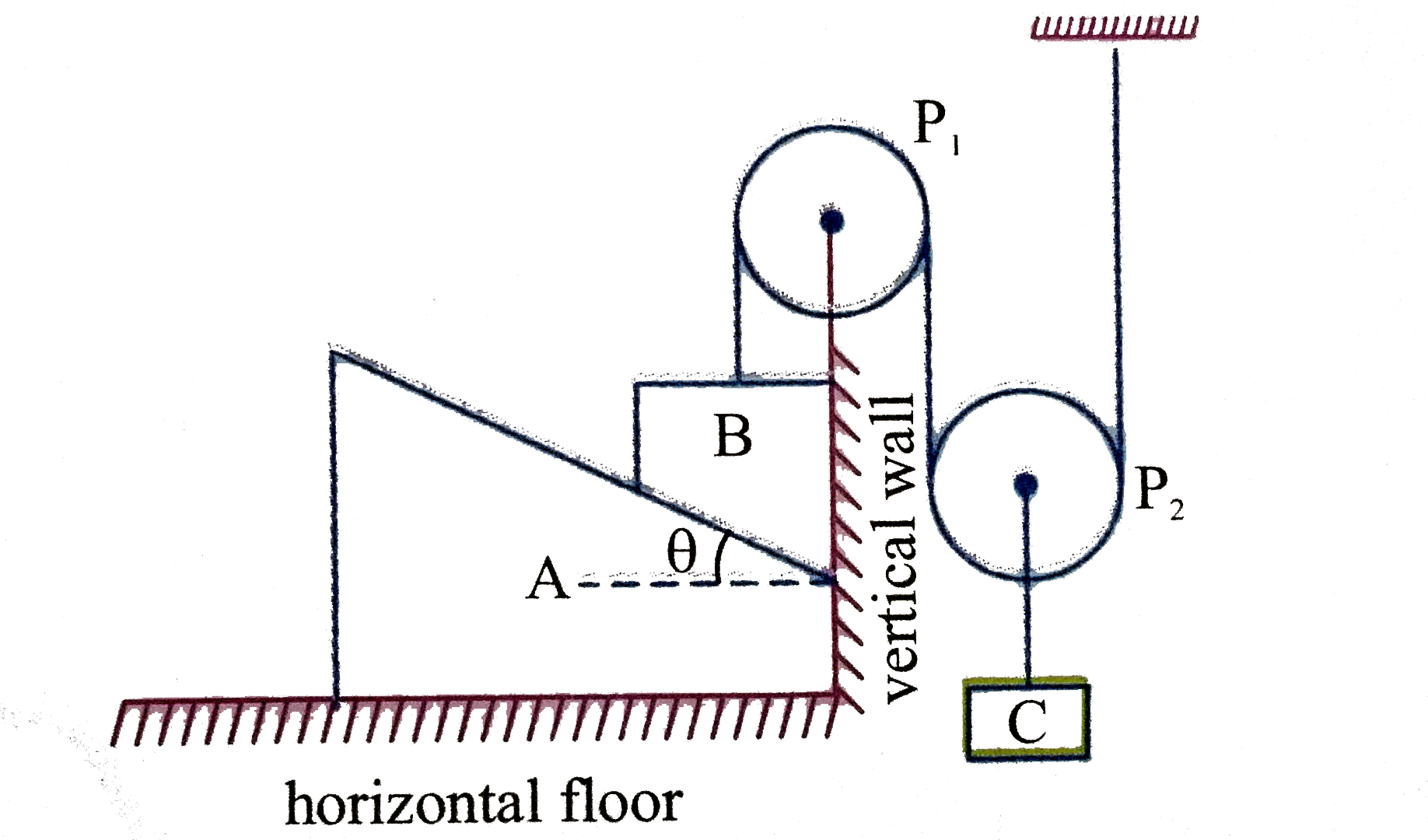
In the shown P(1) and P(2) are massless ...

In the shown `P_(1)` and `P_(2)` are massless pulleys `P_(1)` is fixed and `P_(2)` can move Masses of `A,B` and `C` are `(9m)/(64) 2m` amd m respectively All contacts are smooth and the string is massless `theta = tan^(-1)((3)/(4))` (Take `g = 10m//s^(2)`)
The tension in string connecting pulley `P_(2)` and block `C` is `(13)/(x)` Calculate x (Take `m =1 kg`)
.

Promotional Banner

Similar Questions

Explore conceptually related problems

In the arrangement shown in the all contact surfaces are smooth strings and pulleys are massless Given M_(1) =1kg, M_(2) =2kg, M_(3) =4kg and g =10ms^(-2) .

In the figure, pulleys are smooth and strings are massless, m_(1) =1 kg and m_(2)=(1)/(3) kg. To keep m_(3) at rest, mass m_(3) should be

Three blocks A,B and C of mass 10 kg each are hanging on a string passing over a fixed frictionless pulley as shown in figure. The tension in the string connecting blocks B and C is (g=10m//s^(2))

In fig. both pulleys and the string are massless and all the surfaces are frictionless. Given m_(1)=1kg, m_(2)= 2kg, m_(3)=3kg . Find the tension in the string

In fig. both pulleys and the string are massless and all the surfaces are frictionless. Given m_(1)=1kg, m_(2)= 2kg, m_(3)=3kg . Find the tension in the string

Pulleys are ideal and string are massless. The masses of blocks are m_(1) = 4kg and m_(2) = 1kg as shown.If all surfaces are smooth then the acceleration of m_(2) in m//s^(2) is ( g =10 m//s^(2) )

Blocks of mass M_(1) and M_(2) are connected by a cord which passes over the pulleys P_(1) and P_(2) as shown in the figure. If there is no friction, the acceleration of the block of mass M_(2) will be

Blocks of mass M_(1) and M_(2) are connected by a cord which passes over the pulleys P_(1) and P_(2) as shown in the figure. If there is no friction, the acceleration of the block of mass M_(2) will be

In fig, all the pulleys and strings are massless and all the surfaces are frictionless. A small block of mass m is placed on fixed wedge (take f=10ms^(-2) ). The tension in the string attached to m is