

Home
Class 12
PHYSICS
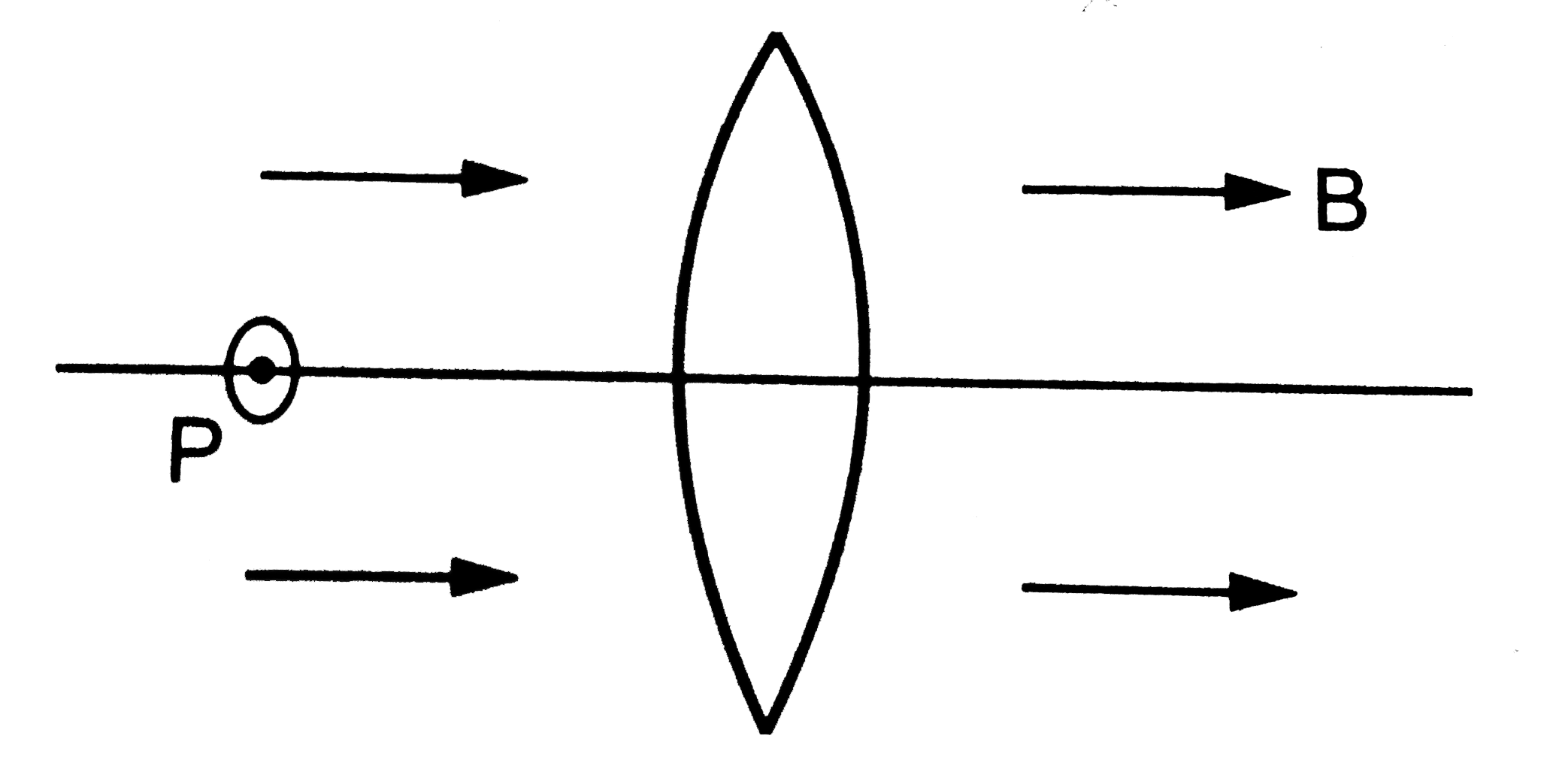
Shows a convex lens of focal length 12 ...

Shows a convex lens of focal length 12 cm lying in a uniform magnetic field B of magnitude 1.2 T parallel to its principal axis. A particle having a charge `2.0X 10^(-3) C` and mass `2.0 X 10^(-5)` kg is projected perpendiucular to the plane of the diagram with a speed of `4.8 ms ^(-1).` The particle moves along a circle with its centre on the principal axis at a distance of 18 cm from the lens. Show that the image of the particle goes along a circle end find the radius of thet circle.

Promotional Banner

Similar Questions

Explore conceptually related problems

Figure shows a convex lens of focal length 10cm lying in a uniform magnetic field B of magnitude 1.2 T parallel to its principal axis.A particle havig a charge 2.0xx10^(-3) C and mass 2.0xx10^(-5) kg is projected perpendicular to the plane of the diagram with a speed of 4.8 m//s .The particle moves along a circle with its centre on the principal axis at a distance of 15 cm from the lens.The axis of the lens and of the circle are same.Show that the image of the particle goes along a circle and find the radius of that circle.

Figure shows a convex lens of focal length 10cm lying in a uniform magnetic field B of magnitude 1.2 T parallel to its principal axis.A particle havig a charge 2.0xx10^(-3) C and mass 2.0xx10^(-5) kg is projected perpendicular to the plane of the diagram with a speed of 4.8 m//s .The particle moves along a circle with its centre on the principal axis at a distance of 15 cm from the lens.The axis of the lens and of the circle are same.Show that the image of the particle goes along a circle and find the radius of that circle.

A particle having a charge of 2.0X10^(-8) C and a mass of 2.0X10^(-10)g is projected with a speed of 2.0X10^3 ms^(-1) in a region having a uniform magnetic field of 0.10 T. The velocity is perpendicular to the field. Find the radius of the circle formed by the particle and also the time period.

A particle having a charge of 2.0X10^(-8) C and a mass of 2.0X10^(-10)g is projected with a speed of 2.0X10^3 ms^(-1) in a region having a uniform magnetic field of 0.10 T. The velocity is perpendicular to the field. Find the radius of the circle formed by the particle and also the time period.

A particle having a charge of 2.0X10^(-8) C and a mass of 2.0X10^(-10)g is projected with a speed of 2.0X10^3 ms^(-1) in a region having a uniform magnetic field of 0.10 T. The velocity is perpendicular to the field. Find the radius of the circle formed by the particle and also the time period.

A uniform magnetic field of magnitude 0.20 T exists in space from east to west what speed should a particle of mass 0.010 g and having a charge 1.0 X 10^(-5)C be projected from south to north so that it moves with a uniform velocity?

A uniform magnetic field of magnitude 0.20 T exists in space from east to west what speed should a particle of mass 0.010 g and having a charge 1.0 X 10^(-5)C be projected from south to north so that it moves with a uniform velocity?

A uniform magnetic field of magnitude 0.20 T exists in space from east to west what speed should a particle of mass 0.010 g and having a charge 1.0 X 10^(-5)C be projected from south to north so that it moves with a uniform velocity?

A uniform magnetic field of magnitude 0.20 exists in space from east to west.A particle having mass 10^(-5)kg and charge 10^(-5)C is projected from south to north so that it moves with a uniform velocity.Find velocity of projection of the particle? (g=10 m//s^(2))

A particle having a charge of 5.0 mu C and a mass of 5.0 X 10^(-12)kg is projected with a speed of 1.0km s^(-1) in a magnetic field of a magnetic field of magnitude 5.0 m T. The angle between the magnetic field and the velocity is sin^(-1)(0.90) . show that the path of the particle will be a helix. Find the diameter of the helix and its pitch.