

Home
Class 11
PHYSICS
In the figure shown m(1)=1 kg,m(2)=2kg, ...

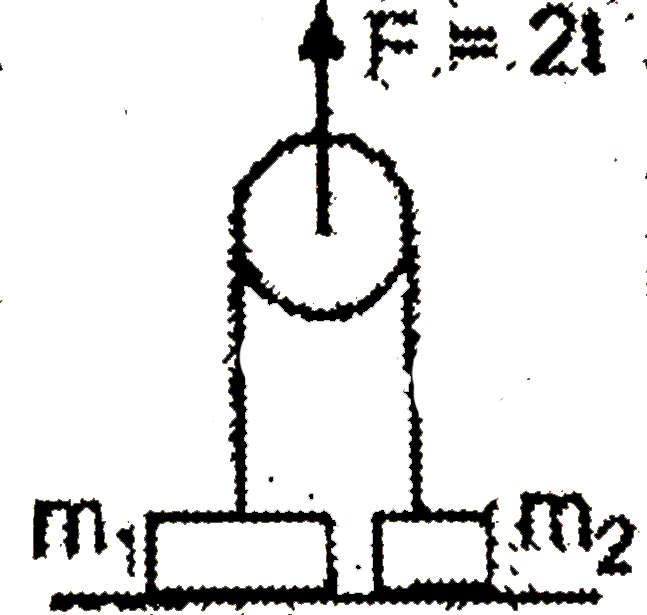
In the figure shown `m_(1)=1 kg,m_(2)=2kg`, pulley is ideal. At `t=0`, both masses touches the ground and string is taut. A force `F=2t` is applied to pulley (t is in second) then `(g = 10 m//s^(2))` :

Promotional Banner

Similar Questions

Explore conceptually related problems

In the figure shown m_(1) = 1 kg , m_(2) = 2 kg , pulley is ideal . At t = 0 , both masses touches the ground and string is tout . A force F = 2t is applied to pulley ( t is in second ) then m_(1) is lifted off the ground at time ( g = 10 m//s^(2))

In the figure shown m_(1) = 1 kg , m_(2) = 2 kg , pulley is ideal . At t = 0 , both msses touches the ground and string is tout . A force F = 2t is applied to pulley ( t is in second ) then m_(1) is lifted off the ground at time ( g = 10 m//s^(2))

In the figure shown, m_(1) = 10kg, m_(2) = 6kg, m_(3) = 4kg. If T_(3) = 40 N, T_(2) = ?

In the figure shown, m_(1) = 10kg, m_(2) = 6kg, m_(3) = 4kg. If T_(3) = 40 N, T_(2) = ?

In the arrangement shown in fig. m_(1)=1kg, m_(2)=2 kg . Pulleys are massless and strings are light. For what value of M, the mass m_(1) moves with constant velocity.

In the arrangement shown in fig. m_(1)=1kg, m_(2)=2 kg . Pulleys are massless and strings are light. For what value of M, the mass m_(1) moves with constant velocity.

In the arrangement shown in fig m_(1)=1kg, m_(2)=2 kg Pulleys are massless and string are light. For what value of M the mass m_(1) moves with constant velocity (neglect friction):

In the arrangment as shown below m_(1) = 1 kg, m_(2) = 2 kg . Pulleys are massless and strings are light . For what value of M the mass m_(1) moves with constant velocity . ( Neglect Friction)

In the arrangment as shown below m_(1) = 1 kg, m_(2) = 2 kg . Pulleys are massless and strings are light . For what value of M the mass m_(1) moves with constant velocity . ( Neglect Friction)