

Home
Class 11
PHYSICS
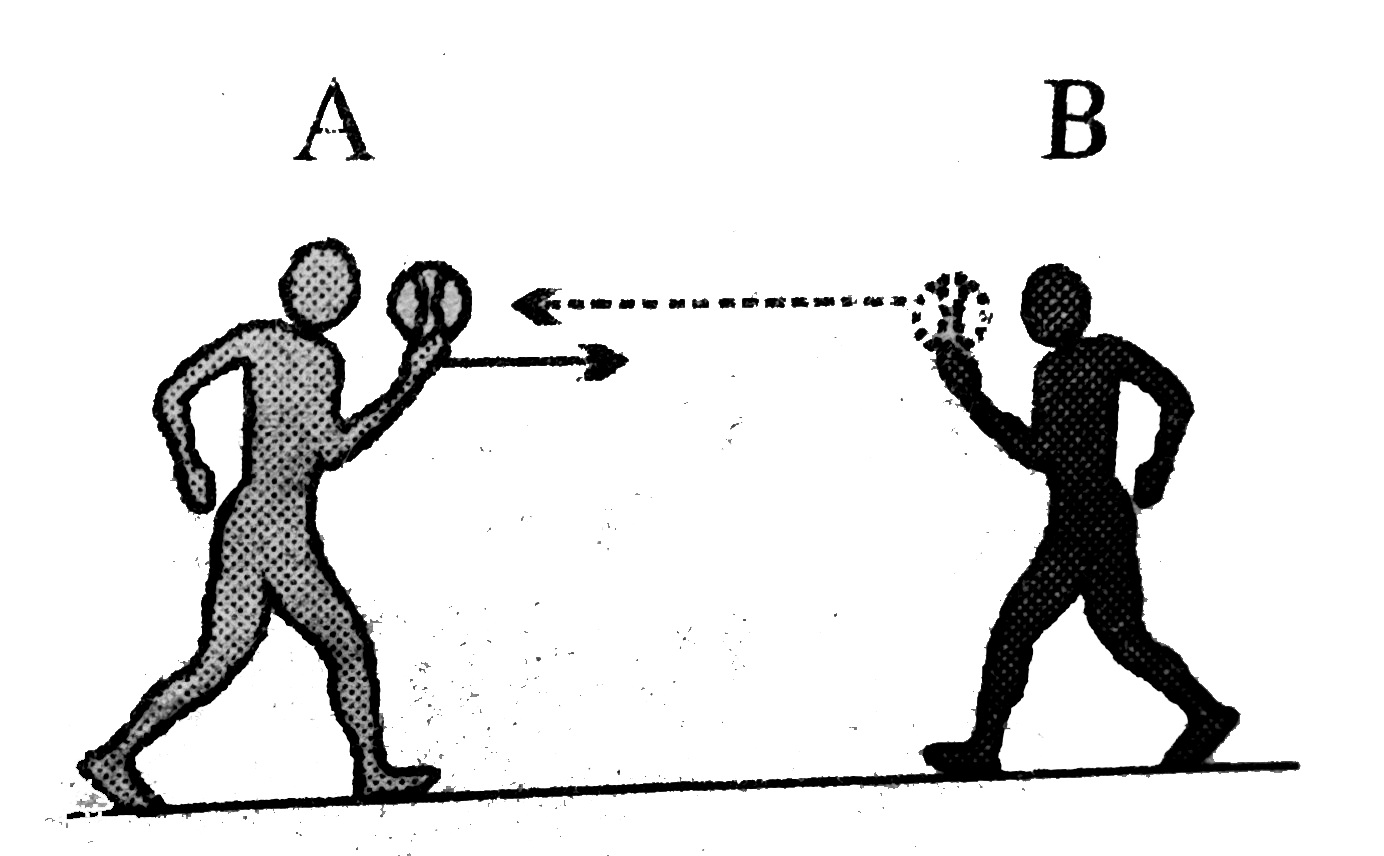
Consider two skaters A and B initially a...

Consider two skaters `A` and `B` initially at rest on ice -(friction is negligible) with `A` holding a ball. A has greater mass than `B` and the ball has some significant mass. A throws the ball to `B`. `B` catches it and throws it back to `A` who catches it again. The magnitudes of the skater's (excluding ball) final velocities, A momentum and kinetic energies (denoted below as `v, p` and `K` respectively) are related as

Promotional Banner

Similar Questions

Explore conceptually related problems

The mass of a ball A is double the mass of another ball B. The ball a moves at half the speed of the ball. B. Calculate the ratio of the kinetic energy of A to the kinetic energy of B,

A ball A of mass 0.2 strikes another ball B of unknown mass at rest . If the ball A makes an elastic head on collision and then rebounds at one half of its original speed , then calculate the mass of ball B .

Two balls A and B of masses m and 2 m are in motion with velocities 2v and v, respectively. Compare: Their momentum.

A ball of mass M moving with speed v collides perfectly inelastically with another ball of mass m at rest. The magnitude of impulse imparted to the first ball is

A ball of mass M moving with speed v collides perfectly inelastically with another ball of mass m at rest. The magnitude of impulse imparted to the first ball is

A ball of mass M moving with speed v collides perfectly inelastically with another ball of mass m at rest. The magnitude of impulse imparted to the first ball is

A ball of mass M moving with speed v collides perfectly inelastically with another ball of mass m at rest. The magnitude of impulse imparted to the first ball is

Two balls of equal size are dropped from the same height from the roof of a building . One ball has twice the mass of the other. When the balls the ground, how do the kinetic energies of the two balls compare ?