

Home
Class 12
PHYSICS
A sphere of density rho falls vertically...

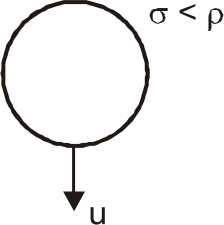
A sphere of density `rho` falls vertically downward through a fluid of density `sigma`. At a certain instant its velocity is u. The terminal velocity of the sphere is `u_0`. Assuming that stokes’s law for viscous drag is applicable, the instantaneous acceleration of the sphere is found to be `beta(1-(sigma)/(rho))(1-u/(u_(0)))`. here `beta` is in an integer. find `beta`.

Promotional Banner

Similar Questions

Explore conceptually related problems

Two spheres of the same material, but of radii R and 3R are allowed to fall vertically downwards through a liquid of density sigma . The ratio of their terminal velocities is

A sphere of radius 0.25mm and of density 9000kg/m^3 falls through an oil of co-efficient of viscosity 0.2 Ns/m^2 and of density 800kg/m^3 . Find the terminal velocity of the sphere.

An iron sphere of mass 20xx10^-3 kg falls through a viscous liquid with terminal velocity 0.5 ms^(-1) The terminal velocity (in ms^-1 ) of another iron sphere of mass 54 xx 10^2 kg is

A sphere of radius R and density rho_1 is dropped in a liquid of density sigma . Its terminal velocity is v_1 . If another sphere of radius R and density rho_2 is dropped in the same liquid, its terminal velocity will be:

A solid ball of density rho_(1) and radius r falls vertically through a liquid of density rho_(2) . Assume that the viscous force acting on the ball is F = krv , where k is a constant and v its velocity. What is the terminal velocity of the ball ?

A solid ball of density rho_(1) and radius r falls vertically through a liquid of density rho_(2) . Assume that the viscous force acting on the ball is F = krv , where k is a constant and v its velocity. What is the terminal velocity of the ball ?

A particle performs linear S.H.M. At a particular instant, velocity of the particle is u and acceleration is alpha while at another instant, velocity is v and acceleration beta (0ltalphaltbeta) . The distance between the two position is

A particle performs linear S.H.M. At a particular instant, velocity of the particle is 'u' and acceleration is ' prop ' while at another instant, velocity is 'v' and acceleration ' beta ' (0ltpropltbeta) . The distance between the two position is

A particle performs linear S.H.M. At a particular instant, velocity of the particle is 'u' and acceleration is ' prop ' while at another instant, velocity is 'v' and acceleration ' beta ' (0ltpropltbeta) . The distance between the two position is