

Home
Class 11
PHYSICS
A track consister of two circular parts ...

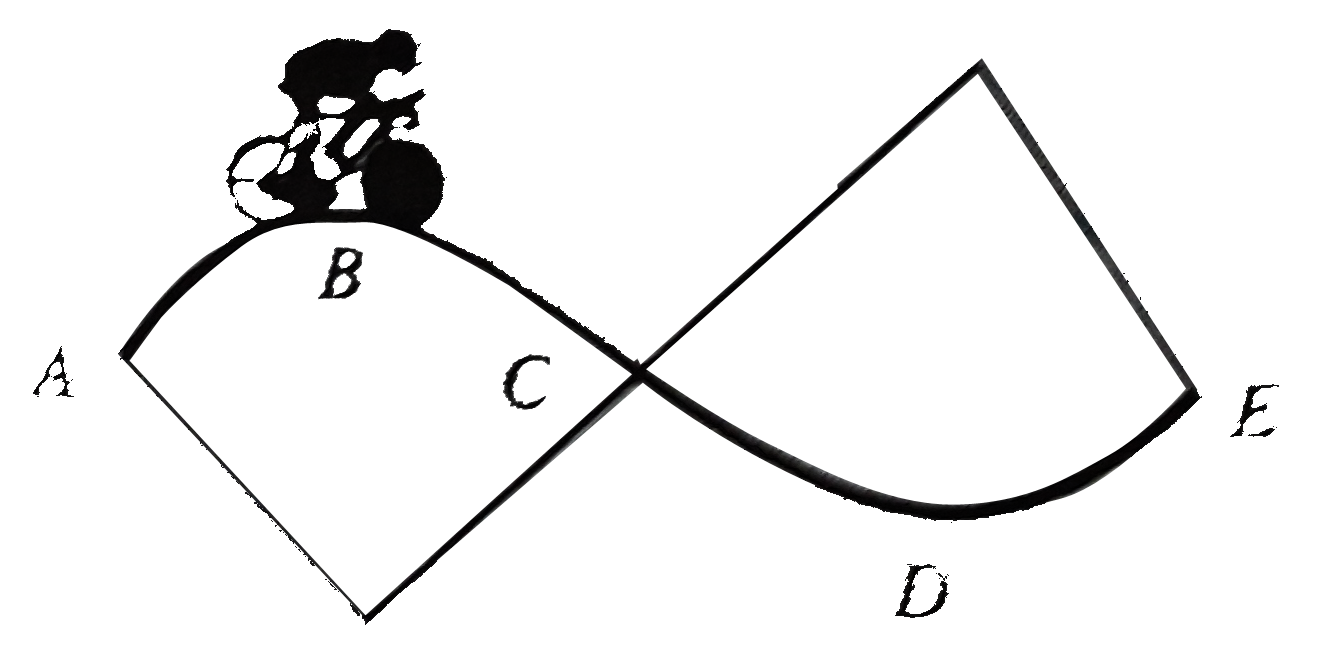
A track consister of two circular parts ABC and CDE of equal redius `100m` and joined smoothly as shown in Fig .Each part subtends a right angle at its center A cycle weighing `100 kg` together with the rider travels constant speed of `18 kmh^(-1)` on the track

a. Find the normal contact force by the road on the cycle when it is at B and at D.
b. Find the force of friction exerted by the track on the tyres when the cycle is at B,C and D.
c. Find the normal force between the road and the cycle just before and just after the cycle crosses C
d. What should be the minimum friction coefficient between the mad road and the tyre , which will ensure that the cyclist can move with constant speed ?

Promotional Banner

Similar Questions

Explore conceptually related problems

A track consists of two circular pars ABC and CDE of equal radius 100 m and joined smoothly as shown in figure.Each part subtends a right angle at its centre. A cycle weighing 100 kg together with rider travels at a constant speed of 18 km/h on the track. A. Find the normal contact force by the road on the cycle when it is at B and at D. b.Find the force of friction exerted by the track on the tyres when the cycle is at B,C and D. c. Find the normal force between the road and the cycle just before and just after the cycle crosses C. d. What should be the minimum friction coefficient between the road and the tyre, which will ensure that the cyclist can move with constant speed? Take g=10 m/s^2

A track consists of two circular pars ABC and CDE of equal radius 100 m and joined smoothly as shown in figure.Each part subtends a right angle at its centre. A cycle weighing 100 kg together with rider travels at a constant speed of 18 km/h on the track. A. Find the normal contact force by the road on the cycle when it is at B and at D. b.Find the force of friction exerted by the track on the tyres when the cycle is at B,C and D. c. Find the normal force between the road and the cycle just before and just after the cycle crosses C. d. What should be the minimum friction coefficient between the road and the tyre, which will ensure that the cyclist can move with constant speed? Take g=10 m/s^2

A track consists of two circular pars ABC andCDE of equal rdius 100 m and joined smoothly as shown in figure.Each part sutends a right ngle at its centre. A cycle weighing 100 kg together with rider travels at a constant speed of 18 km/h on the track. A. Findteh nromal contct force by tehroad on the cycle whenit is at B and at D. b.Findteh force of friction exerted by the track on the tyres when the cycle is at B,C and D. c. Find the normal force between teh road and teh cycle just before and just after the cycle crosses C. d. What should be the minimum friction coefficient between the road and the tyre, which will ensure that teh cyclist can move with constant speed? Take g=10 m/s^2

A track consists of two circular pars ABC andCDE of equal rdius 100 m and joined smoothly as shown in figure.Each part sutends a right ngle at its centre. A cycle weighing 100 kg together with rider travels at a constant speed of 18 km/h on the track. A. Findteh nromal contct force by tehroad on the cycle whenit is at B and at D. b.Findteh force of friction exerted by the track on the tyres when the cycle is at B,C and D. c. Find the normal force between teh road and teh cycle just before and just after the cycle crosses C. d. What should be the minimum friction coefficient between the road and the tyre, which will ensure that teh cyclist can move with constant speed? Take g=10 m/s^2

A track consists of two circular parts ABC and CDE of equal radius R and joined smoothly as shown. Each part subtends an angle 2theta at center. A vehicle of mass m travels with constant force by the road on the vehicle when it is at (i) B (ii) D (iii) just before C and (iv) just after C . (b) find the friction by the track on the vehicle when it is at B , C and D . (c) what should be the minimum friction coefficient between the road and the vehicle, which will ensure that cyclist can move with constant speed.

Find the maximum velocity for the overturn of a car moving on a circular track of radius 100 m. The co-efficient of friction between the road and tyre is 0.2

Find the maximum velocity for skidding for a car moved on a circular track of radius 100 m . The coefficient of friction between the road and tyre is 0.2

A scooter weighing 150 kg together with its rider moving at 36 km/hr is to take a turn of radius 30 m. What horizontal force on the scooter is needed to make the turn possible?If the horizontal force needed for the turn in the previous problem is to be supplied by the normal force by the road what should be the proper angle of banking?

A scooter weighing 150 kg together with its rider moving at 36 km/hr is to take a turn of radius 30 m. What horizontal force on the scooter is needed to make the turn possible?If the horizontal force needed for the turn in the previous problem is to be supplied by the normal force by the road what should be the proper angle of banking?

A vehicle is moving on a track as shown in Fig. The normal reaction between tyre's and road is :