Home
Class 11
PHYSICS
A ball is thrown vertically upwards with...

A ball is thrown vertically upwards with a velocity of `20 ms^(-1)` from the top of a multistorey building. The height of the point from where the ball is thrown is 25.0 m from the ground. (a) How high will the ball rise ? and (b) how long will it be before the ball hits the ground ? Take `g = 10 ms^(-2)`.

Text Solution

Verified by Experts
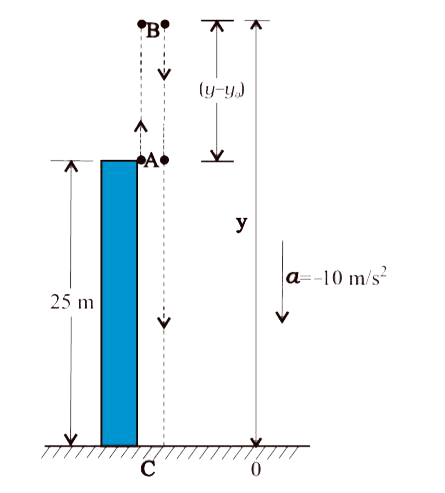
(a) Let us take the y-axis in the vertically upward direction with zero at the ground, as shown in Fig.
Now `upsilon_(0)=+20 ms^(-1)`,
`a=-g=-10 ms^(-2)`,
`upsilon = 0 ms^(-1)`
If the ball rises to height y from the point of launch, then using the equation
`upsilon^(2)=upsilon_(0)^(2)+2(y-y_(0))`
we get
`0=(20)^(2)+2(-10)(y-y_(0))`
Solving, we get, `(y-y_(0))=20m`.
(b) We can solve this part of the problem in two ways.
Promotional Banner

Topper's Solved these Questions

  • MOTION IN A STRAIGHT LINE

    NCERT TELUGU|Exercise EXERCISES|23 Videos
  • MOTION IN A STRAIGHT LINE

    NCERT TELUGU|Exercise ADDITIONAL EXERCISES|5 Videos
  • MOTION IN A PLANE

    NCERT TELUGU|Exercise EXCERCISES|30 Videos
  • OSCILLATIONS

    NCERT TELUGU|Exercise Additional Exercises|6 Videos

Similar Questions

Explore conceptually related problems

A ball is thrown vertically upwards with a velocity of 20ms^-1 from the top of a multistorey building. The height of the point from where the ball is thrown is 25.0 m from the ground. How high will the ball rise?

A ball is thrown vertically upwards with a velocity of 20ms^-1 from the top of a multistorey building. The height of the point from where the ball is thrown is 25.0 m from the ground. How long will it be before the balls hits the ground? Take g=10ms^-2 [Actual value of g is 9.8ms^-2] .

A stone is thrown vertically upwards with an initial velocity of 10ms^(-1) from the top of a cliff of height 40m.How much time it take to reach the ground?

A ball is projected horizontally with a velocity of 5 ms^(-1) from the top of a tower of height 10 m. When it reaches the ground (g=10 ms^(-2) )

