Home
Class 11
PHYSICS
Two identical billiard balls strike a ri...

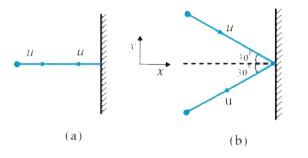
Two identical billiard balls strike a rigid wall with the same speed but at different angles, and get reflected without any change in speed, as shown in Fig. 5.6. What is (i) the direction of the force on the wall due to each ball? (ii) the ratio of the magnitudes of impulses imparted to the balls by the wall ?

Text Solution

Verified by Experts

An instinctive answer to (i) might be that the force on the wall in case (a) is normal to the wall, while that in case (b) is inclined at 30° to the normal. This answer is wrong. The force on the wall is normal to the wall in both cases. How to find the force on the wall? The trick is to consider the force (or impulse) on the ball due to the wall using the second law, and then use the third law to answer (i). Let u be the speed of each ball before and after collision with the wall, and m the mass of each ball. Choose the x and y axes as shown in the figure, and consider the change in momentum of the ball in each case :
Case (a)
`(p_x)_("initial")` = mu `(p_y)_("initial") = 0`
`(p_x)_("final")` = -mu `(p_y)_("final") = 0`
Impulse is the change in momentum vector. Therefore ,
x-component of impulse = – 2 m u
y-component of impulse = 0
Impulse and force are in the same direction. Clearly, from above, the force on the ball due to the wall is normal to the wall, along the negative x-direction. Using Newton’s third law of motion, the force on the wall due to the ball is normal to the wall along the positive x-direction. The magnitude of force cannot be ascertained since the small time taken for the collision has not been specified in the problem.
case (b)
`(p_x)_("initial") = ` mu cos `30^@ , (p_y)_("initial") = ` - mu sin `30^@`
`(p_x)_("final")` = - mu cos `30^@ , (p_y)_("final") = ` - mu sin `30^@`
Note while `p_x` changes sign after collision , `p_y` does not. therefore
x - component of impulse = - mu `cos 30^@`
y = component impulse = 0
The direction of impulse (and force) is the same as in (a) and is normal to the wall along the negative x direction. As before, using Newton’s third law, the force on the wall due to the ball is normal to the wall along the positive x direction. The ratio of the magnitudes of the impulses imparted to the balls in (a) and (b) is
2mu/(2mu cos `30^@`) = `(2)/(sqrt3) = 1.2`
Promotional Banner

Topper's Solved these Questions

  • LAW OF MOTION

    NCERT TELUGU|Exercise EXERCISE|23 Videos
  • LAW OF MOTION

    NCERT TELUGU|Exercise EXERCISE (ADDITIONAL EXERCISE)|17 Videos
  • KINETIC THEORY

    NCERT TELUGU|Exercise ADDITIONAL EXERCISE|3 Videos
  • MECHANICAL PROPERTIES OF FLUIDS

    NCERT TELUGU|Exercise EXERCISE|45 Videos

Similar Questions

Explore conceptually related problems

A rigid ball of mass m strikes a rigid wall at 60° and gets reflected without loss of speed as shown in the fiugre below. The value impulse imparted by the wall on the ball will be:

A batsman hits back a ball straight in the direction of the bowler without changing its initial speed of 12 ms^(-1) . If the mass of the ball is 0.5 kg., determine the impulse imparted to the ball. (Assume linear motion of the ball)

A batsman hits back a ball straight in the direction of the bowler without changing its initial speed of 12 m s^(-1) . If the mass of the ball is 0.15 kg, determine the impulse imparted to the ball. (Assume linear motion of the ball)

A batsman deflects a ball by an angle of 45^@ without changing its initial speed which is equal to 54 km/h. What is the impulse imparted to the ball ? (Mass of the ball is 0.15 kg.)

NCERT TELUGU-LAW OF MOTION-EXERCISE (ADDITIONAL EXERCISE)
  1. Two identical billiard balls strike a rigid wall with the same speed b...

    Text Solution

    |

  2. Figure shows the position-time graph of a body of mass 0.04 kg. Sugg...

    Text Solution

    |

  3. Figure shows a man standing stationary with respect to a horizontal c...

    Text Solution

    |

  4. A stone of mass m tied to the end of a string revolves in a vertical c...

    Text Solution

    |

  5. A helicopter of mass 1000 kg rises with a vertical acceleration of 15 ...

    Text Solution

    |

  6. A stream of water flowing horizontally with a speed of 15ms^(-1) push...

    Text Solution

    |

  7. Ten one-rupee coins are put on top of each other on a table. Each coi...

    Text Solution

    |

  8. An aircraft executes a horizontal loop at a speed of 720 km/h with i...

    Text Solution

    |

  9. A train runs along an unbanked circular track of radius 30 m at a spee...

    Text Solution

    |

  10. A block of mass 25 kg is raised by a 50 kg man in two different ways a...

    Text Solution

    |

  11. A monkey of mass 40 kg climbs on a rope. which can stand a maximum ten...

    Text Solution

    |

  12. Two bodies A and B of masses 5 kg and 10 kg in contact with each othe...

    Text Solution

    |

  13. A block of mass 15 kg is placed on a long trolley. The coefficient of ...

    Text Solution

    |

  14. The rear side of a truck is open and a box of 40 kg mass is placed 5 m...

    Text Solution

    |

  15. A disc revolves with a speed of 33/3 rev/min, and has a radius of 15...

    Text Solution

    |

  16. You may have seen in a circus a motorcyclist driving in vertical loops...

    Text Solution

    |

  17. A 70 kg man stands in contact against the inner wall of a hollow cylin...

    Text Solution

    |

  18. A thin circular loop of radius R rotates about its vertical diameter ...

    Text Solution

    |
