

Home
Class 12
PHYSICS
Figure shows a potentiometer with a cell...

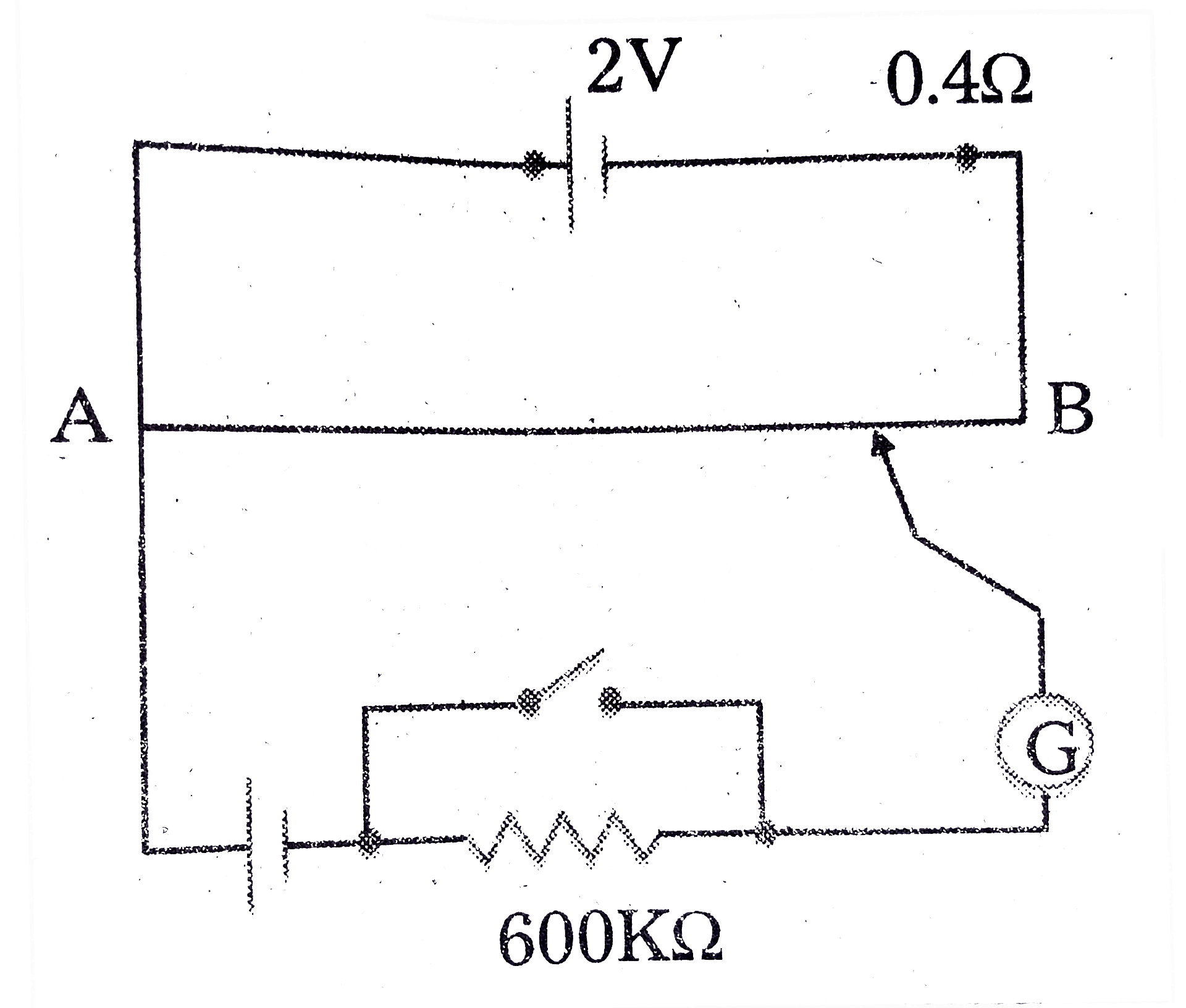
Figure shows a potentiometer with a cell of 2.0 V and internal resistance `0.40 Omega` maintain a potential drop across the resistor wire AB. A standard cell which maintains a constant emf of 1.02 V (for very moderate currents upto a few mA) gives a balances point at 63.3 cm length of the wire. To ensure very low currents drawn from the standard cell, a very high resistance of `600 Omega` is put is series with it, which is shortedd close to the balance point. The standard cell is then replaced by a cell of unknown emf `epsilon` and the balance point found similarly, turns out to be at 82.3 cm length of the wire.

What is the value `epsilon` ?

Promotional Banner

Similar Questions

Explore conceptually related problems

Figure shows a potentiometer with a cell of 2.0 V and internal resistance 0.40 Omega maintain a potential drop across the resistor wire AB. A standard cell which maintains a constant emf of 1.02 V (for very moderate currents upto a few mA) gives a balances point at 63.3 cm length of the wire. To ensure very low currents drawn from the standard cell, a very high resistance of 600 Omega is put is series with it, which is shortedd close to the balance point. The standard cell is then replaced by a cell of unknown emf epsilon and the balance point found similarly, turns out to be at 82.3 cm length of the wire. Would the method work in the above situation if the driver cell of the potentiometer had an emf of 1.0 V instead of 2.0 V?

Figure shows a potentiometer with a cell of 2.0 V and internal resistance 0.40 Omega maintain a potential drop across the resistor wire AB. A standard cell which maintains a constant emf of 1.02 V (for very moderate currents upto a few mA) gives a balances point at 63.3 cm length of the wire. To ensure very low currents drawn from the standard cell, a very high resistance of 600 Omega is put is series with it, which is shortedd close to the balance point. The standard cell is then replaced by a cell of unknown emf epsilon and the balance point found similarly, turns out to be at 82.3 cm length of the wire. Is the balance point affected by the internal resistance of the driver cell.

Figure shows a potentiometer with a cell of 2.0 V and internal resistance 0.40 Omega maintain a potential drop across the resistor wire AB. A standard cell which maintains a constant emf of 1.02 V (for very moderate currents upto a few mA) gives a balances point at 63.3 cm length of the wire. To ensure very low currents drawn from the standard cell, a very high resistance of 600 Omega is put is series with it, which is shortedd close to the balance point. The standard cell is then replaced by a cell of unknown emf epsilon and the balance point found similarly, turns out to be at 82.3 cm length of the wire. What purpose does the high resistance of 600 k Omega have?

Figure shows a potentiometer with a cell of 2.0 V and internal resistance 0.40 Omega maintain a potential drop across the resistor wire AB. A standard cell which maintains a constant emf of 1.02 V (for very moderate currents upto a few mA) gives a balances point at 63.3 cm length of the wire. To ensure very low currents drawn from the standard cell, a very high resistance of 600 Omega is put is series with it, which is shortedd close to the balance point. The standard cell is then replaced by a cell of unknown emf epsilon and the balance point found similarly, turns out to be at 82.3 cm length of the wire. Is the balance point affected by this high resistance?

Figure shows a potentiometer with a cell of 2.0 V and internal resistance 0.40 Omega maintain a potential drop across the resistor wire AB. A standard cell which maintains a constant emf of 1.02 V (for very moderate currents upto a few mA) gives a balances point at 63.3 cm length of the wire. To ensure very low currents drawn from the standard cell, a very high resistance of 600 Omega is put is series with it, which is shortedd close to the balance point. The standard cell is then replaced by a cell of unknown emf epsilon and the balance point found similarly, turns out to be at 82.3 cm length of the wire. Would the circuit work well for determining an extermely small emf, say of the order of a few mV (such as the typcial emf a thermo-couple)? if not, how will you modify the circuit?