Home
Class 12
PHYSICS
Obtain the maximum kinetic energy of b-p...

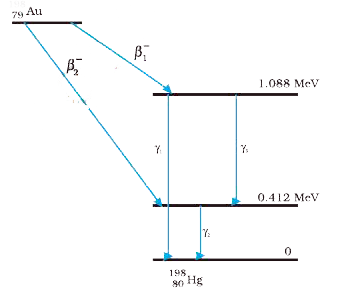
Obtain the maximum kinetic energy of b-particles, and the radiation frequencies of g decays in the decay scheme shown in Fig. You are given that
`m(""_(8)^(19)Au) = 197.968233 u`
`m(""_(8)^(19)Hg) =197.966760 u`.

Text Solution

Verified by Experts

`K_("max")(beta_(1)^(-))=0.284MeV, K_("max")(beta_(2)^(-))=0.960MeV`
`v(gamma_(1))=2.627xx10^(20)Hz, v(gamma_(2))=0.995xx10^(20)Hz, v(gamma_(3))=1.632xx10^(20)Hz`
Promotional Banner

Similar Questions

Explore conceptually related problems

The nucleus ._(10)^(23)Ne decays by beta - emission. Write down the beta - decay. Write down the beta - decay equation and determine the maximum kinetic energy of the electrons emitted. Given that : m(._(10)^(23)Ne)=22.994466 u m(._(11)^(23)Na)=22.089770 u .

The radionuclide ""^(11)C decays according to ""_(6)^(11)C to ""_(5)^(11) B + e^(+) + v, T_(1//2) = 20.3 min The maximum energy of the emitted positron is 0.960 MeV. Given the mass values: m ( ""_(6)^(11)C) = 11.011434 u and m (""_(6)^(11)B ) = 11.009305 u, calculate Q and compare it with the maximum energy of the positron emitted.

The work function of a certain metal is 3.31xx10^-(-19) j then, the maximum kinetic energy of photoelectrons emitted by incident radiation of wavelength 5000 ÅIS1(GIVEN,H= 6.62XX10^(-34)J_(-s),c=3xx10^(8)ms^(-1),e=1.6xx10^(-19)C)

Bohr proposed his atomic model based on Planck.s quantum theory and derived following relations for one electron system in C.G.S. units : For H -atom : r_(n) = n^(2) xx r_(1), E_(n) = E_(1) xx Z^(2), u_(n) = (u_(1))/(n), u_(1) = 2.19 xx 10^(8) cm//sec., E_(1) = -13.6eV For 1 electron system, other than H r_(n) = (n^(2) xx r_(1H))/(Z), E_(N) = (E_(1H) xx Z^(2))/(n^(2)), u_(n) = (u_(1H) xx Z)/(n) . Later on de Broglie proposed the dual nature of electron and put forward his wave concept. The wave length of electron in an orbit was given lambda = h/mu The circumference (in m) of 3^(rd) Bohr orbit in H-atom is :

Bohr proposed his atomic model based on Planck.s quantum theory and derived following relations for one electron system in C.G.S. units : For H -atom : r_(n) = n^(2) xx r_(1), E_(n) = E_(1) xx Z^(2), u_(n) = (u_(1))/(n), u_(1) = 2.19 xx 10^(8) cm//sec., E_(1) = -13.6eV For 1 electron system, other than H r_(n) = (n^(2) xx r_(1H))/(Z), E_(N) = (E_(1H) xx Z^(2))/(n^(2)), u_(n) = (u_(1H) xx Z)/(n) . Later on de Broglie proposed the dual nature of electron and put forward his wave concept. The wave length of electron in an orbit was given lambda = h/mu The potential energy of electron in 3^(rd) Bohr orbit of H-atom is :
