

Home
Class 12
PHYSICS
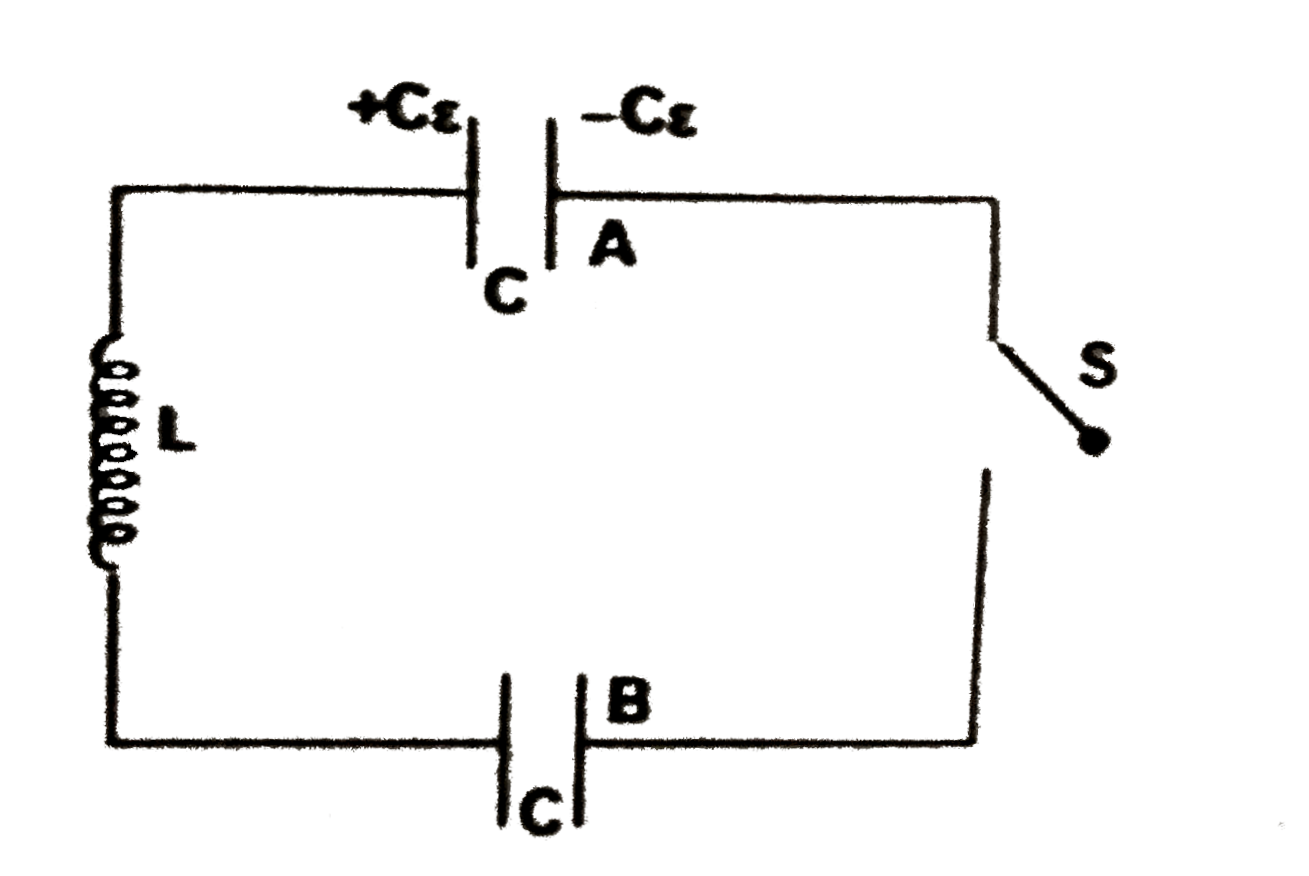
Initially capacitor 'A' is charged to a ...


Initially capacitor 'A' is charged to a potential drop `epsilon` and capacitor B is uncharged At t=0, switch S is closed, then the maximum current through the inductor is

Promotional Banner

Similar Questions

Explore conceptually related problems

Initially the capacitor is uncharged find the charge on capacitor as a function of time, if switch is closed at t=0.

Initially the capacitor is uncharged find the charge on capacitor as a function of time, if switch is closed at t=0.

In the adjacent circuit, the capacitor 'A' of capacitance '3C' and the capacitor 'B' of capacitance 'C' are initially charged by potential drops 4_(varepsilon) and 8_(varepsilon) respectively and connected through and inductor of inductance 'L' with zero initial current as shown. The switch 'S' is closed at t = 0 . then the maximum current through the inductor is

In the adjacent circuit, the capacitor 'A' of capacitance '3C' and the capacitor 'B' of capacitance 'C' are initially charged by potential drops 4_(varepsilon) and 8_(varepsilon) respectively and connected through and inductor of inductance 'L' with zero initial current as shown. The switch 'S' is closed at t = 0 . then the maximum current through the inductor is

A capacitor of capacitance Chas initial charge Q_0 and connected to an inductor L as shown. At t=0 switch S is closed. The current through the inductor when energy in the capacitor is three times the energy of inductor is

For the circuit shown in figure below, At t = 0, switch is closed, the initial current through resistor and final charge on capacitor are

Initially capacitor is uncharged at t = 0 switch is closed. Charge on capacitor when current in the circuit is 10 % of maximum current :

Initially capacitor is uncharged at t = 0 switch is closed. Charge on capacitor when current in the circuit is 10 % of maximum current :