

Home
Class 12
CHEMISTRY
An efficient, aerobic catalytic system f...

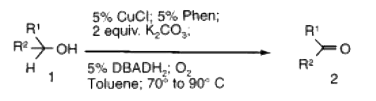
An efficient, aerobic catalytic system for the transformation of alcohols into carbonyl compounds under mild conditions, copper-based catalyst has been discovered. This copper-based catalytic system utilizes oxygen or air as the ultimate, stoichiometric oxidant, producing water as the only by-product

A wide range of primary, secondary, allylic, and benzylic alcohols can be smoothly oxidized to the corresponding aldehydes or ketones in good to excellent yields. Air can be conveniently used instead of oxygen without affecting the efficiency of the process. However, the use of air requires slightly longer reaction times.
This process is not only economically viable and applicable to large-scale reactions, but it is also environmentally friendly.
The Copper based catalyst mention in the study above can be used to convert:

Promotional Banner

Similar Questions

Explore conceptually related problems

An efficient, aerobic catalytic system for the transformation of alcohols into carbonyl compounds under mild conditions, copper-based catalyst has been discovered. This copper-based catalytic system utilizes oxygen or air as the ultimate, stoichiometric oxidant, producing water as the only by-product A wide range of primary, secondary, allylic, and benzylic alcohols can be smoothly oxidized to the corresponding aldehydes or ketones in good to excellent yields. Air can be conveniently used instead of oxygen without affecting the efficiency of the process. However, the use of air requires slightly longer reaction times. This process is not only economically viable and applicable to large-scale reactions, but it is also environmentally friendly. Which of the following is a secondary allylic alcohol?

An efficient, aerobic catalytic system for the transformation of alcohols into carbonyl compounds under mild conditions, copper-based catalyst has been discovered. This copper-based catalytic system utilizes oxygen or air as the ultimate, stoichiometric oxidant, producing water as the only by-product A wide range of primary, secondary, allylic, and benzylic alcohols can be smoothly oxidized to the corresponding aldehydes or ketones in good to excellent yields. Air can be conveniently used instead of oxygen without affecting the efficiency of the process. However, the use of air requires slightly longer reaction times. This process is not only economically viable and applicable to large-scale reactions, but it is also environmentally friendly. Benzyl alcohol on treatment with this copper-based catalyst gives a compound ‘A’ which on reaction with KOH gives compounds ‘B’ and ‘C’. Compound ‘B’ on oxidation with KMnO_(4)- KOH gives compound ‘C’. Compounds ‘A’, ‘B’ and ‘C’ respectively are :

An efficient, aerobic catalytic system for the transformation of alcohols into carbonyl compounds under mild conditions, copper-based catalyst has been discovered. This copper-based catalytic system utilizes oxygen or air as the ultimate, stoichiometric oxidant, producing water as the only by-product A wide range of primary, secondary, allylic, and benzylic alcohols can be smoothly oxidized to the corresponding aldehydes or ketones in good to excellent yields. Air can be conveniently used instead of oxygen without affecting the efficiency of the process. However, the use of air requires slightly longer reaction times. This process is not only economically viable and applicable to large-scale reactions, but it is also environmentally friendly. The carbonyl compound formed when ethanol gets oxidised using this copper-based catalyst can also be obtained by ozonolysis of:

An efficient, aerobic catalytic system for the transformation of alcohols into carbonyl compounds under mild conditions, copper-based catalyst has been discovered. This copper-based catalytic system utilizes oxygen or air as the ultimate, stoichiometric oxidant, producing water as the only by-product A wide range of primary, secondary, allylic, and benzylic alcohols can be smoothly oxidized to the corresponding aldehydes or ketones in good to excellent yields. Air can be conveniently used instead of oxygen without affecting the efficiency of the process. However, the use of air requires slightly longer reaction times. This process is not only economically viable and applicable to large-scale reactions, but it is also environmentally friendly. An organic compound ‘X’ with molecular formula C_(3)H_(8)O on reaction with this copper based catalyst gives compound ‘Y’ which reduces Tollen’s reagent. ‘X’ on reaction with sodium metal gives ‘Z’ . What is the product of reaction of ‘Z’ with 2- chloro-2-methylpropane?

Which can be oxidized to the corresponding carbonyl compound?

Which can be oxidized to the corresponding carbonyl compound?

Discuss oxidation of primary,secondary and tertiary alcohols.

A primary alcohol can be oxidised to an aldehyde by choosing the reagent-